The Game Plan

Since signing up for the Training CT this weekend, I’ve had some doubts. The last time we jumped was at the Carolina Clinic, and I wondered if I would be able to prepare Foster for another jumping round in time for this show. Thanks to the winter weather keeping us in the covered arena (an area too small for any real jumping) for the last couple weeks, in addition to vacation, Foster’s work has been irregular at best. But, I knew he could technically get around a Training course with relative ease.

Training warmup vertical

Yesterday was the first time I was able to ride in the outdoor jump arena in a month, and with impending rain, I thought to make the best of it and get in a jump school. I had his open-fronts on, breastplate attached, and was doing up the girth when I decided- this was feeling too forced. Whenever it starts to feel that way regarding a show, I know it’s not the right decision. So I have elected to not jump this weekend.

IMG_3018

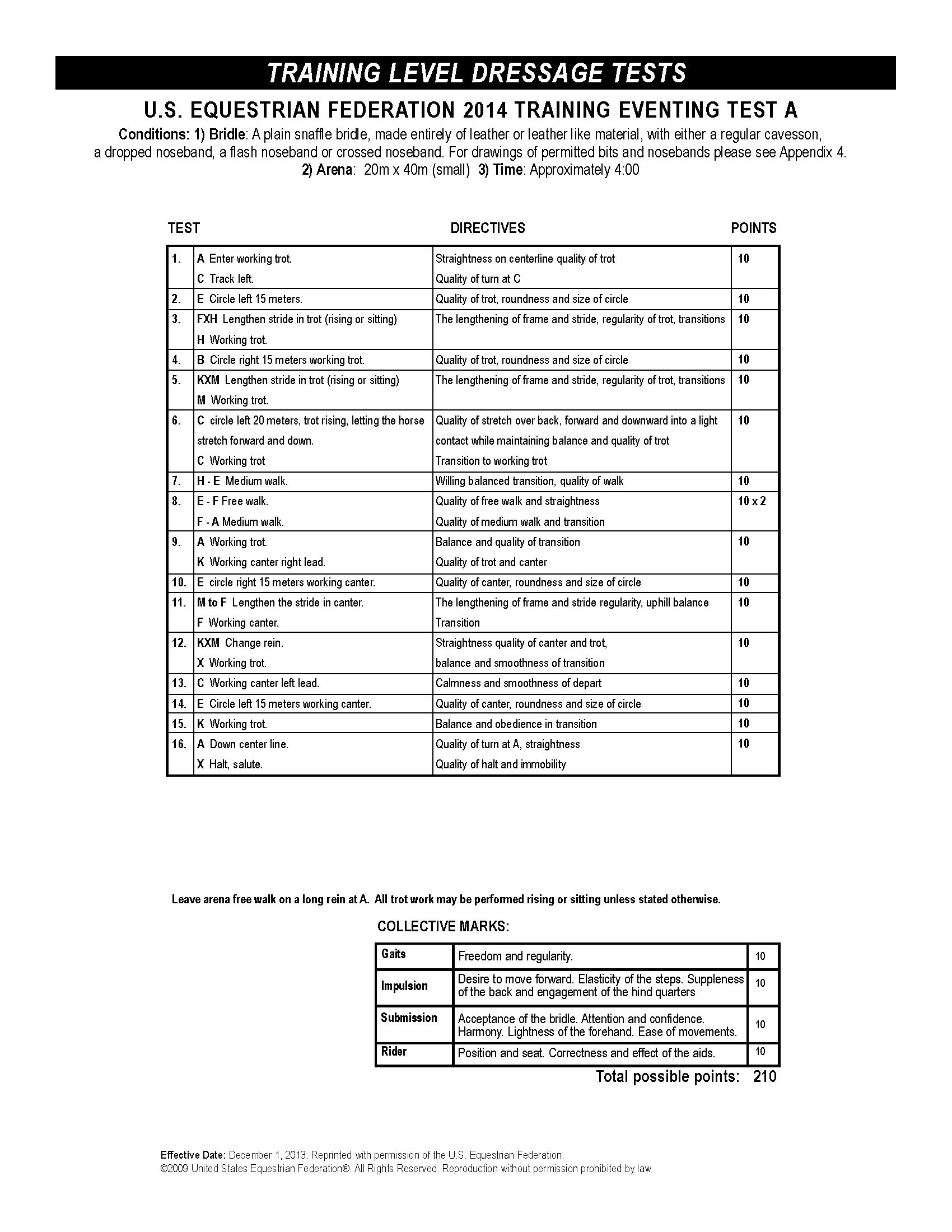
Instead, we’ll forge ahead with the Training A dressage test, and [if the show staff will allow,] add another dressage test to the mix- First level 1. This will mark Foster’s first official time competing at First level, and shouldn’t be a great stretch for him, as the movements are very similar to the Training A test we’ve been practicing. There’s a slight chance he may be a bit tired for the second test, but I would much rather a lazy dressage test than an underpowered jump round, any day.
314942_10100270570366729_1915773862_n

So, with that decision made, I quickly switched tack and instead dressaged around all the jumps I had set up not moments before. Immediately I felt a weight taken off my chest, and Foster was much happier than he has been in several rides to be out in the fresh air. We schooled our lengthenings at canter and trot before calling it a day. His expression was happy, ears alert and eyes bright, and I feel I’ve made the right decision by my horse.

As much as I want to get our first Training competition under our belt, his happiness and well being will always come first. Always!
 

The Competitor’s Toolbox: The Horse

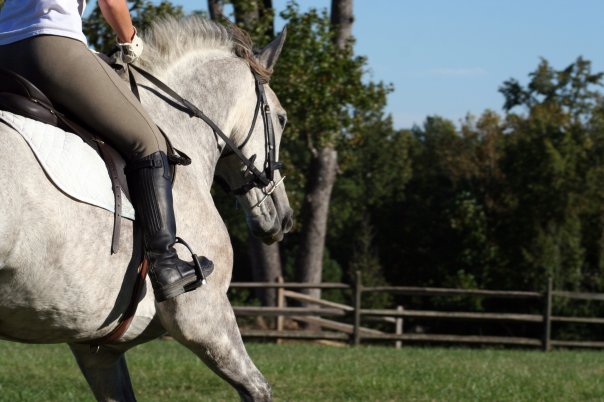
The last aspect any competitor must consider, and equally if not most important aspect of equestrian competition, is the horse.

Without it, I suppose we could still compete, if only in a slightly, er, more humble sort of way.


But let’s be a bit more serious. The horse is our partner, and if he is not ready, we mere humans are woefully unable to compensate for the margin of error.

To be fair to the horse, we must ask what is reasonable of him in terms of both fitness and training. It is just as unjust to ask a horse to understand a new skill and execute it perfectly in a stressful environment as it is to push him to the extremes of his abilities and therefore compromise his soundness of body.

Derp faces abound

Derp faces abound

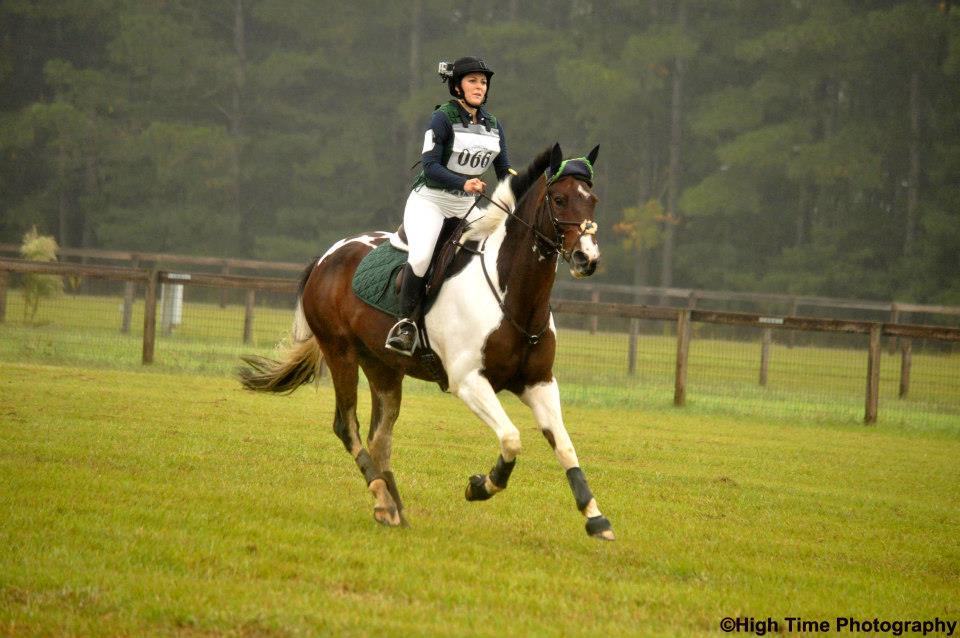
On the rider’s part, we alone are responsible for ensuring our mounts are physically ready to compete at the level we are to demand of them. Foster, for instance, is half warmblood, and as such, requires more work to get his cardiac fitness ready for anything more than Beginner Novice. Looking forward to Training level, it’s up to me to get my horse prepared by incorporating conditioning rides into our regular schedule. Mind-numbingly boring though they may be, that comes with the territory of having a [part] warmblood. Luckily, the reward is worth the work- galloping cross country on a fit (read: non-laboring) and happy horse is an amazing feeling, and gives me an accomplished feeling without ever having jumped a fence.

The second part of this is the horse’s mental preparation. Is the horse completely comfortable with the exercises we are asking him to compete at the show? Knowing that in most competition settings there is going to be some level of distraction, whether that be a horse lunging, a dog barking, or a flag flapping in the wind, keeping the experience positive can live or die by your horse being mentally prepared.

If I’m honest, right now I feel that Foster is more than prepared for Training level dressage, which to me is the equivalent of First level [pure] dressage. The jumping, as is usual, we’re teetering on the edge of being prepared. My goal is to feel comfortable jumping 3’6″ courses before doing any kind of horse trials- this so that when I walk up to a wide Training table on cross country that I won’t pee in my pants with fear (though I’m sure I still will, nonetheless). We’re not quite there yet, the recent snow especially messing things up, but that’s my requirement before moving up to a full 3 phase event. That’s the bar that makes me comfortable asking my horse to complete a task at a show.

4755_696682465709_1959682_n

Horses are the entire reason we compete in equestrian events, and therefore must be at the forefront of our competition considerations. With that in mind…

What do you do to get your horse mentally and physically fit for competition? What aspects of this do you struggle with? How do you decide if your horse is ready to move up a level?


The Competitor’s Toolbox: The Mental Game

Recently I have been thinking about myself as not only a horseperson, but also as a competitor. That is, assessing how I stack up and whether or not I am prepared at competitions so that those shows set myself and my horse up for success. I’ve determined that there are three ways to think about the requirements of a good competitor, and these are the Mental Mindset or Psyche of the rider, Equipment, and Preparation of the Horse.

The first then that I want to assess is the mental game. I think a lot of this is knowing your strengths and weakness, and staying mentally focused so that you remain in the moment enough to use your strengths to your advantage, and make corrections (for your weaknesses) as you go along.

For instance, while it’s taken me many years to get there, I think I have a good Dressage ‘game face’. Intercollegiate Dressage in particular taught me to ride every step of every test, and have confidence in my abilities. I’ve practiced and perfected visualizing exactly how I plan to ride each movement in my mind, and now find this process relaxes me whenever nerves try to come up. Visualization comes up again in my day-to-day riding, as when I feel the horse getting heavy or sloppy I picture myself as a Grand Prix rider, tall and elegant and soft but clear with my aids. This in turn tends to correct my equitation and helps my horse respond to me more efficiently.

Game face on.

Game face on.

My weakness, then, is jumping. Because I have been a formal student of jumping for less time, I lack the ability to visualize exactly what I want to achieve, and therefore have less confidence going on course. Looking for riders at the top level as visual examples is, in my opinion, less clear, as I see a bevy of different releases, leg positions, and styles among professional jumpers and eventers. Additionally, not knowing the course until the day of (or sometimes the hour of) the competition makes my mental run-throughs rushed and not nearly as effective. In short, the techniques that work so well for me as a dressage competitor fall short for the other phases.

CHP, October 2014

CHP, October 2014

Instead for jumping, I have started using other techniques to get my psyche in order. The bullet lists you see in each lesson post become mantras that I repeat as I prepare for the competition. I try to find songs that get me pumped. J played this one for me getting ready for the clinic, and I really found it helped me find a groove, even if the only lyrics I really know are ‘like a great white shark on shark week!’ (enthusiastically yelled by myself, of course).


Besides knowing your mental strengths and weaknesses, there are the other responsibilities of the rider to know- speeds required for the level and what that feels like, penalty rules, technicalities (such as what to do if your horse refuses the second fence in a related combination, whoops), and so on and so forth. Any detail of this could be the difference between success and failure (although we never fail, we just gain a learning opportunity!), or a blue ribbon and a red ribbon. Growing our knowledge and becoming a student of the sport is what being an amateur is about, and the more we know, the more we set ourselves up for success.

What mental techniques do you use to prepare for or at competition? How do you handle the stresses of competing? Are there mental aspects that you would like to improve yourself?

Let’s Discuss: Flying Changes

Flying changes keep coming up in my training, and I admit, I’m at an internal impasse.

One one hand, and to state the obvious- having a flying change would make showjumping courses less embarrassing much more fluid, as my requests for a simple change mess with our forward momentum. Granted, he is almost amazingly well balanced in counter canter, so it’s not like we are careening around lopsided on the wrong lead, but still. He will offer the change occasionally, but it’s fairly random. Also, I need to work on getting the correct lead over fences and not leaning left dammit.

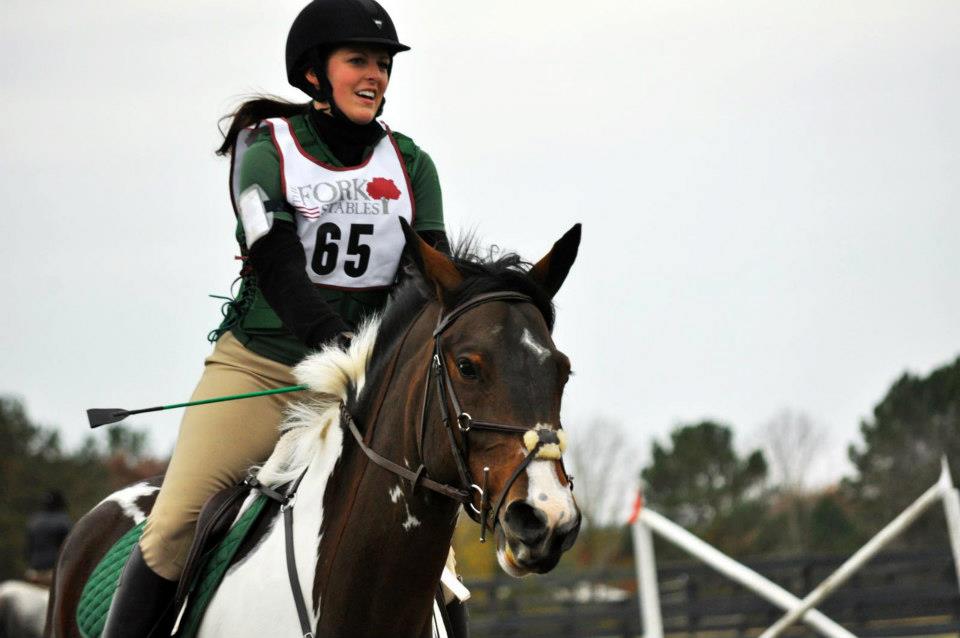
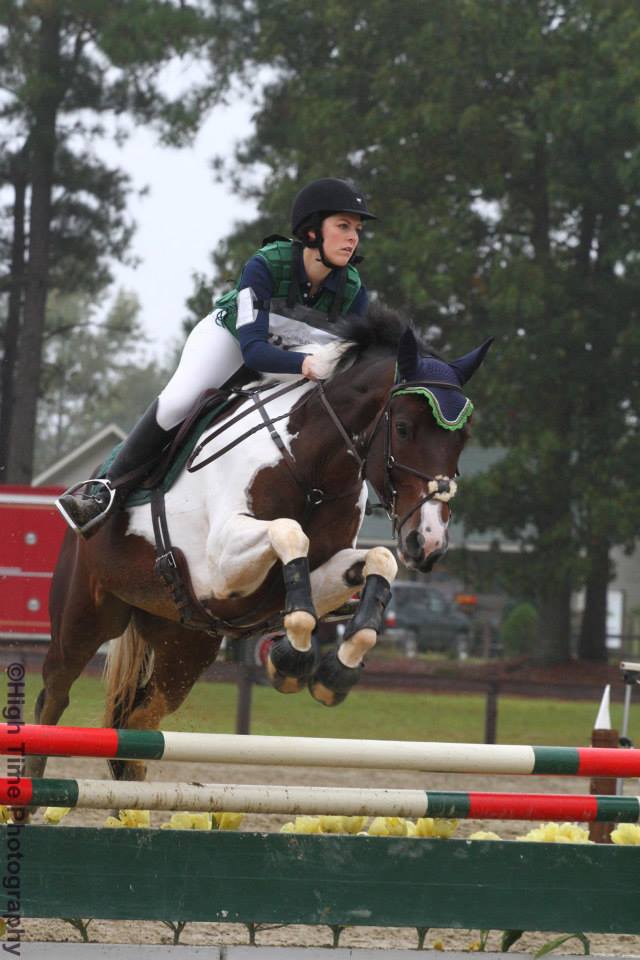
PC: High Time Photography

PC: High Time Photography

On the other hand, we are working towards the goal of a Second level test this year. Counter canter starts at First level test 3. Counter canter gets a lot easier when your horse is not trying to switch leads on you when you change the bend. Again, Foster is quite well balanced at the counter canter.

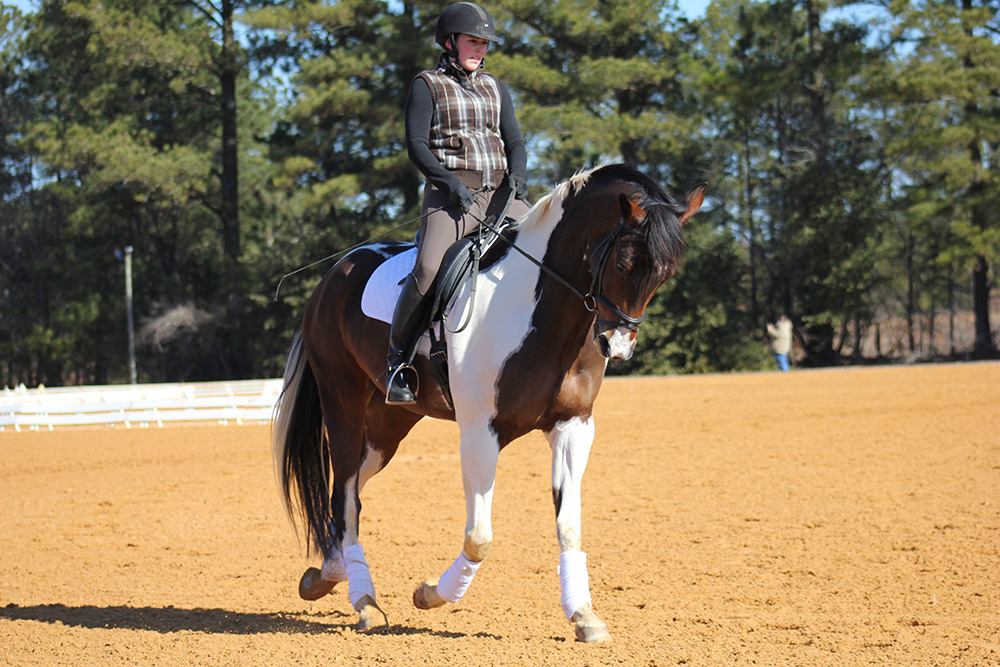
dressage

I have never taught a horse a change, and could count on one hand the times I have sat on a school master, much less practiced a change on a schooled horse. I understand the theory, just have not practiced it. We (as in a friend who knew what they were doing) started trying to teach Foster to change over a cavaletti, but the results were mixed. According to her, he is a tough cookie when it comes to changes. My dressage trainer is happy with not schooling changes (obviously).

fb_IMG_3099

PC: J


In Great Britain, they don’t worry about the change as much, and I’ve heard a couple opinions over the years that changes really aren’t required until Preliminary. However, there are other disciplines like H/J where changes seem almost necessary even from the pony stages.

So I ask you, wise readers- what do you think? Forget the change and focus on getting my lead over the fence/Second level wondrousness? Or, get the change and figure out the counter canter later?


Winter Weather and a mini Dressage Lesson Recap

Winter weather has officially hit North Carolina (and seemingly a lot of other places too), so obviously, pretty much everything that can be closed is closed. And of course the problem with living in a house on a hill is that when said hill ices over, you’re pretty much stuck anyways. So if you want to find me, I’ll be in my sweatpants working from home the next couple days.

The upside to all this is that everytime I look outside I think of this…


… and therefore sing all four parts to my husband, complete with cheesy railroad noises. I like to think I’m adorable, but I’m probably just hurting my chances on getting that next blog post out of him. Whatevs snow snow Snow SNOW SNOW!!!

Before the ice storm hit, I was able to squeeze in a dressage lesson and discuss  the feedback from the clinic. Foster had a couple days off after the clinic, then a long stretchy session to work out any kinks, so even though I hadn’t dressaged yet since the clinic, it was still helpful.

clinic canter

Basically the lesson was a repeat of lessons before in that there was a lot of emphasis on transitions within and between gaits, lateral work in the form of shoulder and haunches in, and more work on our lengthenings. Foster’s still figuring these out to some degree, and part of how he is dealing with the added ‘pressure’ of the lengthening is to curl under, so I’m learning how to get his poll up and keep him going, or for now, come back to the walk then try again.

trotlengthening

One of the most aggravating parts of my test was getting that 5.5 on the free walk, and so we worked on getting him to really take the extra stretch without rooting. Part of solving this problem includes my moving my hands towards his mouth (i.e, pushing my elbows to the fence!) so that he has even more ‘place’ to go. So obviously this is a feeling that I need to get the hang of in order to get the most out of my horse! Funny how habits transcend disciplines!

Carolina International Clinic Recap: Dressage

Wow. Let me just say that again- WOW. I feel so much wiser having attended the clinic at the Carolina Horse Park yesterday, and can’t wait to write it all down!

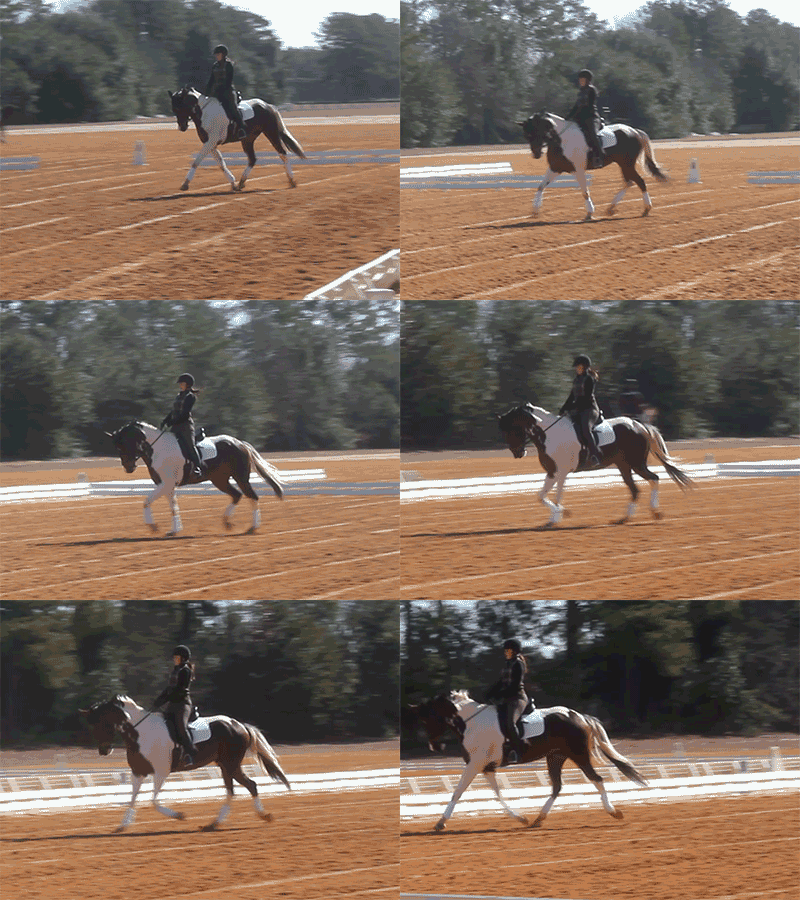
Even though the clinic format was 1) course walk, 2) dressage, 3) jumping, I feel it’s worthwhile discussing dressage first. We warmed up on our own, and while it was cold and a bit windy it remained sunny and the footing quite nice. Foster felt in fairly good form, though a bit short in his neck, so I decided to post the trot to keep his back soft. We did a few transitions, and a couple lengthenings in both trot and canter before heading into the arena.

fb_IMG_3111

I thought we put down a fairly good test, minus a couple bobbles. During our canter lengthening, the horse in the adjacent ring spooked, causing Foster to spook in turn. Luckily I was able to get him back to save the next movement, the downward transition at X, but that still unsteadied me slightly. His upward canter departs need revisiting a bit, he almost broke in the medium walk, and he has picked up the fun new habit of rooting in our free walk (advice here anyone?) which brought our normal 7-8 down to a 5.

fb_IMG_3127

After the test, Will Faudree, our ring judge, walked us through his thoughts. He was quick to ding us on the bobbles, and noted that he really expected these lower level tests to appear seemless, rather than as punctuated movements. There was also lots of advice on how to be a better test rider- for instance, by preparing and executing the transitions on the long sides of the arena (the walk at H and last trot at K) a little early, since to the judge’s eye they appear late if done exactly at the letter. Also he pointed out that by starting my centerline well outside of the actual arena, it gave him longer to watch any waviness of Foster’s hind end, and suggested starting the centerline closer to the arena so as not to give a bad impression too early. Will then went through each movement of the test and his thoughts as to why he scored the movement as he did, which was of course vastly helpful in understanding the score sheet.

Collective Marks: Gaits - 7.5, Impulsion - 7.5, Submission - 6.5, Rider - 7

Collective Marks: Gaits – 7.5, Impulsion – 7.5, Submission – 6.5, Rider – 7

This test would have earned me a 66.4%, or 33.6 in an actual event. I definitely walked away knowing that we have homework to do to bring those 5’s up, and I’ll be damned if we’re going to start getting anything less than 7’s on our free walk. However, this is an encouraging start, plus we accomplished our first goal for 2015!

  • Get a 7 on a lengthening

They still need help, but apparently 7’s are within our reach!

Warm-up lengthening

Warm-up lengthening

All in all we walked away with our head held high, and I can’t wait to put all the wonderful feedback to good use!

Tomorrow- the course walk!


Lengthenings and Counter Canter

Well, we did end up schooling over fences this weekend, but several factors, including an odd spike of anxiety on my part, derailed the session and I’m doing my best to forget it and just remember the awesome-sauce practice we had a few days earlier instead.

Otherwise we had a dressage lesson yesterday, and I asked Eliza to get on for the first half and feel out the lengthenings and counter canter. Overall it was nice to hear that he felt better in the connection, a little straighter, and overall a bit stronger behind. Thumbs up from me for justifying spending all that dough on hock injections.

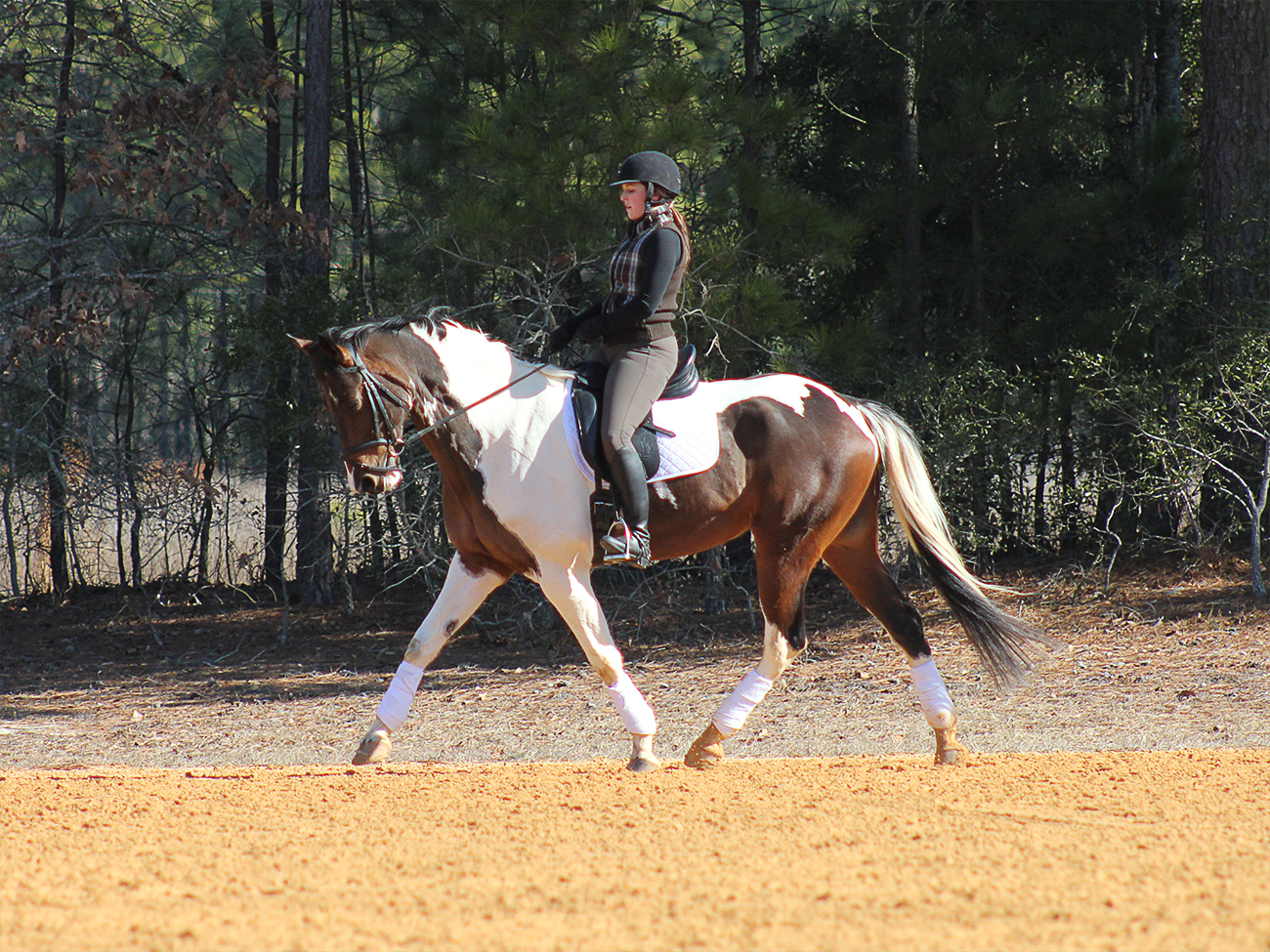
It was super helpful to see what a professional could eek out of Foster’s lengthenings, which I’ve described before as lackluster. Horses of the past loved lengthenings and were more than willing to make the transition with enough gusto to spring me from the saddle. Foster, not so much. So seeing what she could do gave me a visual that I could reference when I’m working on it on my own. He’s still green in them and wants to tuck a bit, or break to canter, but there is some lift starting to happen through his shoulder and definite push from behind. After getting on, I was able to replicate some of the good steps, and I know it’ll get better over time.

Excuse my video skills, I was trying to listen while watching/videoing:

Things I took away from the lesson include another technique for not sticking my elbows out like a chicken, and that I really need to practice holding my dressage whip in my left hand. Foster does not appreciate it bumping all over his body.

The plan is to give us both today off, and tomorrow review a few dressage movements in a light ride so as to conserve energy for the clinic!

Weekend Wrap Up: Dressage Lesson

The following day after our showjumping lesson, we squeezed in a dressage lesson with Eliza. Since it had been a month before that we had our last lesson, it was good to check in and visit some of what we have been working on.

We started with free walk to working walk transitions, and then halt to walk transitions without using his neck, then the same at the trot. It was quite windy and at first it felt like his neck was a short steel bar, but after lots of transitions within and between the gaits, followed by inside to outside bend on a circle, he eventually loosened up a bit.


Many of the things we worked on we have done before. Shoulder-in and renvers, and inserting 10 meter circles whenever he gets stiff. These 10 meter circles have been somewhat tricky for us, so mentally (and sometimes physically) I need to ride them as two halves, even it that means riding half a circle, going straight until he’s soft, then riding the second half of the circle. The renvers are still hard for me as I work on my coordination with weighted inside seat, shoulders and leg placement, but it was easier than the first time we did it so I’m counting that as a win.


For me, the highlight of the lesson was again the walk-canter transitions, which continue to improve. I do need to sit deep and down into the transition to help him with the first strides, and be quicker in my aids to the left so we don’t get a jump into a trot transition instead of canter. Keeping my upper body strong, shoulders back and swinging my seat with the movement will allow him to establish balance on his hind end and a true three-beat gait.

My new dressage anthem(?):


As per usual, a few added tidbits to remember:

  • Try wearing gloves, supposedly they will help me keep my wrists soft and hands closed (ugh, but I don’t wanna!)
    • On the note of closed hands- this article popped into my news feed on the ‘dressage fist’
  • Keep my upper arms vertical, feel the edge of my shirt, let elbows hang (dammit. have got to work on this)
  • Move those hips!

Foster will now be getting a few days off after getting his hocks injected. After all these exciting videos (thanks J and A) it might be a boring couple of days ahead!

First Level Practice & A Chiro/Hock Update

Last night I threw Foster on the lunge and was pleased to note that the not-quite-rightness in the left hind from the night before was definitely negligible, so much that I was hunting for it, so I hoped on and we worked for about 35 minutes on some Training dressage stuff. The only difference was that he tried balancing himself in my right hand, which was rather annoying, and we finished when he was soft and balanced in both directions. Expecting him to be back to 100% tomorrow.

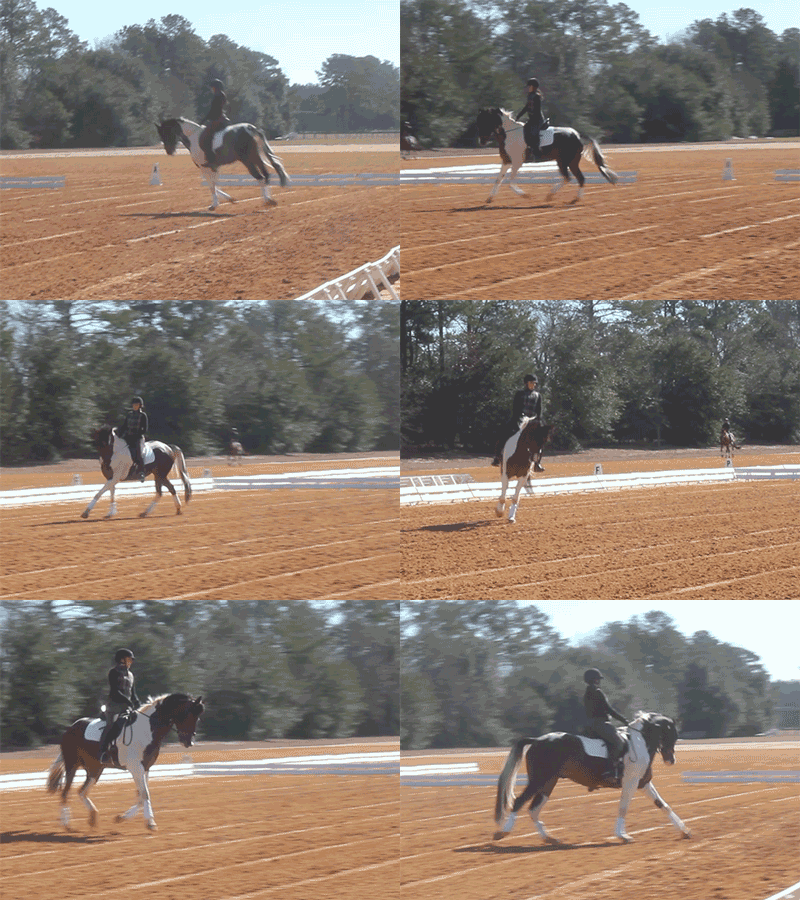
Also, J was able to take some video of us last week practicing the First Level test 1 tear drops. That is, half of a 10 meter circle to centerline, then a diagonal back to the rail. Video is always helpful, and I can easily see that I need to increase his impulsion, more bend through the body, and make sure he doesn’t get tight with his neck to balance himself. Still, for our first shot at it, it’s not terrible, I guess.

In other news, I bit the bullet and signed him up for the hock injections, to happen next week. Assuming he’s back to 100% tomorrow, we will use the weekend to stuff in a couple last minute lessons and he’ll take it easy next week as he recovers from the procedure. Because of the close timing between the originally scheduled massage and injections, I cancelled the massage so that there is some clarity to what helps (and I suppose what doesn’t). Hopefully the injections are what he needs to make himself straight, and will set us up for success as we start doing bigger and better things.