Do’s and Don’ts: So you want to sell your horse

I grew up on a horse farm, where my mother started out buying OTTB’s and reselling them before moving into the breeding business. She handled her sales ethically and responsibly, and her breeding clients would come back for foal after foal. Growing up, as soon as I was able to lead a horse I would help take sales photos, and then as I became a better rider we would buy resale prospects at auction, I would put training and miles into them, and we would sell the horse and get another. Quite the learning experience.

Our main stud, Hadrian, taken at the old farm

Our main stud, Hadrian, taken at the old farm

So it probably comes as no surprise that I like to make a daily venture into online classifieds to see what the horse market is doing. It is obvious to me that some of the ads are going to be successful, and others not. Here is my own little list of Do’s and Don’ts I’ve collected over the years.

DO List a Price
If you have no price tag, I tend to assume you are A) asking so much money you are embarrassed to say, or B) going to waste my time playing number games. Either way, I personally never contact a seller if ‘Private Treaty’ is on a listing. Figure out what you think your horse is worth, and what you want to ask ahead of time. Then let prospective buyers know. If you want a buy-back clause in the sale agreement, you can discuss that in the negotiations.
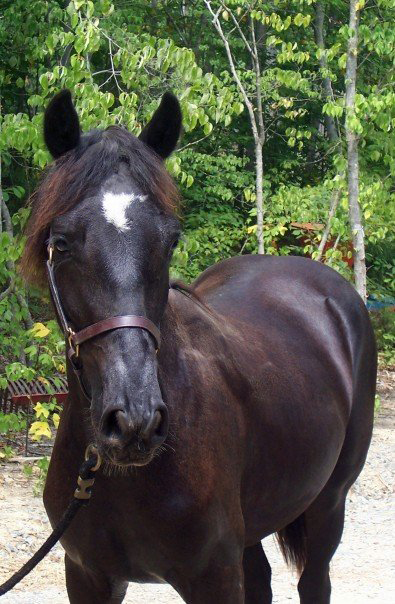
Friesian cross filly, Fleur

Friesian cross filly, Fleur

DO Have a Picture
In the world of smartphones and tech gadgets, there really are no excuses for this. You don’t have a camera, or a smartphone? I bet you know someone who does. Back in the day we had to take our photos to be developed before mailing them in. I bet you can find a way.

Another stud photo, taken by a professional

Another stud photo, this time of our Connemara stallion, taken by a professional

DON’T Forget the Action Shot!
So, this mostly applies to horses being sold as riding horses, but also pertains to breeding and young stock. There is nothing worse to me than seeing a fancy Dressage/Showjumping/Eventer/Whatever horse that has a price tag of $20k + but has no photo of it doing anything beyond existing in a paddock. Surely if he’s done every circuit imaginable, and has tons of ribbons to his name, someone documented it. Even if it’s not a photo at a show, which is optimal, it is still going to be important to your prospective buyer to see how the horse moves and reacts with a rider on his back.

Image

A sales photo of one of our foals- no fancy camera, but it gives a lot of information on her way of going

DON’T Make the Horse Look Like a Mule
Or the Do version of this- learn to take a conformation shot. It can be tricky, but it’s worth the effort. Taken as a profile shot, the front legs of the horse should be together and the back feet apart. Not parked under itself, and for goodness sake try to get those ears forward! It just makes a good impression. Don’t let your ad end up here.

Image

This photo of Foster is not perfect (and could be made better with a bath and braids) but would suffice

DO List a Phone Number
This may be a personal preference, but I as a buyer would much rather talk to someone over the phone about a horse than through an email. I am thinking of buying a half-ton creature from you that within its rights could kill me easily, and I want to know that you as the seller come across as a decent person who is not trying to sell me a four-legged devil.

DO Have a Video
This one is a little more difficult. But if at all possible, have a video. I insisted on seeing one before I made the trip to see Foster, because again, I was looking for a prospect for a certain discipline and if he moved downhill or like a three legged goat, it wouldn’t be worth my time. Not to mention these days videos are more and more common, help yourself out.

Here’s a very homemade video of a green draft cross for sale, meant to demonstrate his puppy-dog personality:

DON’T misspell words/horse terms
OK, so this is the grammar nazi speaking. But when you list your horse as being 15.5 hands tall, with pretty gates, I think you own a horse of questionable height that decorates fences for a living. OK so maybe not, but seriously. Also main/mane, tale/tail, and those little ‘ and ” signs are for measurements. He doesn’t jump 26 fences, he jumps 2’6″ fences. Sorry, rant over.

36atr2All of these details will make your ad more easily understood and attractive to buyers. While the sales process can often be a frustrating one, giving potential buyers more information up front can help cut down on tire-kicking and other time-wasting annoyances. In addition to this, as a seller it gives you confidence knowing that the prospective new owner has as much information as possible, and you are connecting the right horse with the right buyer. Win-win, people, win-win.

Wedding weekend, grumpy quads, and a clip job

You know you’ve had a good weekend when your legs are so sore from dancing that you struggle with stairs, and sitting down is actually more like falling into a chair, because your quads just can’t handle those last couple inches before your butt hits the seat.

Selfie with the bride!

Selfie with the bride!

This past weekend marked the last wedding of the year, and it went off with a bang. I had a simply marvelous time seeing old friends, testing my public speech abilities (not so hot- I shake like a leaf!), and putting some serious moves down on the dance floor. Also one odd moment when the entire dance floor decided to fill my updo with glow sticks… Can’t wait to see that picture! The bride is a current best friend and former dressage teammate of mine, so it was fitting that the venue take place in a converted barn, and we seriously raised the roof on that joint!

The bride and I geeking out at her HP-themed engagement party!

The bride and I geeking out at her HP-themed engagement party!

Back at home, I decided I was not so sore I couldn’t give Foster a clip, which he definitely needs with temperatures predicted to reach the 80s this week. It’s not my most meticulous job ever, but I thought it was pretty good for getting it done in just under an hour!

Will take better photo of the clipped pony later

Will take better photo of the clipped pony later

Our work with the draw reins seems to be paying off, and his canter transitions are slowly improving. We’ll continue to visit dressage town this week, and maybe get a jump school in before daylight savings hits this weekend! Can I just say, I hate daylight savings- getting to the barn in the dark is just sad.

Hope y’all had great weekends as well!! Happy Monday!

10 Questions

Not really much interesting going on here this week, other than gorging myself at the fair last night, continuing to feel angst about the USEA rule changes, and squeezing in a couple rides (Foster was a precious dressage pony this week, and guess what- we worked on lengthenings!). So, I’m hopping on the bandwagon with Viva Carlos’s 10 questions

1. How many pairs of breeches/jods do you own?
OK, first- yay ‘jods’! I wouldn’t say my collection is all that impressive.. maybe 15? I’m seriously digging all thing Kerrits right now so my collection is slowly expanding…

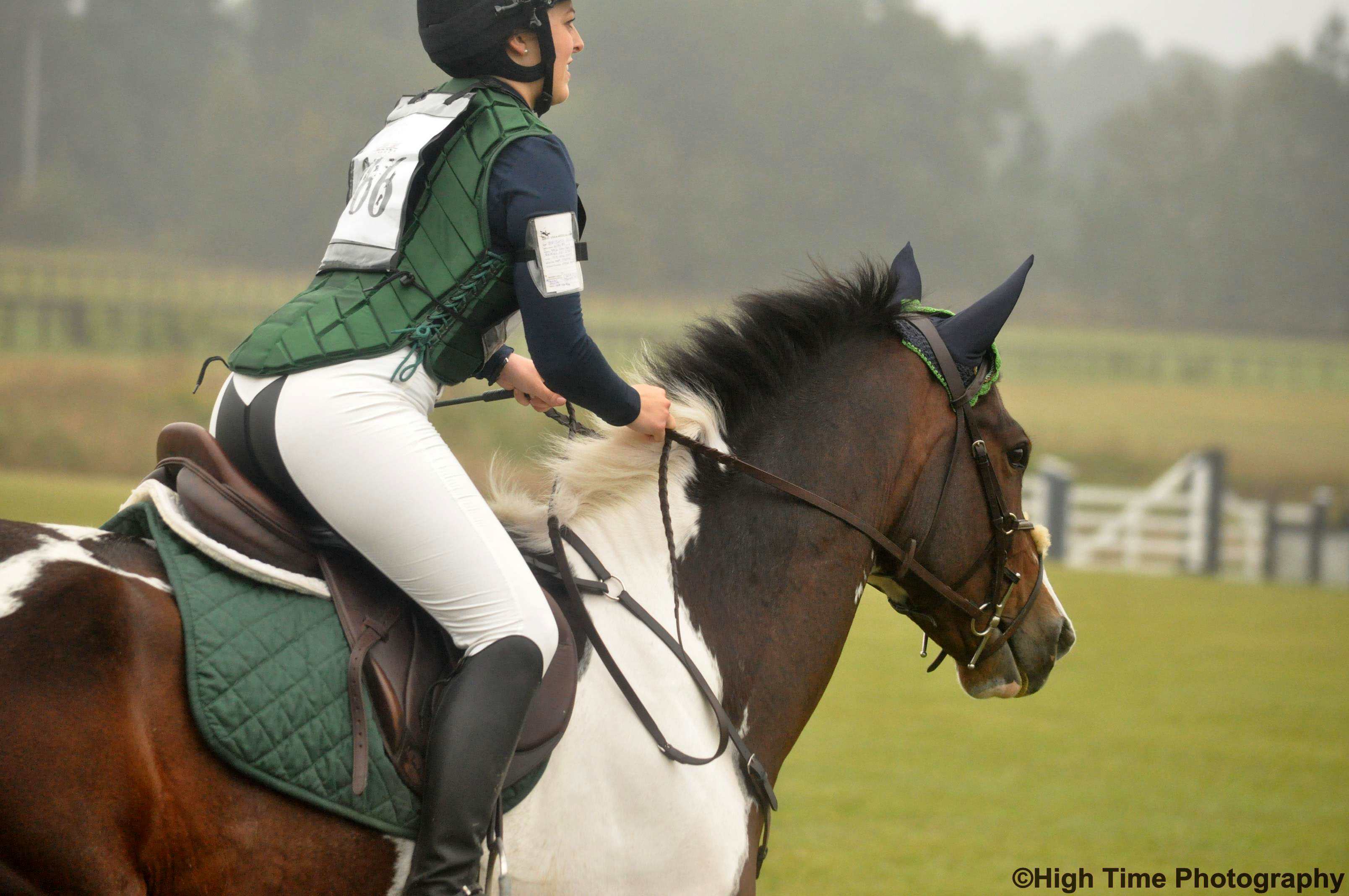
In my mind I call these the Kerrits Arrowbutt Breeches PC: High Time Photogrpahy

In my mind I call these the Kerrits Arrowbutt Breeches
PC: High Time Photogrpahy

2. How many horses have you ridden?
I think my head would spin if I tried to add this up, I’m going to say easily 100+

3. How many trainers have you had?
I had two trainers as a kid that would take turns with me on weekends, then a trainer in middle school that got me into foxhunting.. let’s see, then I trained with a BNT in high school briefly (too bad I had no idea what I was doing) before taking things a little more casual with a mostly dressage/eventing instructor for years. 2 different trainers with the dressage team, and 2 trainers with Foster before settling on my current 2-trainer situation. 11 trainers in 20+ years, that’s not that bad right?

Getting a pep talk before XC from my high school trainer

Getting a pep talk before XC from my high school trainer

4. How many barns have you ridden at?
Besides the farm I grew up at, I have moved around boarding barns a bit.. but if I think about it…12

5. What is the name of the horse you consider yourself to have the greatest bond with?
Foster is probably the obvious.. but Ivan, and my old Haflinger, Tanner, are close seconds.

I wouldn't say we had the closest bond, but I was fairly obsessed with this guy, who I made my unofficial 'project' freshman year

I wouldn’t say we had the closest bond, but I was fairly obsessed with this guy, who I made my unofficial ‘project’ freshman year

6. What is your favorite show name you’ve ever encountered?
I think Daddy’s Money is hilarious for little ponies… I don’t think I could choose, otherwise- there are so many I want to use myself, just need more ponies!

7. What do you consider your greatest weakness or flaw in riding?
Oh, so many struggles… but I’d say more than anything I am supremely aware of my very-much-less-than-perfect equitation over fences.

8. What do you consider to be your greatest strength?
Basic dressage training for greenies.. And I probably only say this because it’s where I have the most experience- Foster is my 3rd horse to bring from basically no dressage to schooling Second (ish) level stuff

9. Have you ever leased a horse?
Nope

The obsession started early...

The obsession started early…

10. What is the name of the first horse you rode?
A horse named Ghost, when I was 18 months old (there’s a video somewhere of this auspicious occasion). Then lessons on Heidi at 4.

Skinnytaste

For your Wednesday enjoyment: a completely non-horse-related post.

I try to be a somewhat healthy eater. I try to avoid fried foods (except at the fair, where I’m headed tonight! *squee!*), and now that I am a grown up and do my own grocery shopping, I try to avoid sweets (it helps that the husband has no sweet tooth to speak of). My downfalls are things like Asian noodles, anything Cadbury’s, and when I get sad, ice cream.  I try to cook as much as possible, but this year have been struggling to make time for culinary exploration.

Whenever I do cook, though, I find my recipes on skinnytaste.com. This woman is brilliant at making home-cooked meals just that bit lighter, without sacrificing taste. Meals that I come back to again and again include the turkey chili,

Also done on a stove top!

Also done on a stove top!

spinach and feta quiche,

easy-crust-less-spinach-pie

Always a crowd pleaser

and chicken parmesan.

Husband favorite, and so easy!

Husband favorite, and so easy!

Anyways, the point of sharing all this with you is that I am so excited that there is finally a Skinnytaste cookbook, and it couldn’t be better! Can’t wait to cook up some tasty and not-so-sinful creations!

skinnytastebook

Just for Kicks: Made from Scratch vs the Made Horse

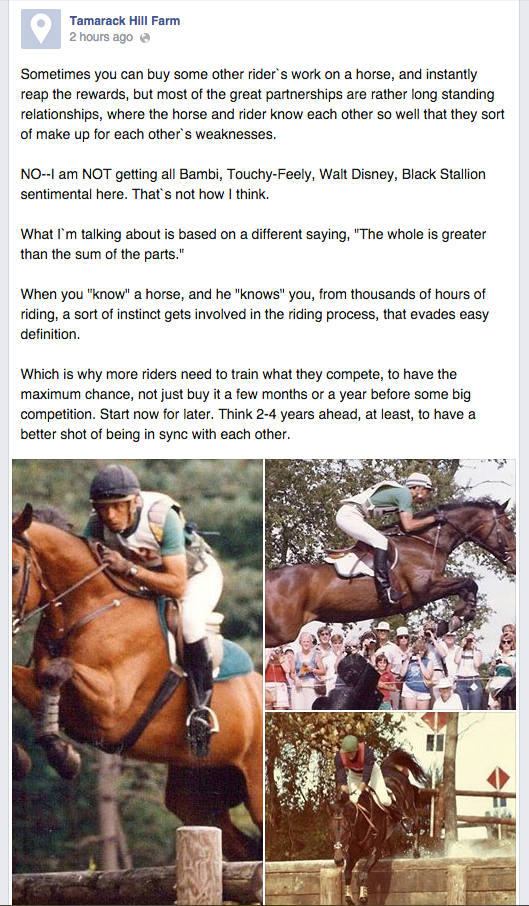
I follow Denny Emerson on facebook, and enjoy reading his delightfully outspoken posts almost every day. For non-eventers, Denny is an eventing legend who has been around the block and back, and still competes and jumps bigger fences at a ripe old age (how old is he, anyways?) than I probably ever will in my lifetime. Just saying- follow him, you’ll be glad you did.

Anyways, Denny posted the following commentary this morning:

Screen Shot 2014-10-21 at 9.49.47 AM (2)


Just interesting food for thought… I was spoiled with a ‘made’ showjumper (that would be Merry), that I turned into an eventer, and I would describe our relationship as definitely rocky for the first couple years. Since her, due to one circumstance or another, I’ve been bringing along my own green horses, with relatively good results. Foster and Ivan, my last horse, I had from their younger years (Foster just turned 4 and Ivan was 2), and their little quirks (and there’s a lot of them) meant/mean a lot to me.

What do you guys think? What has been your experience- how has it been to take over the ride on an experienced horse? What about bringing along your own?

Tooling around

My philosophy when it comes to dressage and riding in general is pretty classical. I believe in creating a solid foundation of basics, and try to be disciplined in not skipping steps before progressing to the next thing. Sometimes my insistence on perfecting the basics of dressage holds me back from practicing new skills, but that’s another story for another time.

In general, I abhor tools that help riders cut corners. I’ll never be impressed by the horse that only goes ’round’ in side reins, or in an elevator bit. (Side story- when I first started riding Ivan I spent months retraining him in a snaffle, because his former trainer/consigner was trying to sell him as a 1st level horse in an elevator bit.) However, there are times when these ‘tools’ can find a place in a classically influenced program.

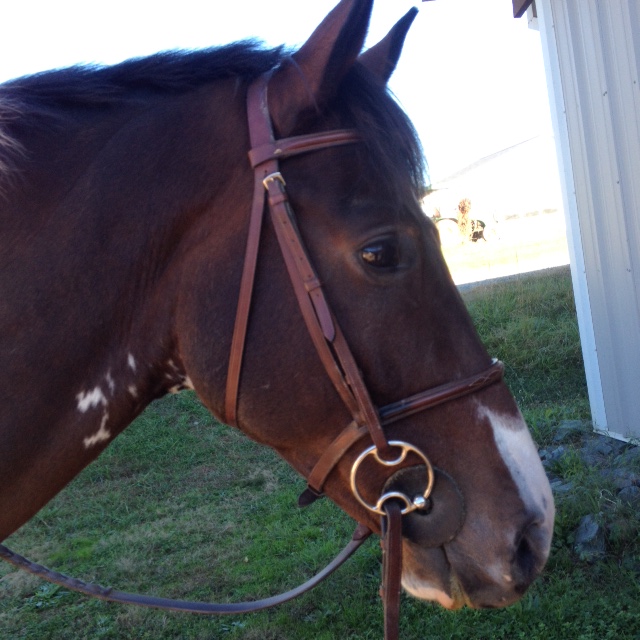
After many discussions with my dressage trainer, we decided to try riding Foster in draw reins to improve his canter transitions. Traditionally the weakest part of our tests, Foster loves earning 6’s by using his neck to pull himself into the transition, causing him to go momentarily hollow before coming back into the bridle. It’s been very hard to train out of him, because conformationally his underneck is a very big, strong muscle (though much smaller than it used to be). While he is not trying to be disobedient, I struggle physically with showing him how not to engage those muscles for balance. The use of draw reins in these transitions helps me maintain a round topline and connection, and I am quick to release and praise him, hopefully teaching him that this is the correct approach to transitions.

Coming back into the bridle

Coming back into the bridle

My last lesson was in draw reins, as I wanted a professional to watch the way I rode and confirm that I am using them in a correct way. I feel quite clumsy having so much in my hands, but I feel I’ve got the hang of it now. The plan is to ride in this way for 4 rides before taking them off, because obviously I don’t want to create dependency on them. This weekend was ride #2 in the reins, and I’m anxious to see how he goes in that first ride away from them.

Round canter is round

Round canter is round

Similarly in the jumping world, I have been exploring new bits. Generally I ride in a full cheek Waterford, which solved the issue of Foster’s bracing and rushing a couple years ago. Now that I feel like I have solid brakes, and need something with leverage to break the poll. I previously tried the Waterford Baucher, which made Foster break at the poll but also lowered his neck and sent him on the forehand. At the advice of my last lesson, we discussed a Wonder Bit, and I finally was able to try the below model yesterday.

metalab+loop+ring+gag+oval

Color me impressed- he was uphill, softer, and engaged, and I felt like I had good control without going overboard. I set up some fun jumps in the arena, including a faux (tarp) liverpool and fan oxer and played with bending lines and collection/lengthenings. Everything rode really well, and I’m hoping to repeat the experience and make sure it wasn’t just a fluke!

photo (8)

So overall, it’s been a weekend of experimenting and twinging our regular program to incorporate new tools.

Just for Kicks: USEA Proposed Rule Changes

It has been announced that changes are being proposed at the USEA to the lower levels, in order to bring it up to other country’s standards. Click here for the article on EventingNation. Here’s the recap for those who are unaware:

Cross Country Beginner Novice Novice Training
Speeds @ optimum time 300 350 mpm 350 400-430 mpm 420-470 *450–480 mpm
Speed faults 420 520 mpm 450 520 mpm 520 mpm

* When multiple divisions of Training level are offered, Open Training speed is 480 mpm.

Show Jumping Beginner Novice Novice Training Preliminary
Heights 0.79m (2’7”) 0.90m (2’11”) 1.0m (3’3”) 1.10m (3’7”)
Height Option* 0.85m (2’10”) 0.95m (3’1”) 1.05m (3’5”) 1.15m (3’9”)
Spreads of oxers 1.00m (3’3”) 1.10m (3’7”) 1.20m (3’9”) 1.30m (4’3”)
Spreads w/ height option 1.05m (3’5”) 1.15m (3’9”) 1.25m (4’1”) 1.35 (4’5”)
Spreads of triple bar 1.20m (3’11”) 1.30m (4’3”) 1.40m (4’7”) 1.50m (4’11”)
Spreads w/ height option 1.25m (4’1”) 1.35m (4’5”) 1.45m (4’9”) 1.55m (5’1”)

* One vertical and one oxer permitted at these heights

Being that I have, do, and will be competing at these levels, I’d like to weigh in with my opinion, which is two-fold. If you want to skip the discussion- scroll to the end.

Speed
The current argument for upping the speeds required is that some horses have to do circles at the end of their course before crossing the finish flags in order to avoid speed penalties (for non-eventers, you can actually incur points against you if you go too fast, a time is given as incurring speed faults along with the optimum time). The purpose of the speed faults is to dissuade riders from reckless riding on course.

Beginner Novice XC Oct. 2012

Beginner Novice XC Oct. 2012

From my standpoint, I can understand why increasing the speed @ optimum time could be a good idea. Even if my sometimes pokey horse might struggle with this, I will admit that encouraging a more forward ride might be a good thing. I completely disagree, however, with increasing the speed fault speed to 520. In the current USEA guidelines, 520 meters per minute is a standard speed for a Prelim course. Let me tell you, you are seriously cruising at 520 mpm. Here is a video comprised of Prelim riders at Morven Park in 2011, for example:

Why would anyone jump Beginner Novice (2’7″) or Novice (2’11”) need to get anywhere near Prelim (3’7″) speed in order to safely get around a course? In my opinion, there is no training program that should ever include galloping 2’7″ fences as part of their regimen. If I see someone  taking these smaller fences at almost-Prelim speed (because of course actual Prelim speed incurs speed faults), I think it is safe to assume that either A) the ride is lacking control of the horse, and therefore dangerous OR B) the rider is lacking discipline, and is therefore dangerous.

OctSHT2014_0321-3610283733-O

Erm, yes, I may have trotted a couple steps after the up-bank

Let’s talk about how these new speeds might affect other competitors. When Beginner Novice (the most affected level here) allows horses on course that could be traveling at anything between 350 and 515 meters per minute, it is likely that passing on course is more apt to happen. Think about your average cross country course, which is a mixture of water elements, fields, and wooded trails. Will the horse traveling at the higher speed wait until you are conveniently in a big field to pass you? My experience tells me probably not. Now think about your average horse or rider at the Beginner Novice levels. Beginner Novice is a division created for either green horses, or inexperienced riders. How is a pair like this, presumably new to the sport, going to handle the likelihood of being passed on course? Some horses get understandably upset when another horse gallops up behind them blindly. Novice or young riders may not know how to handle the situation of being approached so quickly on course.

To me, this is the greatest danger of allowing faster speeds on these lower level courses. I think the only solution to this dangerous passing scenario would be to increase the time between riders allowed on course, to allow slower pairs a ‘head start’. However, knowing that most shows operate on tight time schedules, I see this an unlikely predicament.

Height
I can think of (and have heard from on the interwebs) more than a few lower-level riders who are crapping themselves thinking about the new height allowances in showjumping. Many of these riders (of course, not all) ride at the lower levels because they lack confidence to move up. Increasing the heights of some fences is crippling to the anxiety of this crowd, and I truly feel for them. While 2″ is not a whole lot (the increase for Novice and Training), 3″ added to Beginner Novice course practically turns them into Novice fences, exactly what that same crowd is looking to avoid. While I don’t see this increase in height to be as dangerous as the speed fault scenario, I do wonder how these changes will adversely affect current riders at the lower levels.

10649873_10102184144209409_4711948768496501054_n

That being said, I do think that these height rules could find merit at the annual Championship Competition (AEC). These riders have to qualify in order to attend, and are therefore presumably better prepared to tackle a slightly harder course. Similarly, if the championship heights are clearly communicated before the event, it would ease the tension between traditional schooling venues as to what facilities implement 2014 heights versus the new proposed heights.

In Summary
In my mind, having a more forward optimum time is fine. Still safe, and rewarding a forward ride. I get that. Increasing the speed fault speed allowed- big, big red flags for me, and I hope they will be heavily weighed in the proposal discussions. For height, I don’t understand how increasing the height of a couple fences at the lower levels brings us up to international standards, and even more so, I don’t understand why making these lowest levels consistent with other countries matters. Is there going to be a Beginner Novice Olympics any time soon? Traveling to competitions in other countries for Training level? I seriously doubt it. Perhaps implementing new heights for Championship courses is the way to go. Overall, I would like to see better reasons for implementing changes that will affect the greater population of eventers, and that is those competing at the Beginner Novice through Training levels.

Weigh in! What do you think about the new changes? How will they affect you and your decisions about what level to ride at?

Show Recap: Novice @ Carolina Horse Walk – Competition day

After walking the cross country course Saturday, the sky opened up and it poured. And poured. And poured. Luckily this provided excellent opportunity to huddle in Foster’s stall, do a bit of braiding, mentally run through my test, and try not to think about what was happening to the footing all through the deluge.

No dressage photos, so look at us in our snazzy new colors!

No dressage photos, so look at us in our snazzy new colors!

Dressage
Needless to say, it was still very very wet Sunday morning. The dressage warm-up quickly turned to slop, which my poor pony is not so used to working in. I attribute his being slightly stiff in his neck because of this, as he attempted to pick his way through the mud and muck. Still, I was happy with the test he put in, and I was pretty confident it would score in the low 30’s.

photo (7)

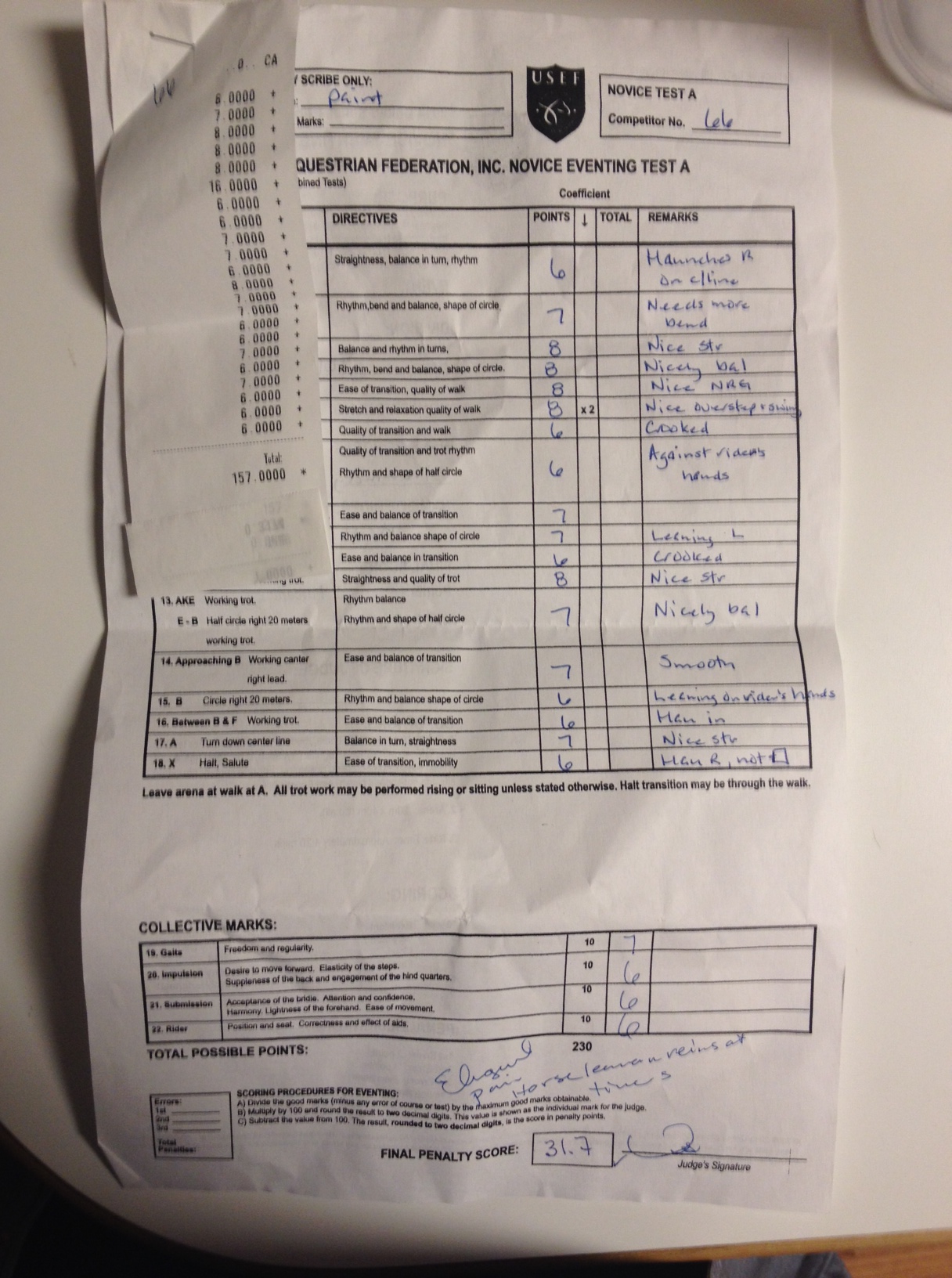
The test earned us a 31.7, good for 5th place. Looking at the test, I’m pleased with the number of 8’s on there, and it appears we were off to a pretty good start. I am, however, a little bummed with how the test finished, and I didn’t feel some of the things the judge remarked on. Similarly, I wish I could have seen my ride, so I could understand why our overall scores dropped so much from the last show just a couple weeks ago. So we’ll be chalking it up to experience and trying to improve even more for the next outing.

Showjumping
Because of the slop, I was a little worried about how showjumping would go. Foster looked just a hair too relaxed hanging out in his stall, and I knew he would need some extra oomph to push out of the steadily deteriorating footing. I gave myself about 15 minutes of warm up, starting by trying to get him really moving forward (kind of successful), before hopping over a couple fences. He was a bit sticky to the fences, but I decided to take the risk of not jumping further in order to save our energy for the fences that would count.

OctSHT2014_1814-3610283681-O

I’ll say this in regards to our round- thank goodness you don’t get pretty points in eventing. He jumped me out of the tack over fence 7, which I got him a little unprepared to and he made a huge effort over. He didn’t pick up the correct leads 100% of the time, and once I brought him back to a trot to switch leads. Because of this, I think, we got 1 time fault, but went otherwise clear through a course that was definitely taking names. I saw 1 fall, and 2 refusals just while I was waiting- an unusual pattern for these lower levels.

Fence 7

Fence 7

Cross Country
When I got to cross country, I was more than a little worried about the footing on course. Foster does not have studs, and though the sandy footing holds up pretty well, I still wondered about jumping these large fences like #3 right from the start. Combine that with watching 2 different horses have refusals at that fence, and thought I was going to puke. But a quick hop over the couple cross country warm-up fences and Foster perked up substantially, and I decided to give it a go.

I won’t rehash the entire experience, when you can watch the helmet cam!

Obviously the course ran pretty well. Other than getting in deep to 8A, we got all our spots and while being forward, Foster was adjustable and able to come back to me when I needed to rebalance him, such as down the hill and through some turns. We came in right under time because of my more conservative ride.

Breezing over fence 3

Breezing over fence 3

In Conclusion
Overall, we finished 4th out of a field of 15 or so horses. I am super happy with how the day went, and again, know there are things to improve which is a great place to be. It was a great relief to finally conquer the trakehner and brush that have been worrying me all year.  We’re still waiting to break into the 20s for dressage, but between this and the last show I feel like Foster can confidently be described as a solid Novice horse. I’m thankful for the opportunity to put in another confidence-giving run, and look forward to our last show of the season, next month!

Show Recap: Novice @ Carolina Horse Park – Course Walk

Ahh, that wonderful horse show hangover feeling you get. You know the one- you’ve spent an entire weekend on your feet, shoveling poo, hanging water buckets that inevitably splash all down your pants, walking courses, doing all sorts of math (optimum times, penalty times, time faults, dressage scores… yikes), and maybe doing a bit of riding, before you get back home, exhausted but pleased, and thoroughly brain dead.

So since my brain is not quite up to the task of rehashing all the gory details from the actual competition, let’s just talk about the course.

This slideshow requires JavaScript.

Pretty much from the first fence I knew this was going to be tougher than our last visit to the Horse Park. Generally fence 1 is smaller- Training jumps a Novice fence, Novice jumps a Beginner Novice fence, and so on. Not this time- fence 1 was a maximum height roll top, inviting, but still big enough. It turns out they were re-using the course from the previous recognized show. As it went on, this became more and more clear.

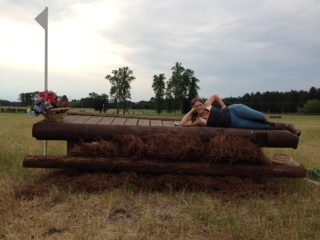
Fence 3 was the giant table that was at the end of my course in May. So right away, the pace needed to be forward and your horse in front of your leg.

Remember this guy? Fence 3, baby!

Remember this guy? Fence 3, baby!

Fence 5 took you through the new Stonehenge complex, which has caused spookiness issues even at the upper levels of competition. Then down and over the massive brush that has made me want to wet my pants. Another fence before hanging a sharp left turn down a hill, then a 90 degree angle turn into a bending line combination. Yikes.

Stonehenge Complex at Carolina International, PC: Everything Eventing

Stonehenge Complex at Carolina International, PC: Everything Eventing

No break after the bending line, because you’ve got to get going again to make it over the huge red bench going up the hill. Followed by collecting again and sitting back into the sunken road at 10 A and B. Then over the trakehner that has made me want to puke ever since I moved up to Novice. Luckily after schooling the trakehner at Running Start, this guy didn’t look quite as intimidating as I remembered. Though I didn’t forget that I could easily sit in that ditch (which I did when I dropped my phone into it in May).

Then up the hill, catch our breath over the up bank down the slope to a rolltop, through the water complex, over one more fence and home free!

Whew.

Tomorrow, a proper recap, and a helmet cam!