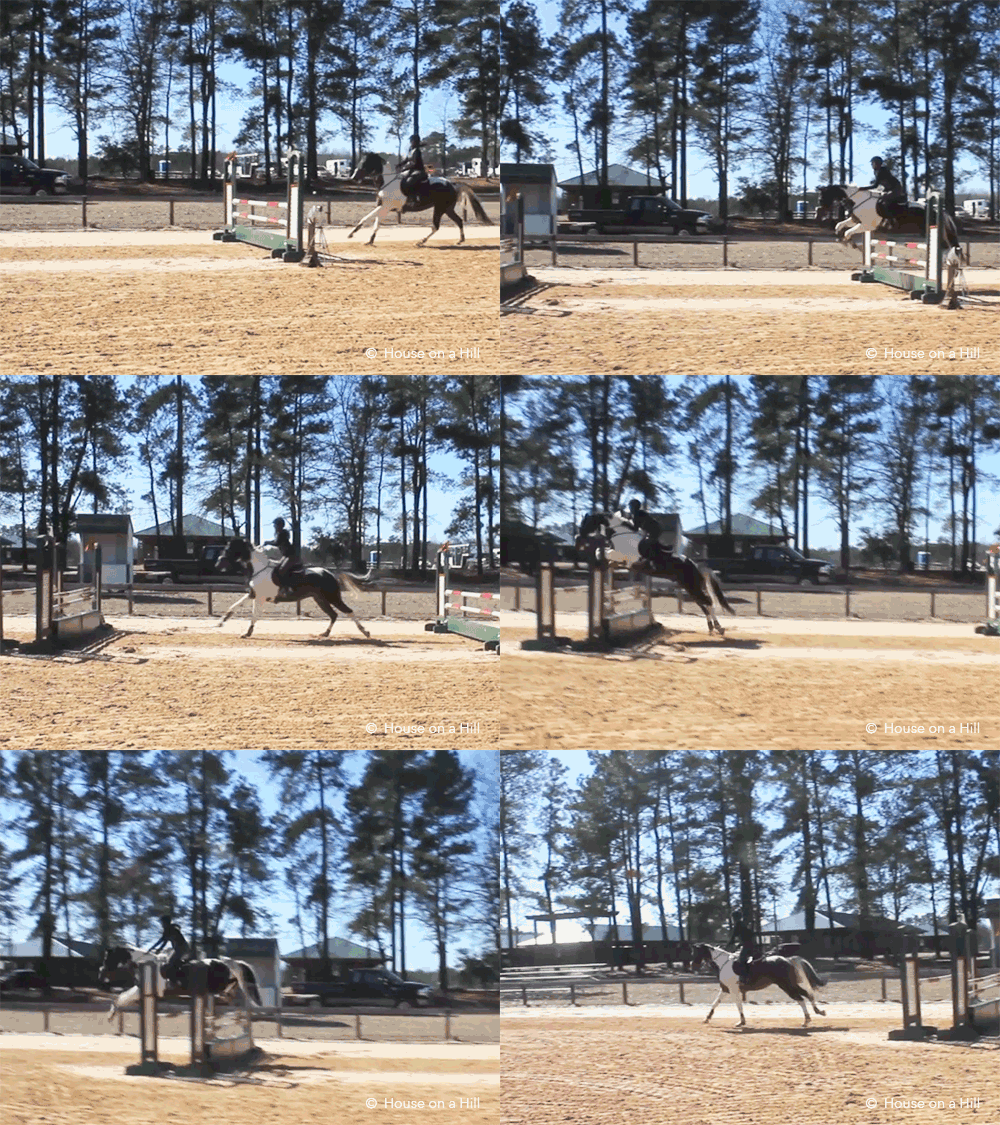
2 weeks isn’t the longest amount of time we’ve gone without jumping by any stretch of the imagination, but still, with the impending show season looming in front of us, it seems like we will never have a chance to prepare.
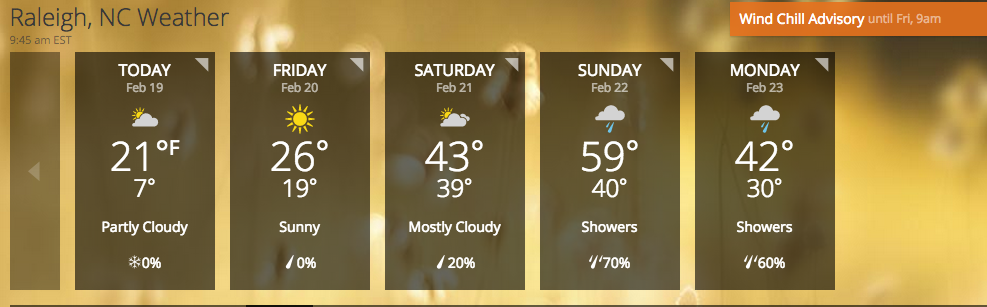
Yesterday we got 2 inches of snow (I’m sure those up north are snickering right now) and expecting (supposedly) another 8-12 inches in the next couple days.
It’s enough that our outdoor arena, which was already under water from the melted ice, will be unusable for some time.
[Thanks Bruno Mars for this song that has been stuck in my head all weekend]
Though the weather has started to warm, and the ice has mostly melted, I find myself having a hard time being cheerful about it. After mentioning my funk to the husband, he observed that this seems to happen around this time every year for as long as he’s known me. Huh. Probably the lack of saddle time combined with minimal sunshine that’s got me down? Really, it’s probably just the lack of saddle time. Damn ice.
Come here human, let me lick you
Foster may have been feeling similarly, as we attempted half heartedly with some dressage work last night in the tiny part of the arena that wasn’t beaten to bits by lessons prior. We’re all waiting the time when the footing in the covered arena will be fixed, but right now as it’s the only arena available (the outdoor being under water, basically), they can’t get in to fix it and we’re all having to deal. If you’re lucky enough to get in there just after it’s been dragged it’s great, but if you’re late to the game (as I was both days this weekend), you end up doing 10 meter figure 8’s. Foster was less than pleased.
Wild man (not really) got lunged on Saturday to see how he was feeling. He was feeling like he would prefer to stand.
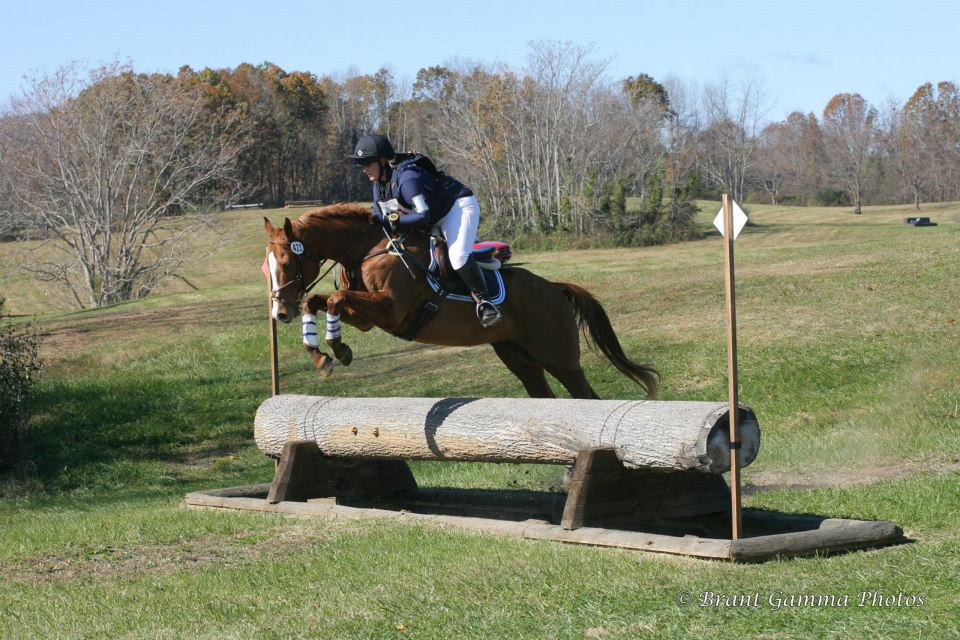
On the bright side, J reminded me that it was the one year anniversary of our first Novice outing yesterday. It was a bittersweet show in a way- our most relaxed dressage test, a clear but fractionally wild feeling showjumping round, and then an awesome XC that culminated in me going into cruise control mode and getting a stupid runout, blowing our chances of getting a 2nd place ribbon. Still, I remember being elated that his Novice debut had only suffered due to rider error- a good reminder for how my attitude should be regarding the clinic move up to Training.
Our first Novice / PC: Brant Gamma
Still, it’s fun to think that a year later, we’re so much improved. The canter has changed immensely, lengthenings are finally coming, and we’re talking about Training with a little less trepidation. Our next attempt is going to come up sooner rather than later, as I’m planning on attending a Combined Training show mid-March. The course should be technically easier than the clinic, although in a smaller arena. My worry is that with all the standing water on the ground, will be get a chance to jump before the show? Guess we’ll just have to wait and see.
News broke recently that the famous Irish stallion, Cruising, has not one, but two clones on the ground. If you are not familiar with Cruising, you probably know his prodigy- Mr. Medicott, or Flexible, for instance, to name a couple. The clone 2 1/2 year old stallions (nicknamed Rooster and Booster), are to be made available at stud to select mares this year. Personally, I was shocked to hear this news.
The late Cruising meets his two clones / PC: Horse and Hound
When we sold our farm, it was purchased by a man with a vision to breed Irish horses (after going through breed books with my parents over the kitchen table, no less). He went to Ireland, purchased himself one grade-A stallion and 10 purebred mares, and imported them to the States. He then bought 40 Belgian draft mares (some halter broke, some not), and started an embryo transfer practice using the draft horses as the recipient mares. For some time we continued to live in the house while he took over the farm, and a little piece of my heart broke seeing half the barn turned into a laboratory. The Irish Draught registry must have felt similarly, and had an absolute shit-fit. They determined that only one foal by a mare/stallion combination could be registered per year. So, if one Irish mare donates 3 embryos that year that become live foals- which one gets registered?
Crusing
I’m sure this rule was at one point overturned (this having happened in the late 90s), but the Irish Draught Society still ruled with an iron fist over their registry books. Getting an Irish horse registered is no joke, including hours of preparation, grooming, and training in hand before going to the inspection in your region. And even then you are not guaranteed approval- we were told to represent one full Irish mare the next year because she wasn’t fully matured in her back end. The approval of Ivan as a registered stallion, an even more rigorous test, then was a huge relief.
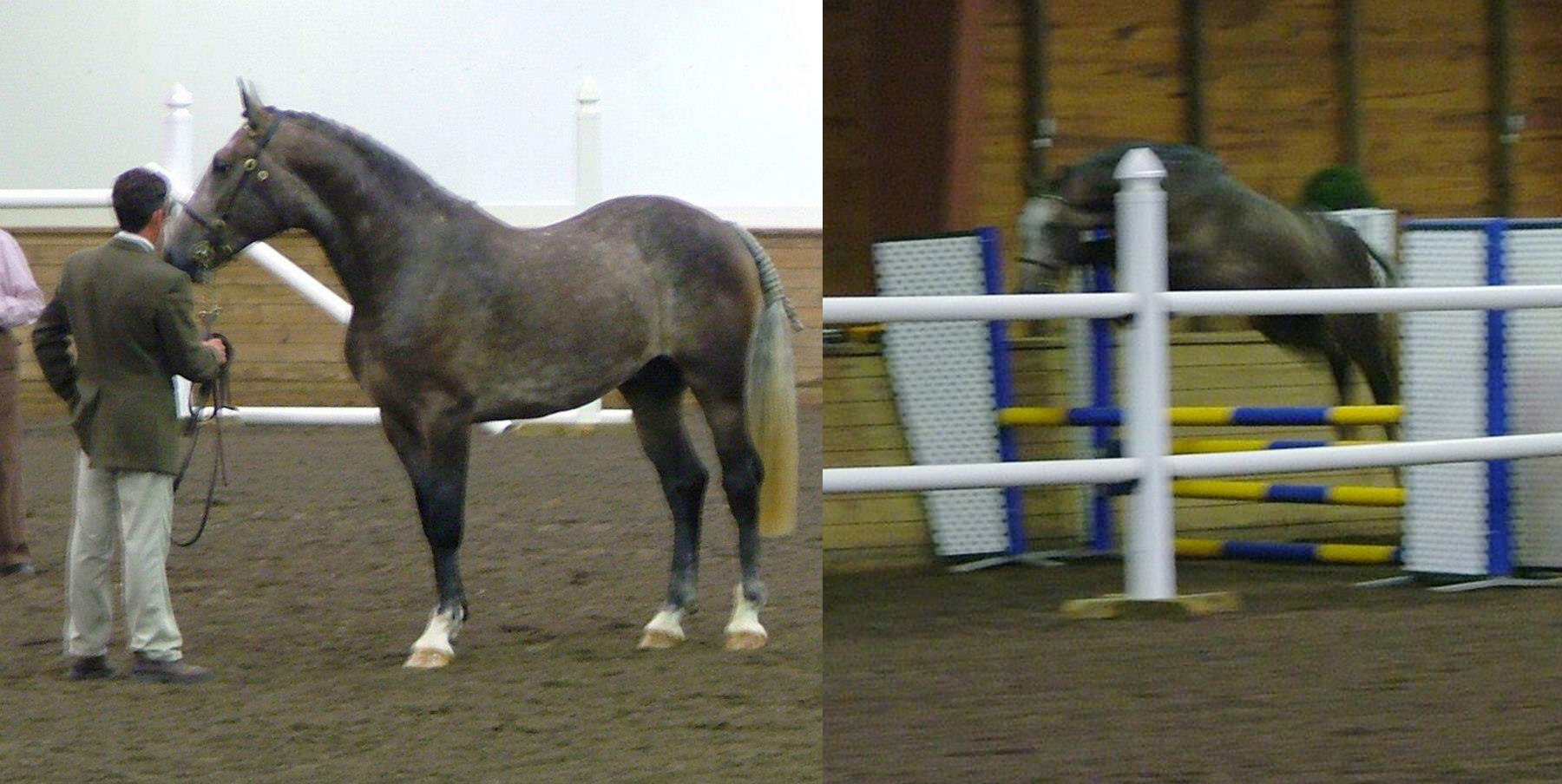
Ivan at his stallion inspection
So, knowing as I do that the Irish Draught Society errs on the conservative side, how did such a prestigious stallion come to be cloned, and the news stay secret for so long? Is it right of them to allow cloned horses into the registry books? What about the multiple clones, such as in Cruising’s case? Personally I’m not fully decided. But I do think if there’s to be a clone for breeding purposes, maybe it should just be one horse and not two, so as to keep the integrity of the breed by not ‘polluting it’ with one genetic line by having it available for the space of three stallions’ lifetimes.
Read the Horse & Hound’s article on the clones here.
Weigh in! What do you think of introducing cloned horses to the genetic pool, and how do you think this will set an example for future generations?
Last night we got hit with a bit more snow, but even so, my office was actually open at normal business hours, so with that in mind and feeling a bit stir crazy at the thought of another day in the house, I decided to drive in.
This post is evidence that I did indeed arrive in one piece, however, after a few moments of precarious fish tailing on some black ice, I think perhaps I should have stayed home. Maybe even more importantly, I don’t think it will be safe to chance driving the 30 minutes back from the barn in the dark tonight. Foster will have to just go on without me.
I feel completely guilty about the situation, especially knowing that going long periods with no exercise is the last thing he needs. But if I can’t get back in one piece I won’t be good to either one of us. Essentially, this week is a wash.
At least the weekend is looking promising, so I’ll just have to hope that I get out to the barn Saturday and get some quality time with Foster. In the meantime, I am extra grateful to the barn staff who are handwalking the horses in the covered, since all the paddocks are sheets of pure ice.
Here’s hoping all of you are staying warm and safe, be careful out there!
Winter weather has officially hit North Carolina (and seemingly a lot of other places too), so obviously, pretty much everything that can be closed is closed. And of course the problem with living in a house on a hill is that when said hill ices over, you’re pretty much stuck anyways. So if you want to find me, I’ll be in my sweatpants working from home the next couple days.
The upside to all this is that everytime I look outside I think of this…
… and therefore sing all four parts to my husband, complete with cheesy railroad noises. I like to think I’m adorable, but I’m probably just hurting my chances on getting that next blog post out of him. Whatevs snow snow Snow SNOW SNOW!!!
Before the ice storm hit, I was able to squeeze in a dressage lesson and discuss the feedback from the clinic. Foster had a couple days off after the clinic, then a long stretchy session to work out any kinks, so even though I hadn’t dressaged yet since the clinic, it was still helpful.
Basically the lesson was a repeat of lessons before in that there was a lot of emphasis on transitions within and between gaits, lateral work in the form of shoulder and haunches in, and more work on our lengthenings. Foster’s still figuring these out to some degree, and part of how he is dealing with the added ‘pressure’ of the lengthening is to curl under, so I’m learning how to get his poll up and keep him going, or for now, come back to the walk then try again.
One of the most aggravating parts of my test was getting that 5.5 on the free walk, and so we worked on getting him to really take the extra stretch without rooting. Part of solving this problem includes my moving my hands towards his mouth (i.e, pushing my elbows to the fence!) so that he has even more ‘place’ to go. So obviously this is a feeling that I need to get the hang of in order to get the most out of my horse! Funny how habits transcend disciplines!
It seems like it’s been a long time coming, but the moment is finally here to discuss how our first Training course went.
But before I get ahead of myself, let’s talk about the warmup. Lizzie Snow handled warmup, and I was glad for it. I won’t lie when I say I was fairly shaking in my boots with trepidation the whole week leading up to this, and visions of destroying my horse’s confidence by landing him in the middle of a meter-high fence plagued my every other thought. So the first thing I did when I got to Lizzie was tell her- I’m anxious about this, this is our first try at this level, and please don’t let me die (OK, so I didn’t say that last bit). Thankfully Lizzie exudes a kind of quiet confidence, and kept us going and talking us through each and every fence.
One thing we talked about before warmup was the approach we would be using that day. Instead of riding the cross rail, then the vertical, then the oxer as I normally do, she wanted each rider to start over to oxer. It could start at a small height and grow to the competition height, but jumping the oxer would help horses start thinking forward, and help the riders not focus on the spot. Also, an ascending oxer would help horses with their shape over the fence, but ending with a square oxer as you will typically see in the ring was key. We would finish over the vertical before going in the arena to reinstate balance, and that was it. A lot of what she also focused on with me was getting the forward canter (Foster feeling quite on the sluggish side, as per usual) and not losing energy through the turns. We also revisited the vertical a couple extra times because I started pumping to it, and Lizzie wanted me to have a quiet upper body and get a balanced ride to it before going in the arena.
After that, we caught our breath for a hot second before starting our course. At this point in time I think we were both a little tired, but I was not going to quit now, and did my best to keep the forward pace through the course. Where I got into trouble was the second one-stride combination coming out of the corner. We lost impulsion at the last stride, making it over the vertical but not forward enough to jump the second element. Totally understandable refusal, and after standing about like a deer in headlights thinking the clinicians would talk to me about it (they didn’t – whoops), I picked up my canter and re-approached.
Following the course, Bobby Costello talked to us about how it went. He thought that Foster was acting a bit like a deadhead (which he maybe was that day) and that I needed to give him a lot of extra support in the energy department. The big observation he made was regarding my elbows. While in my mind I am following his mouth, every time my elbows come back I am actually taking a little of his forward canter away. In Bobby’s words, even if it’s only 1% that I’m taking away, over the span of the course that adds up and eventually saps my forward energy. Instead, I need to think about pushing my elbows towards the fence. He praised Foster for being game going through the one stride on the second go, and decided we wouldn’t revisit that particular element. Instead, we went back through fences 1-6, which included the oxer-to-vertical one stride, focusing on pushing my elbows to the fences.
Although he took out the last fence, the second course was a much better ride. It felt much less sticky, even though Foster ignored my ask for a simple change up to fence 3. Bobby’s advice on this was that we need to get the lead immediately after the fence (2, in this case) and if we can’t get it, canter on. Foster will absolutely be visiting simple change bootcamp soon, because that nonsense doesn’t sit well with me. I also realized that I am not helping with my tendency to lean left, essentially blocking him from picking up that lead after fences. Responsibility on both ends, I guess.
Before we left, Marc also chimed in, saying that it would ride smoother if I remembered that bending lines are like combinations, and not to ride them as completely separate fences. This particularly applied to the ride from fence 1 to 2.
For myself, I think increased fitness would have made this task a lot easier for both of us. Looking back I really did squeeze in just a few jump schools to get ready for the event (my calendar says 3-4 jumping days since November) and that probably wasn’t enough to get us in jumping shape. Foster and I both came off the first course winded, and after the second course we definitely earned our couple days off. But improving our cardiac fitness (and my calf strength, ha) should make getting the forward canter easier, and leave him with enough leftover energy to be more responsive to my cues.
And so we end our recap of the clinic, with a bevy of information to ponder while the winter storm keeps us locked away. All in all, I found the clinic to be a massive success in that we didn’t die, I didn’t wet my pants, and we have a lot of homework that will prepare us for success our next time out. Huzzah!
Obviously the course walk doesn’t leave me with cool action shots or video, but I’m telling you, that doesn’t make it any less interesting. The discussion we had really made me recognize how much detail goes into planning stadium courses, and left both J and I with a newfound appreciation for showjumping in general.
Group selfie after the knowledge drop
Speaking of J, I really must give credit where credit is due and thank her for getting up at the butt crack of dawn to come with me to the clinic! Not only do all these photos/videos exist because of her, but she is probably the main reason why I didn’t pee in my jods before our showjumping time. Big big thanks from me!
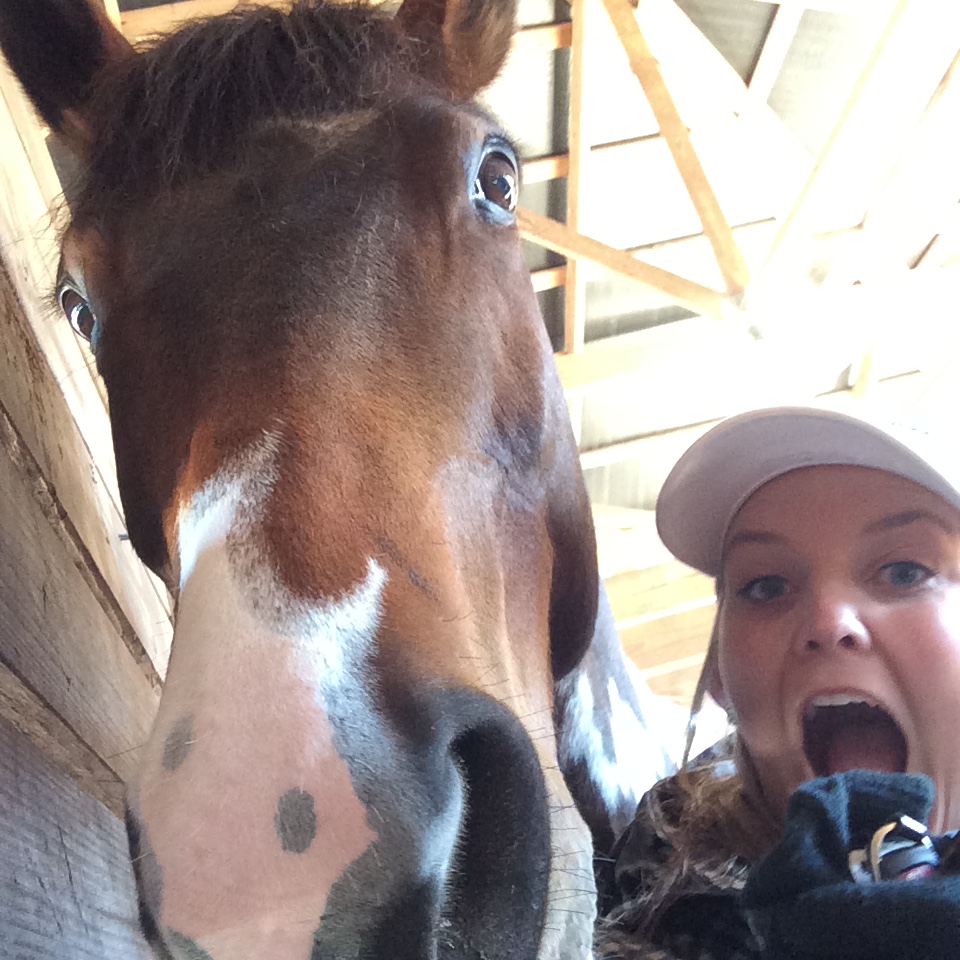
J teaches Foster about selfies
Anyways, back to the clinic. We started at the course map itself, and Marc Donovan (course designer) talked us through all the details that go into this small piece of paper. According to Marc, most designers now make the course sheet to scale for the arena, and he takes care to measure every arena he works with. Decorative signs or bushes placed about the arena are also included, as well as a dotted line path that shows exactly how the course was wheeled off.
The Training course
We learned about the parameters designers typically give themselves, such as changes in direction (a good course has 3) and ideally having an equal number of jumps off of each lead. Marc discussed his particular tendencies in his designs, which are often twisty-turny and on the ‘long’ side, requiring a definite forward ride. As you can see above, the day’s course was no exception.
L to R: Lizzie, Marc, and Bobby at fence 6
We then proceeded to walk the course, with Lizzie Snow and Bobby Costello coming along to ask questions or add their thoughts about how to jump a particular fence. Without going into every detail discussed, here’s the bulleted version (also thanks to J! These notes are a testament to her clever multitasking skills during the walk):
‘Hold’ your shoulders to verticals
Anything more than 7 strides is no longer ‘related’ and you shouldn’t worry about counting strides
You can go backwards through the start flags, and through the finish flags whenever, without penalization
It generally takes a horse 2-3 strides to turn, so when you walk a bending line, walk 2 strides straight and then begin turning in the third stride
Mental Technique: Split the course into sections so that you can focus on a smaller section and reevaluate as you go along
Ride each fence individually, even in the combinations. Focus on the first fence first.
Continue riding through all the turns, focus on turn and then the combination
The more you square off a turn, the slower and more ‘snug’ you will get to the fence
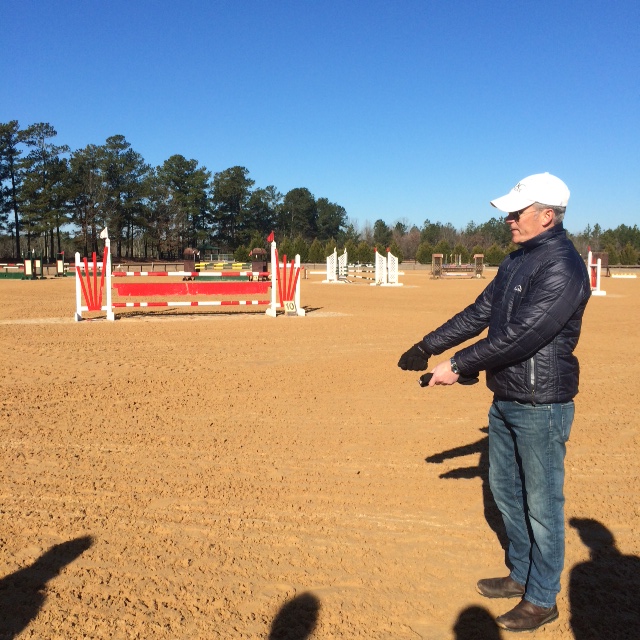
Bobby Costello shows us how to use both hands and outside aids to make a turn to 9
Oxer/vertical combination typically rides longer than a vertical/oxer combination
In an oxer, the first rail is the responsibility of the rider, the back rail is the responsibility of the horse
Ride the front rail of the oxer, not the back rail (your eye gets too long)
When adjusting distances between fences for time/positioning, canter should stay the same throughout but the track you take should change (so swing out wider in a bending line to go slower instead of slowing down the canter)
Take shorter lines for more impulsion and momentum (make tighter turns is where this really applies)
In combinations, land and in the following stride, make the adjustment, not 3 or 4 strides after landing
As you can see, we were imparted with an absolute wealth of knowledge. I’m not overstating when I say that this will completely change how I walk courses in the future. I also realized (even though I may have suspected before) that in showjumping, it’s not just about the fences, and every step must be considered just as in dressage. You can be sure I will be studying these notes and trying to replicate these thoughts in our future stadium rounds.
I hope you all have a great weekend, and I will be putting together a jumping video for next week! Stay warm!
Wow. Let me just say that again- WOW. I feel so much wiser having attended the clinic at the Carolina Horse Park yesterday, and can’t wait to write it all down!
Even though the clinic format was 1) course walk, 2) dressage, 3) jumping, I feel it’s worthwhile discussing dressage first. We warmed up on our own, and while it was cold and a bit windy it remained sunny and the footing quite nice. Foster felt in fairly good form, though a bit short in his neck, so I decided to post the trot to keep his back soft. We did a few transitions, and a couple lengthenings in both trot and canter before heading into the arena.
I thought we put down a fairly good test, minus a couple bobbles. During our canter lengthening, the horse in the adjacent ring spooked, causing Foster to spook in turn. Luckily I was able to get him back to save the next movement, the downward transition at X, but that still unsteadied me slightly. His upward canter departs need revisiting a bit, he almost broke in the medium walk, and he has picked up the fun new habit of rooting in our free walk (advice here anyone?) which brought our normal 7-8 down to a 5.
After the test, Will Faudree, our ring judge, walked us through his thoughts. He was quick to ding us on the bobbles, and noted that he really expected these lower level tests to appear seemless, rather than as punctuated movements. There was also lots of advice on how to be a better test rider- for instance, by preparing and executing the transitions on the long sides of the arena (the walk at H and last trot at K) a little early, since to the judge’s eye they appear late if done exactly at the letter. Also he pointed out that by starting my centerline well outside of the actual arena, it gave him longer to watch any waviness of Foster’s hind end, and suggested starting the centerline closer to the arena so as not to give a bad impression too early. Will then went through each movement of the test and his thoughts as to why he scored the movement as he did, which was of course vastly helpful in understanding the score sheet.
This test would have earned me a 66.4%, or 33.6 in an actual event. I definitely walked away knowing that we have homework to do to bring those 5’s up, and I’ll be damned if we’re going to start getting anything less than 7’s on our free walk. However, this is an encouraging start, plus we accomplished our first goal for 2015!
Get a 7 on a lengthening
They still need help, but apparently 7’s are within our reach!
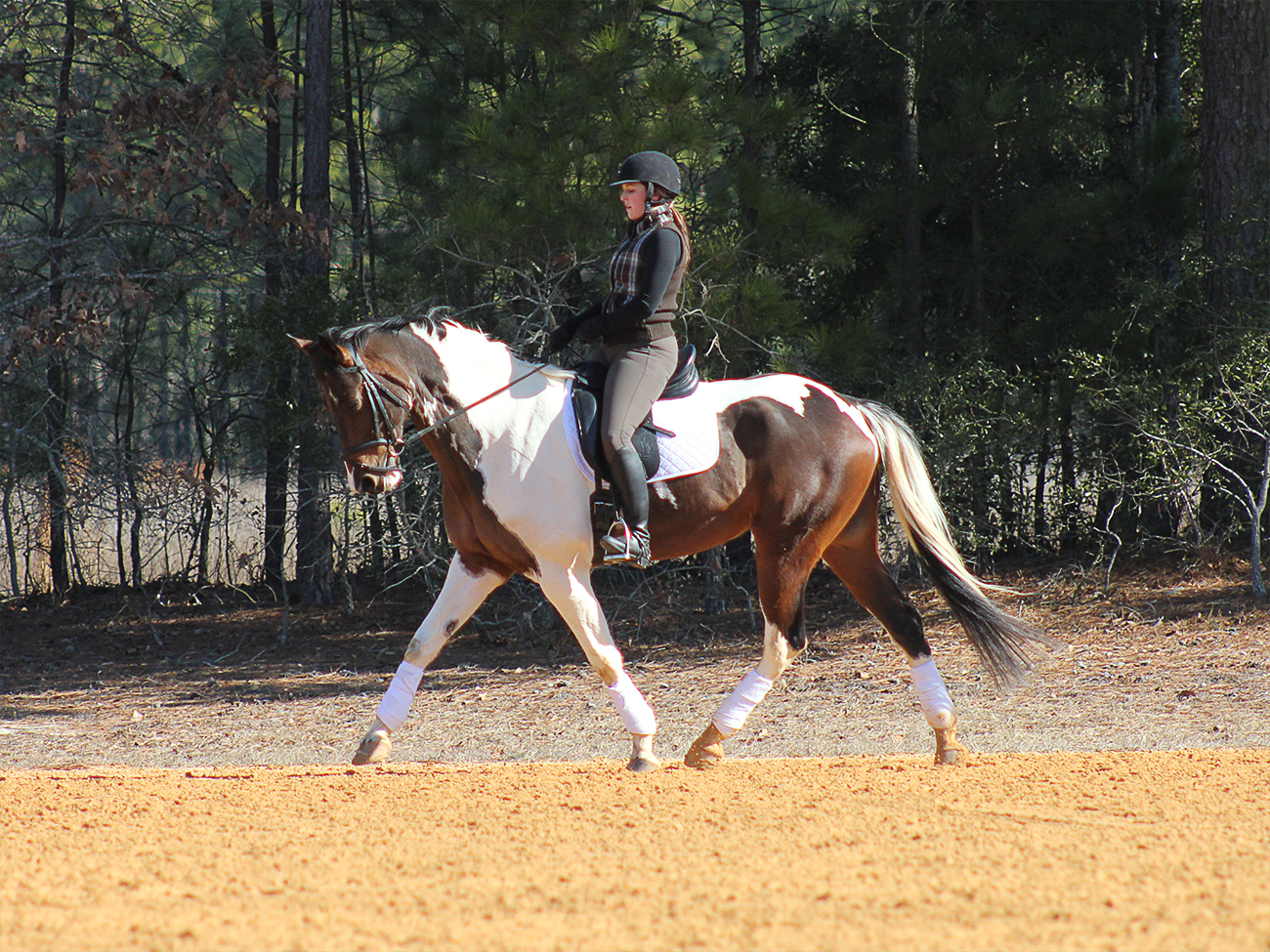
Warm-up lengthening
All in all we walked away with our head held high, and I can’t wait to put all the wonderful feedback to good use!
Not for the first time in my life, I have been taken advantage of by someone in the horse industry. It’s been on my mind on and off (but more on) for the last several months since this incident, so it’s probably worth writing about, at least now that it appears to be finally on its way to being resolved.
Last August I signed up for the Virginia Horse Trials, a schooling event that takes place at the Virginia Horse Center. I had only heard good things about the facilities, and looked forward to trying out a new and promising venue. Then, a week before the competition, I got sick. Sick enough that I couldn’t work even at my desk job, making the 4 hour drive and subsequent cross country riding look like a really daunting prospect. I noticed that VHT had already cashed my checks, so I gave them a ring and confirmed that if I scratched on the closing date that I would get a full refund. They assured me I would, and so the next day, still no better, I both sent an email and left a voicemail with my decision to scratch. The ride times were posted the next day, without my name on the list- good, they’d gotten my messages.
J rocking around the Novice course at VHT last year / PC: Brant Gamma Photos
Fast forward another few weeks. I started checking the mail with an eye for a letter from Virginia, but none came. I emailed VHT once again, asking about my refund (almost $200, by the way), and no response. Called and left a voicemail, and no response. Repeating this process every 1-2 weeks became an exercise in my patience. I became incensed- if a venue promises a refund on their website by a certain date, they should honor it. Or, don’t promise refunds, in which case I would have loaded up on Red Bull and dragged my sorry behind to the event. My resentment eventually led me to social media.
Virginia Horse Trial’s website
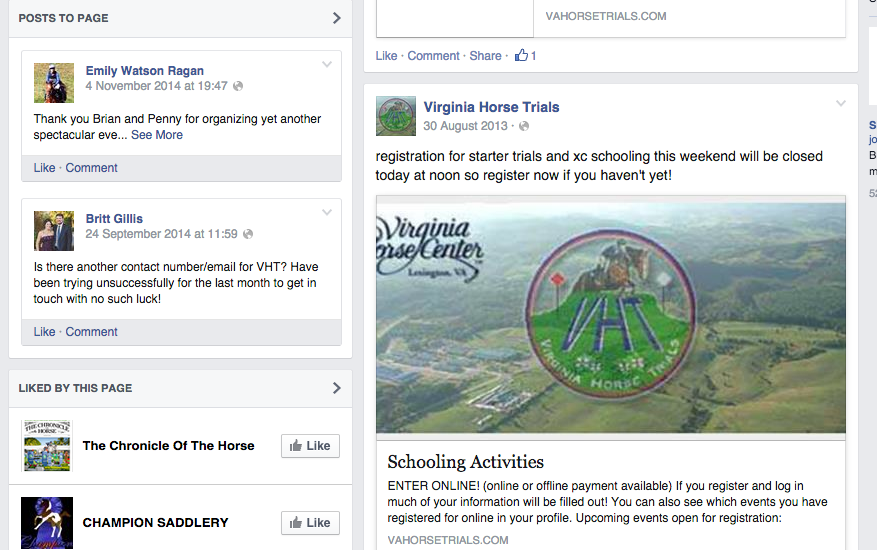
I tried the venue’s facebook page, and again, nothing. Then I cast further, to the broader Virginia eventing association, and found out that I was not alone in my refund pleas.
Virginia Horse Trail’s facebook page
None of my leads followed through. I continued calling every month or so, noting that VHT’s voicemail message had changed- how could they not have received my messages? Friends signing up for their current shows similiarly assured me that their emails were responded to in a timely manner, convincing me that I was purposely being ignored. Around December, I started to give up hope that I would ever get my money back, and vowed to never give this venue money again. I started debating if it was worth having the lawyer husband write them a strongly worded missive as a last ditch effort, and to soothe both of our frustrations on the subject.
J and the VHT Trakehner again (this fence makes me pee my pants) / PC: Brant Gamma Photos
The finally, last month, I had one more brain wave. I emailed Eventing Nation, that hub of all things eventing, thinking that if they didn’t know someone directly maybe they would write a post about it. You know, go all whistle-blower with the business. To my surprise, they forwarded my email to the new owners of VHT, and I got a response the next day.
EN to the rescue
While it seems I won’t be getting my precious dollars back, the new owner has offered me a compromise- a free entry to the Recognized horse trials this May, a $200 value. This gesture, though it requires me to spend money on gas and a renewed USEA membership, goes a long way in feeling like the right thing. Before they can back out of it, I’ve accepted. We’ll see if they follow through or not, but I’m hopeful that the event will be a happy ending to this extremely trying tale! While I didn’t plan on any recognized shows this year- maybe this (and my new USEA membership) will open up other recognized opportunities later this season!
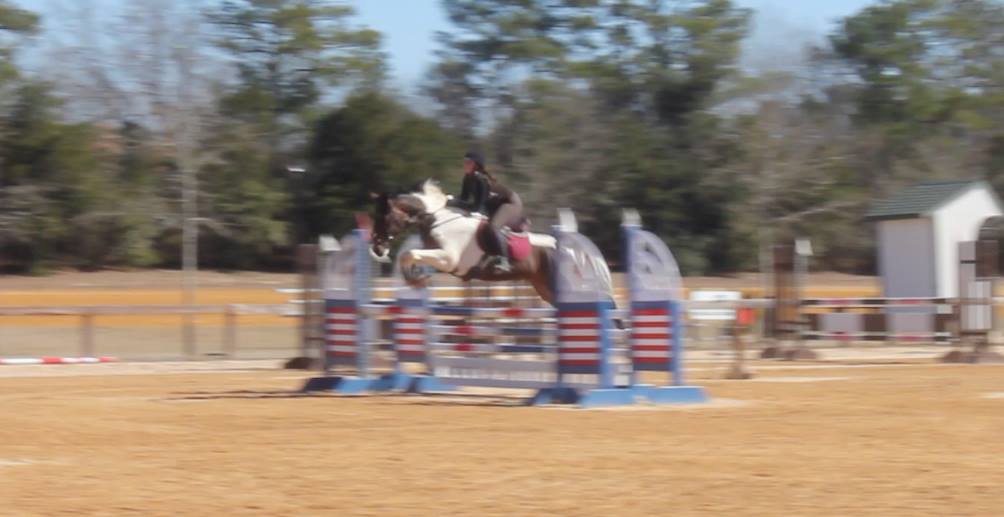
Well, we did end up schooling over fences this weekend, but several factors, including an odd spike of anxiety on my part, derailed the session and I’m doing my best to forget it and just remember the awesome-sauce practice we had a few days earlier instead.
Otherwise we had a dressage lesson yesterday, and I asked Eliza to get on for the first half and feel out the lengthenings and counter canter. Overall it was nice to hear that he felt better in the connection, a little straighter, and overall a bit stronger behind. Thumbs up from me for justifying spending all that dough on hock injections.
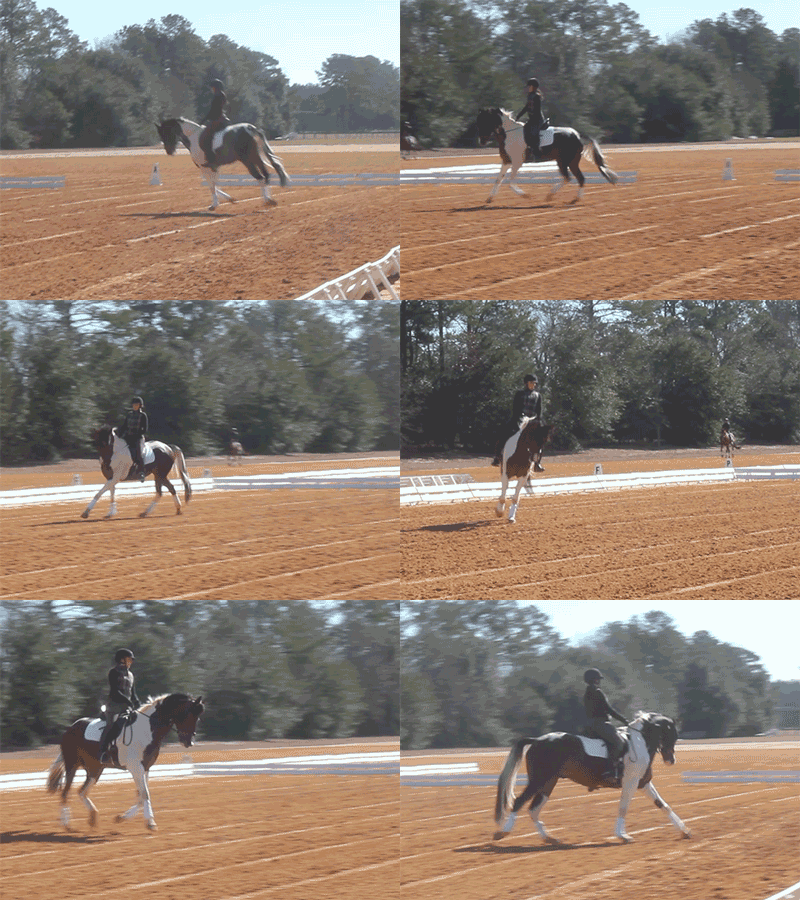
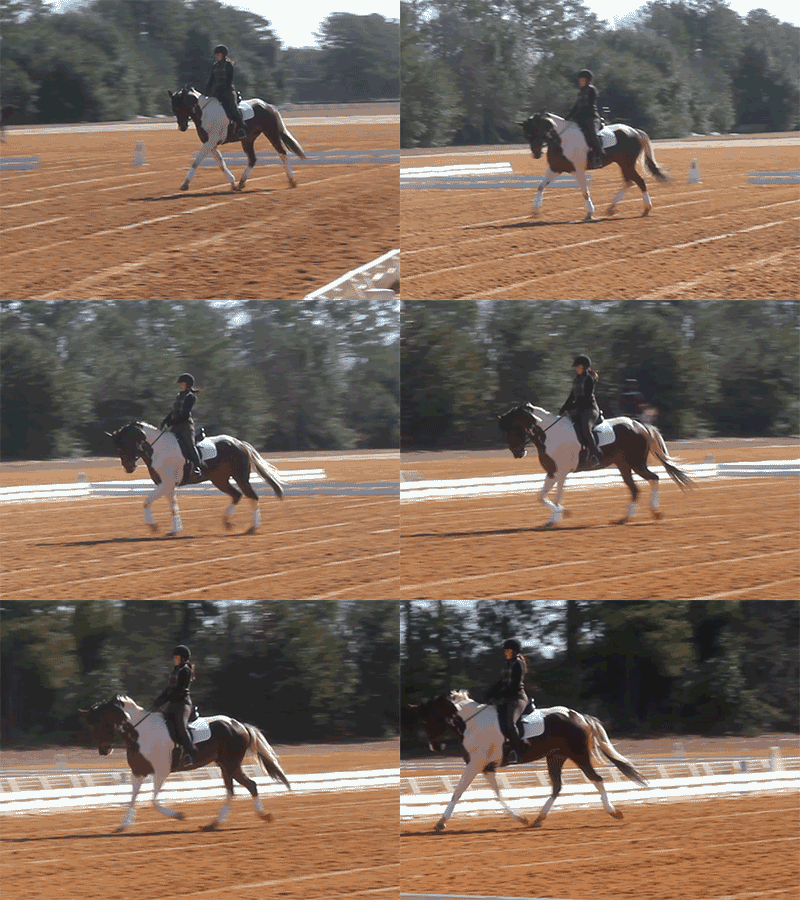
It was super helpful to see what a professional could eek out of Foster’s lengthenings, which I’ve described before as lackluster. Horses of the past loved lengthenings and were more than willing to make the transition with enough gusto to spring me from the saddle. Foster, not so much. So seeing what she could do gave me a visual that I could reference when I’m working on it on my own. He’s still green in them and wants to tuck a bit, or break to canter, but there is some lift starting to happen through his shoulder and definite push from behind. After getting on, I was able to replicate some of the good steps, and I know it’ll get better over time.
Excuse my video skills, I was trying to listen while watching/videoing:
Things I took away from the lesson include another technique for not sticking my elbows out like a chicken, and that I really need to practice holding my dressage whip in my left hand. Foster does not appreciate it bumping all over his body.
The plan is to give us both today off, and tomorrow review a few dressage movements in a light ride so as to conserve energy for the clinic!


 Please, spring, hurry. We need you.











 Red on the Right