Let’s Discuss: How many miles

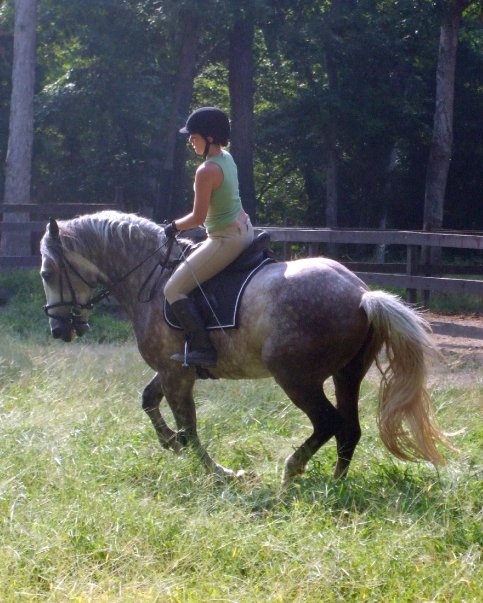
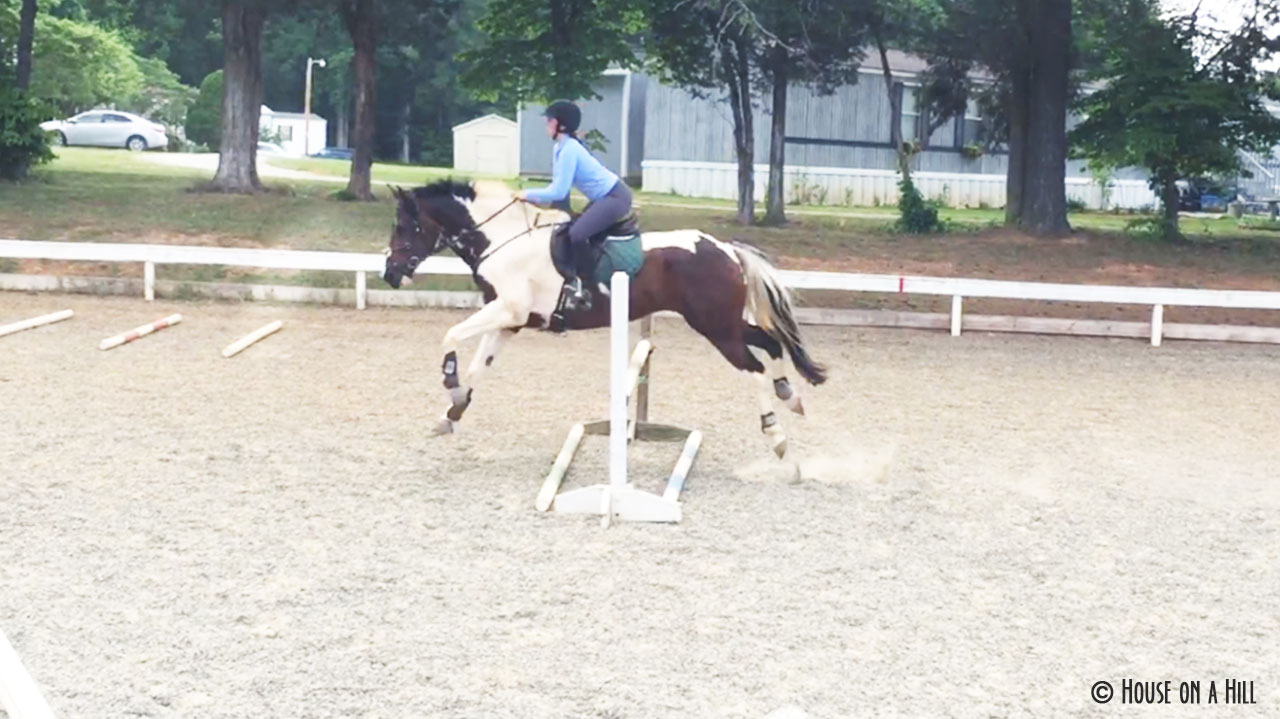
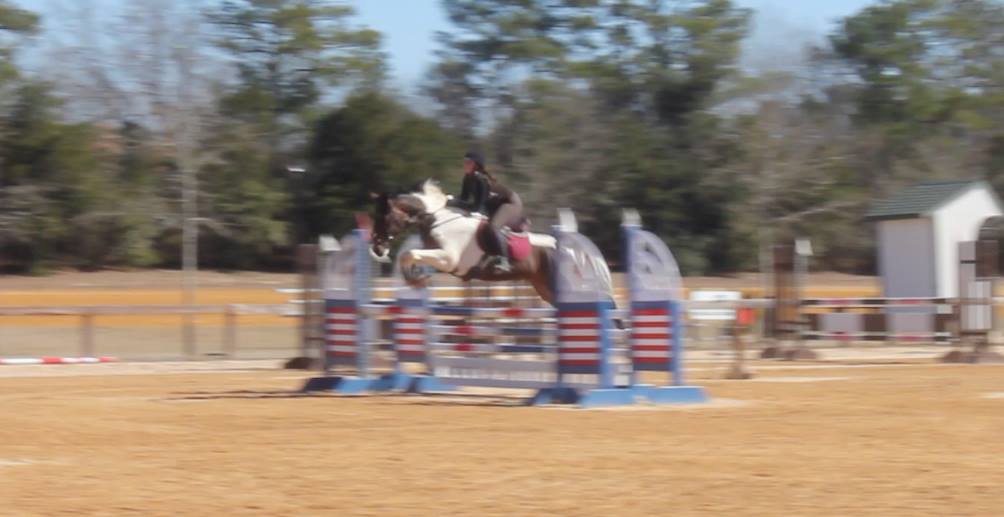
If you were to check out Foster’s competition results over the years, you may notice a trend.

I love going to the Carolina Horse Park.

I mean, what’s not to love about this place? The footing is always perfect, there’s tons of warmup space, the schooling shows are immaculately run, and oh yeah, it’s just over an hour away.

October 2014 @ CHP. Even after torrential rain the footing held up just fine

Novice, October 2014 @ CHP. Even after torrential rain the footing held up just fine

Being close to Southern Pines makes for a convenient trip for schooling, lessons with BC, and knocking about CHP. In fact, I plan to be there again next weekend with Riley’s faux-show debut.

Other facilities that my friends frequent include FENCE (and now the Tryon center) and the Virginia Horse Park, all about 4 hours away. Aiken and all of its eventing wonders is roughly 6 hours away. Hunter jumper shows at Sedgefield are less than two hours away, and that sounds perfect for the occasional HJ foray.

J and the VHT Trakehner / PC: Brant Gamma Photos

J and the VHT Trakehner / PC: Brant Gamma Photos

But to me, it takes a really special reason to make the 4+ hour drives. For instance, I traveled to FENCE for our recognized show debut with Foster, but I’m not sure that I would do the same for a schooling show. After experiencing the bendy, mountainous drive to Virginia, it would probably take even more than that to get me up there.

My friends make fun of me, because I go to CHP so darn often, but an hour drive to a horse show is more than appealing to me.

What about you guys? How far away are your local venues? How does travel impact your equestrian activities?
Let’s Discuss: Neck straps

Not too long ago, amidst some random equestrian googling (side conversation: am I the only one who does this?), I came across an interesting little ditty featuring the prodigious William Fox Pitt touting neck straps.

As one of the many (I assume) that falls prey to jumping anxiety from time to time, I’ll gladly add something to my mount’s attire to make the experience safer. It wouldn’t hurt of course if the addition of a bit of leather around my horse’s neck also increased the size of my jumping balls. (Which are scientifically proven to be a smaller, much less impressive size than my dressaging balls, but yet still prove to be massive compared to my trail riding balls. There’s a difference.)

A time when I had bigger balls. Kind of. Actually I remember being terrified walking that course.

A time when I had bigger balls. Kind of. Actually I remember being terrified walking that course.

My original assumption regarding neck straps was that they came in two forms- a leftover stirrup leather, or a belt. The C4 belts seem to be growing in popularity recently in the eventing world, and little wonder- we eventers go ballistic over anything that can be customized to our cross country colors.

It turns out though that there are a variety of neck straps on the market though- ranging from colorful nylon versions akin to the C4 belts, to thick stirrup-leather styles, and more. The type that appeals to me most is the Nunn Finer version, but I may just be falling prey to the clever product description. Because who doesn’t need an Oh Shit strap?

Grab strap

So, blogosphere- I want to know- how many of you follow WFP’s lead and don your horse’s neck with some extra hardware? Have any of you found the neck strap to be useful, or otherwise? Is this just a cross country thing, or does it translate to showjumping or even flatting as well? Comment with your thoughts!

Let’s Discuss: Weathering the summer weather

Summer in the Carolinas is defined by mugginess and heat. Unless your chosen sport is air conditioned (or swimming), exercising outside in heat-stroke inducing temps, in humidity that could drown you, isn’t for the faint of heart.

As being one of the tomato-faced clan when it comes to exercise, I don’t paint a pretty picture in the summer. But pushing looks aside, continuing to ride is important to me and so I soldier on, armed with tank tops and extra water bottles in hand.

I try to ride when it’s below 90°, but that can be tricky on the most scorching days of the season. Anything above 95 is an absolute no. I also like to hide in the covered arena unless it’s ultra early or late in the day and the sun is hidden. And of course I try to watch the horse’s breathing and make sure he’s not getting overheated as well.

As the mercury continues to rise, how do you guys prepare for higher temps? Do you have any pre or post ride tips to help cope with the heat? What do you do for your horse to help him adjust?

Let’s Discuss: When to start a horse?

You may have picked up from recent posts that I am looking at babies (or tweens, however you want to classify 3 yo ponies) that have not been started in addition to horses already under saddle. With these horses I have to consider when and how they will be brought under saddle.

For myself, I have done the following as far as starting a baby horse:

  • Teaching leading, cross-tying, desensitization, bathing, clipping, fly-spraying, etc
  • Introduce bridle and saddle
  • Sit on horse for first time
  • Ride horse with <10 rides under saddle

… And onward from there. It’s my own personal opinion that the time to start horses depends largely on their bodies. Some breeds mature faster than others and can then be started earlier. Haflingers, for instance, are typically started at the age of 2, though I wouldn’t recommend any really heavy work until later. The Irish Draught gelding pictured yesterday I would start immediately, but hold off jumping for another year.

Introducing tack to a baby

Introducing tack to a baby

A lot of warmbloods mature a bit later, and need more time to grow before getting started under saddle. With these guys, I would prefer the approach of throwing on tack, learning to hack, walk trot and maybe cantering under saddle, and then being chucked out in a field for a season to grow up and just horse. Then, assuming they have matured and everything appears a little more “in place” with their bodies, they could be started in a light program with gradually increasing workload.

Riding Mac as a 3 year old

Riding Mac as a 3 year old

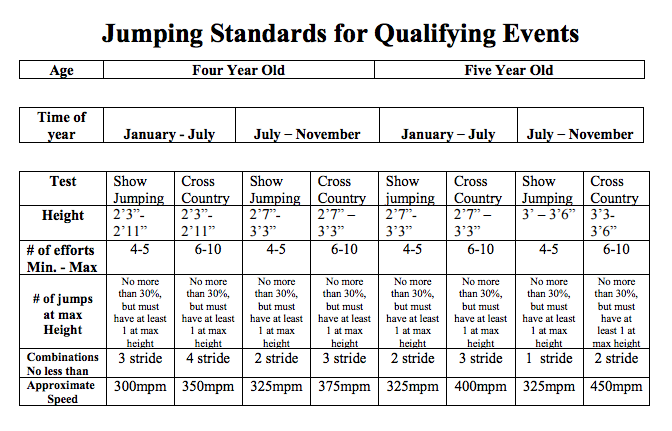
With both of these scenarios, I think it’s important to wait to jump until the 4 year old year. Sure, start them over poles, cavaletti, and maybe some teeny tiny fences, but I think its better to treat those joints as being precious rather than attack a full jumping program. Personally, that’s why the Young Event Horse program makes me a little edgy- if these horses are competing at basically the novice level for these competitions, they are presumably schooling higher at home on a regular basis. Jumping a 4 year old that high makes me cringe a little inside thinking of those fragile joints. I know there are those that will disagree with me, but hey, my blog, my opinion.

Young Event Horse Jumping Heights

Young Event Horse Jumping Heights

What are your thoughts on starting horses? When is the ideal time to get a baby under saddle? Do you have a certain approach you prefer, or an approach that you abhor?

Let’s Discuss: Rider Conformation Faults

I spent some of the weekend visiting with best friend N, and yesterday got to hop on her one-eyed wonder mare, Rea, and her mom’s mare, Ace.

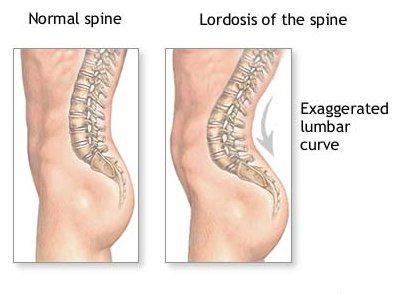
While Rea rode a lot like Foster, Ace immediately called me out on my biggest conformational fault- my hollow lower back. A yoga instructor once told me (how’s that for a professional diagnosis) that I had lordosis of the spine – in horses we call it a dippy back, or sway back. In humans it looks like this:

lordosis1

All I know is that it’s something a couple instructors have caught on to, but tends to fade into the distance after a while. N’s mom worked with me to get me to “fill” my lower back to release the tension there, allowing my pelvis to swing and get Ace to relax and swing her back in return.

Some of the visualizations included putting a hand on my hollow back and trying to fill it up, or push against it with my muscles (which engaged core muscles I realized I haven’t used in some time!), imagining I was widening my lower back, or stretching my shirt in that area. All these were super helpful, and while it will definitely take some time to make a relaxed, non-hollow back muscle memory, gave me a lot to think about in the meantime.

What about you? What is a personal “conformation fault” that you deal with? How do you overcome it, or how does it affect your riding?

Let’s Discuss: The Selling Process

If you’ve never sold a horse before, the best way I can describe the experience is that it can be extremely fulfilling (to pair a creature with another human and take pride in it being a good fit) and yet extremely frustrating (because you have to find an interested person to make a perfect fit with a creature with a mind of its own).

For the most part, it ain’t easy.

I know there’s a lot of people out there who could never consider selling a horse, and I can absolutely appreciate that. As equestrians we pour much of our hearts, souls, and pocketbooks into our horses, and it’s hard to watch all that emotional and financial investment walk onto a trailer and drive off into the sunset.1930067_571154394969_1242_n (1)

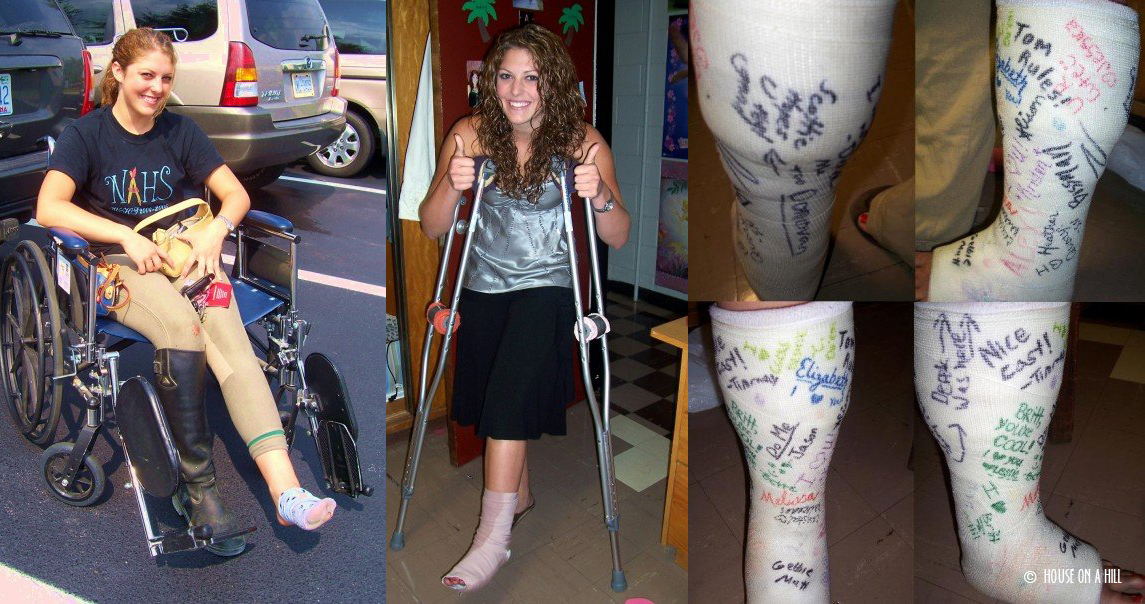
But for me, sometimes selling a horse is the right thing to do. I sold Ivan because even though I loved that big lout, he was occasionally dangerous to my health, and it wasn’t worth losing limbs or life in pursuit of a hobby. It also happened that I was a fresh college graduate in search of my first full time job, and while searching simply could not afford the luxury of a horse.

The progression of my first Ivan-injury

The progression of my first Ivan-injury

Even though I feel like those are excellent reasons, there are those who disagree, that believe that a horse is a lifetime pet. Again, respect to you guys. I want to have that horse that I keep forever, but sometimes circumstances make me decide otherwise. C’est la vie.

When those unfortunate decisions have to be made, I make a real personal effort to make sure the decision is just and valid, and then, quite frankly, attempt to emotionally distance myself from the animal. Isn’t that how breakups go? It doesn’t mean that you necessarily love the creature any less, but for a while you build a wall until you are strong enough to tear it down and appreciate the memories that you stuffed behind it. If you’ve been reading this blog for any amount of time, yes, I am going through a similar process with Foster. Like I said, it ain’t easy.

What are your feelings on selling horses? Is it right- is it wrong? Have you had to part with a four legged beastie in your life? How did you approach the situation, and what advise would you give others going through similar scenarios?

PS- Life is cray right now between houses and horses and work, so expect a couple weeks of not-so-often blog posts. I will be back with updates on the House on a Hill 2.0 once the dust settles again.


Let’s Discuss: Your Fairy Tale Foal

There’s a chance I may be horse shopping in the next few months, and goodness knows I’ve been window-shopping hard core. So it’s got me thinking about bloodlines- what is the perfect mix for me?

I’ve always dreamed about having a Connemara X Thoroughbred cross. To match the sturdiness and cleverness of the Connemara with the stamina of a thoroughbred.. talk about an eventing machine! But alas, the rarity of the Connemara, and lack of available crosses, makes these guys a high ticket item.

Flynn, a lovely Conn X TB gelding

Flynn, a lovely Conn X TB gelding

Then recently I’ve turned my mind to warmbloods. There’s a gelding in the barn by Donnerhall that makes me swoon every time he floats past, and it makes me think, wouldn’t it be nice to own a beastie like that. Surprisingly horses with these bloodlines are easier to find, a quick search on dreamhorse turns up roughly 50 sales ads. And I’m not educated enough on which lines are good (as in amateur friendly, sound, etc) and which ones to avoid, so I flail.

fb_DSC8758

Now if we were to talk Irish Draught and Haflinger lines, I could happily hold a conversation about my favorite sires (Touch of the Blues and Nobleman, respectively), and make an informed decision. But those breeds, while I love love love them, probably aren’t what I’m looking for right now.

So, friends, I give you this opportunity to teach me, and tell me what your dream horse would be made of. What would you want? Any advice for stallions to avoid? Sires to look for?

Let’s Discuss: Footwear

Since the last discussion around socks was way more polarizing (or as polarizing as a discussion around socks could be), I thought it would be interesting to discuss the other essential equipment for our feet- riding boots.

For a long time I schooled in tall boots- specifically a clunky variety of Mountain Horse boots. They were round toed and super comfortable, and inexpensive enough to be replaced every couple years.

From schooling...

From schooling…

And so while they were more than adequate for schooling, in their less than elegant, beat-up condition, they maybe weren’t so attractive for the show ring.

This picture would be much more elegant with better boots

This picture would be much more elegant with better boots

A couple of years ago, when my last pair of round-toed Mountain Horse tall boots expired, I decided to replace them with something a little more appropriate. Still Mountain Horse, but a pair of tall boots specifically used for showing or lessons, and nothing else. Since then I’ve ridden in paddock boots and half chaps to school in.

Schooling in half chaps

Schooling in half chaps

Though those are my preferences, I still see some variety around the barn. Occasionally you’ll see the tried-and-true cowboy boots come into play:

One of the only occasions where I actually rode in cowboy boots

One of the only occasions where I actually rode in cowboy boots

And more often, I see riders choosing to wear Dubarry (or knock-offs like mine, aka Fubarry) boots in the tack.

Dubarry's and Fubarry's at *cough* work. PC: @jprettyman_

Dubarry’s and Fubarry’s at *cough* work. PC: @jprettyman_

Even though they have a heel, these just don’t look super secure to me due to their loose(ish) fit around the leg. But I’ve questioned riders, and they seem to find them comfortable and adequate for schooling in.

What about you guys? What do you like to school in? Is that the same footwear that you wear to compete, or do you segregate your shoes by the purpose? Are there any trends in equestrian footwear that you despise? Adore?


Let’s Discuss: Equestrian Fantasy

When I was younger, I started an equestrian bucket list. Thanks to movies like The Black Stallion, and Wild Hearts Can’t Be Broken, I had gradiose dreams of galloping wildly through and into water.

wildhearts

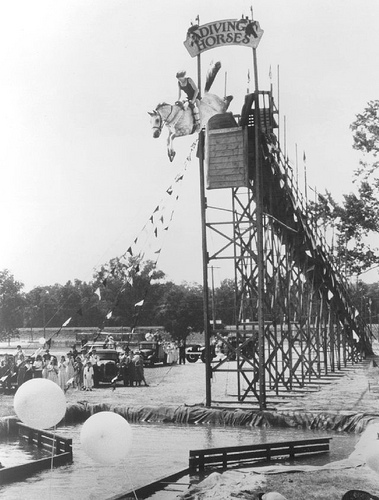
Now, I’m fairly sure diving horses is one of the cruelest things I’ve ever heard of, and even if it weren’t, you couldn’t pay me to try this. After all, these drops into water are exciting enough:

water_rolltop

Fine, fine, I'll share it again.

Fine, fine, I’ll share it again.

In High School I got to live out my dream of galloping down a beach. It probably wasn’t quite as beautiful and dramatic as younger-Britt imagined, since Mac was still a stallion and being an absolute brat, so I had to separate him from the group. When I could finally return, we cantered back a half mile stretch, which was fun and thrilling, but the cool factor was marred by constant stallion screaming. Oh well- I suppose these things never turn out quite as we expect!

Beach

These days, I think my dreams are at once smaller and yet still grandiose. My fantasy is to have that perfect ride around a Training level XC course, and have one of those fist pumping moments of joy as we cross the finish line.

gallop

I’m sure it’s a long way off, but one can dream, right?

What’s your equestrian fantasy? Have you lived it? What’s next on your horsey bucket list?


Let’s Discuss: Return of the Quagga

First of all, thanks to all who chimed in on the inside or outside sock debate. Trivial as it may seem, I loved reading everyone’s comments and it just brings to light one more personal way we equestrians differentiate ourselves! Today’s discussion falls mostly in the world of science and ethics- all regarding a lost equine called the Quagga.

"Quagga in enclosure" by Frederick York (d. 1903) - http://openlibrary.org/books/OL18018139M/Extinct_animals. Licensed under Public Domain via Commons - https://commons.wikimedia.org/wiki/File:Quagga_in_enclosure.jpg#/media/File:Quagga_in_enclosure.jpg

“Quagga in enclosure” by Frederick York (d. 1903). Licensed under Public Domain via Commons

When I was a kid, I had this giant encyclopedia of the Animal Kingdom, which was my favorite possession ever. At the back of that book, it had a section on extinct animals, including the Quagga. I basically memorized this encyclopedia front to back (so much so that my second grade teacher called me Capybara, for my random outbursts of facts on overlarge rodents) to the point where it had to be bound together with duct tape. But the Quagga especially became a cool idea to me, and I remember it popping up in my schoolwork- for instance “create a new animal day” in second grade was a pegasus quagga.

So I found this article on CNN fascinating- a project to recreate the quagga through selective breeding of certain zebras.

"Agasse Quagga" by Jacques-Laurent Agasse - http://www.artprintcollection.com/p668184721/hD664CB2#hd664cb2. Licensed under Public Domain via Commons - https://commons.wikimedia.org/wiki/File:Agasse_Quagga.jpg#/media/File:Agasse_Quagga.jpg

“Agasse Quagga” by Jacques-Laurent Agasse. Licensed under Public Domain via Commons

Can you imagine, a “new” species of equus, raised from the dead? Is it right for conservationists to try and return an extinct species to the earth? Is it OK if the project involves only breeding, and not cloning? Or should cloning be introduced to the project to right man’s wrong? Weigh in with your opinion!

For more information on the Quagga Project, visit their site here.