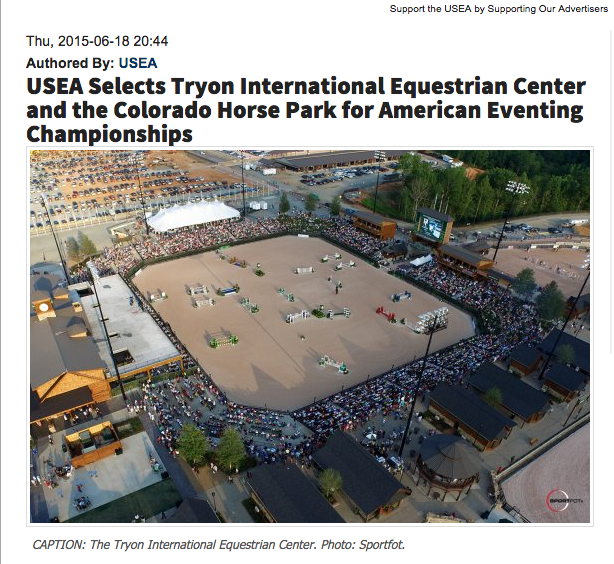
Yesterday the US Eventing Association announced the new venues for the 2016 – 2018 American Eventing Championships. Fellow Carolinians, get excited, because for two of those years the AEC’s will be hosted at the new Tryon Equestrian Center!
I’ve been showing at FENCE since middle school, but have never had a chance to visit the Tryon Equestrian Center, which has been largely touted as the Disneyland of horse sports. Don’t believe me? Check out this photographic tour of the facilities so far at Meg at. Ever since seeing those photographs, I’ve been trying to find an excuse to get down there and show.
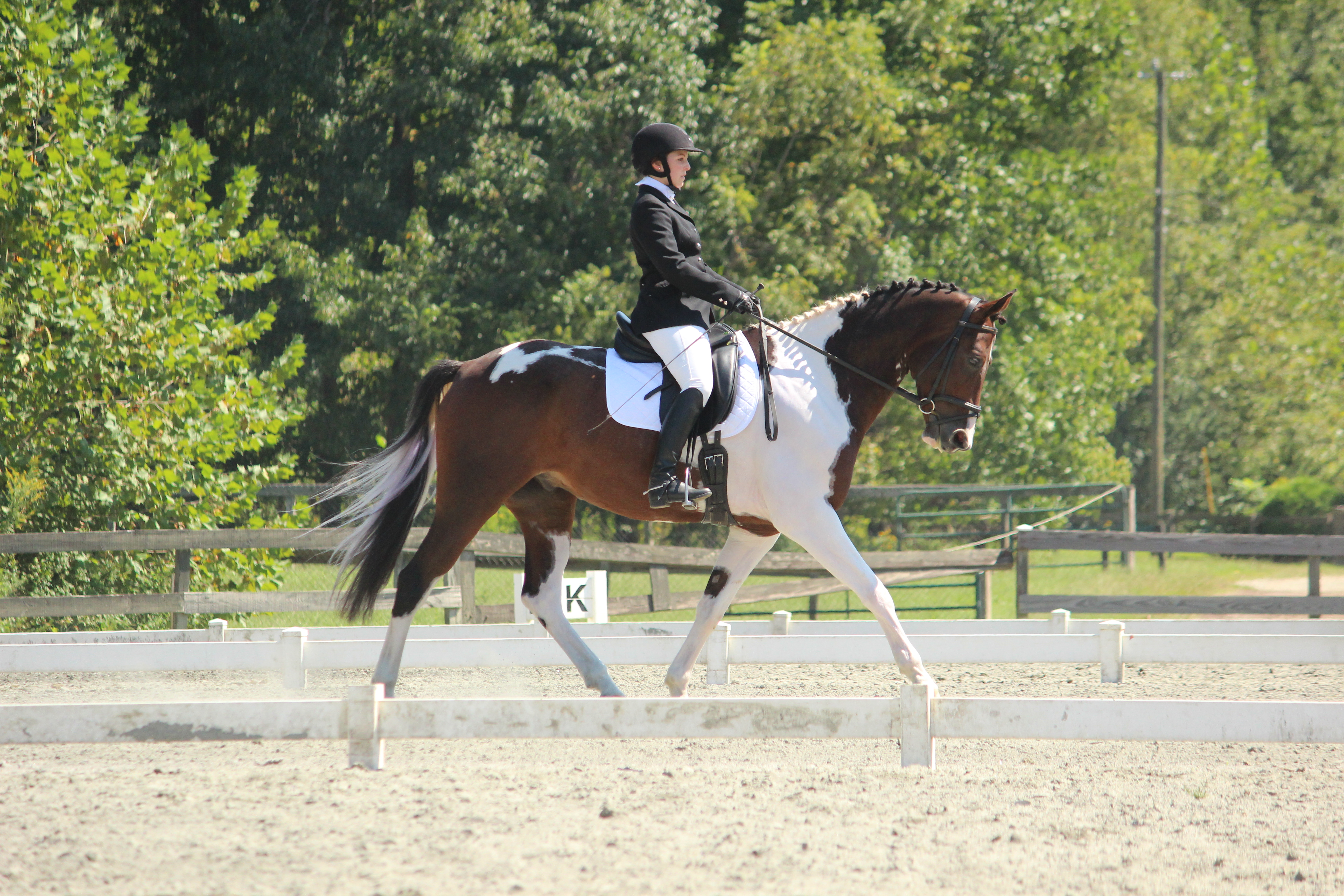
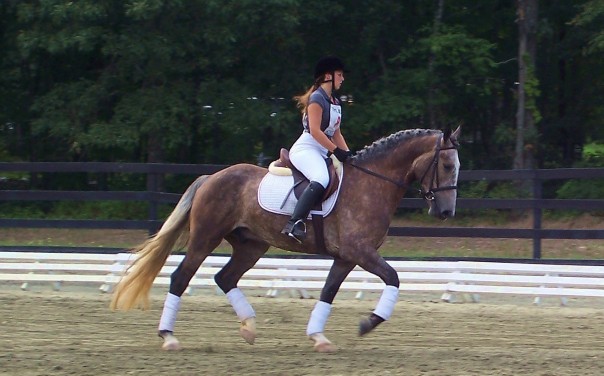
Favorite photo from the FENCE recognized show | PC: Bette
Up until now, rated dressage seemed the likeliest reason to hike down to the facilities, but now?
Maybe, just maybe, we can aim to qualify for the 2016 AEC’s instead.
The qualifications (in a nutshell) for qualifying at the Novice level:
1st or 2nd in any USEA recognized Novice Horse Trials.
OR: 3rd in two USEA recognized Novice Horse Trials
OR: 1st through 5th in any USEA Novice Area Championship
Total of 3 USEA recognized Novice Horse Trials completed without cross country penalties
Something to ponder!!
In other news, between this weekend and next I will have completed 4 different lessons and audited 1 clinic- so prepare yourselves for a bevy of recaps! Have a great weekend!
Even though we are miles away from being ready to compete at an event again, thoughts of planning our season pretty much dominate my brain.
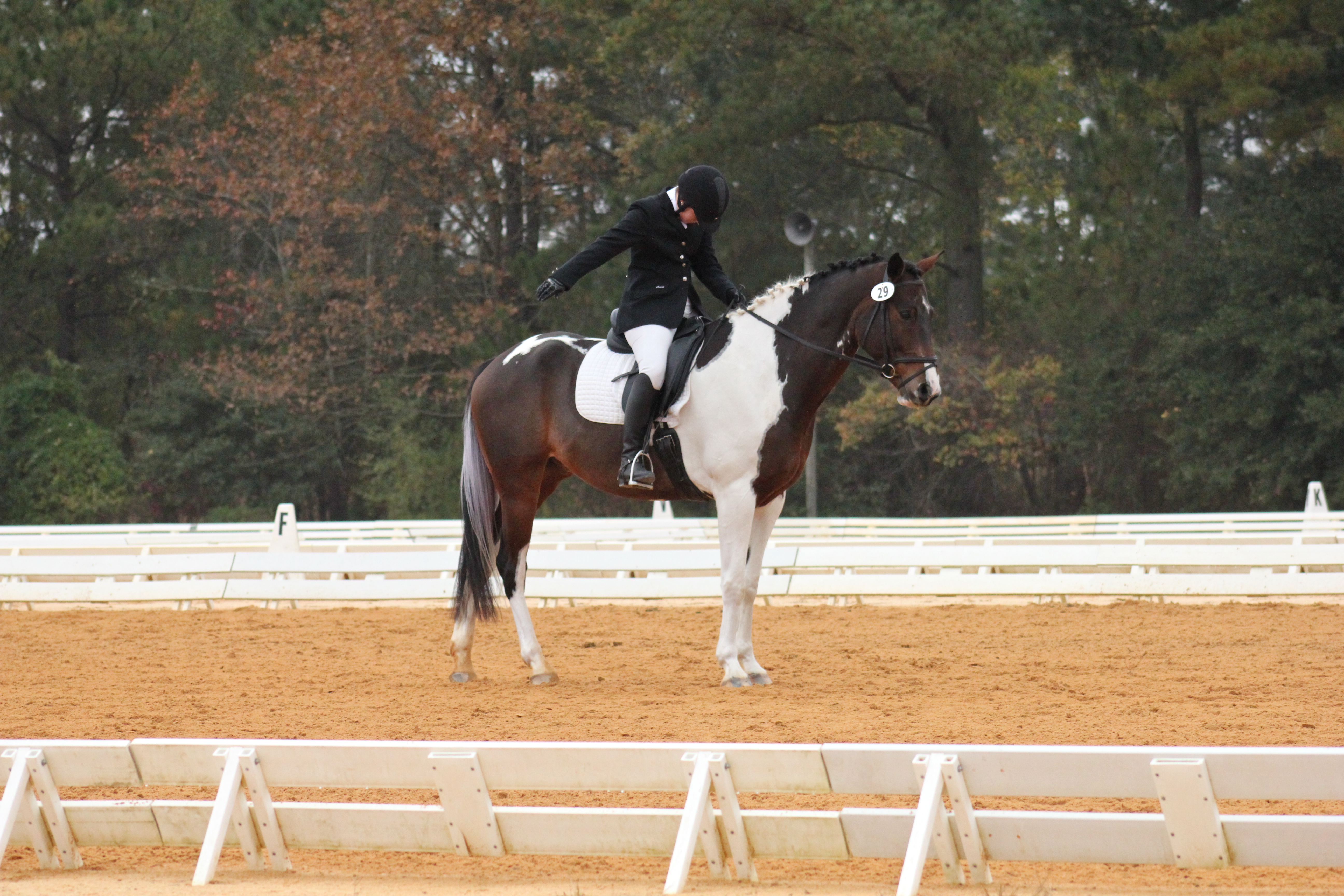
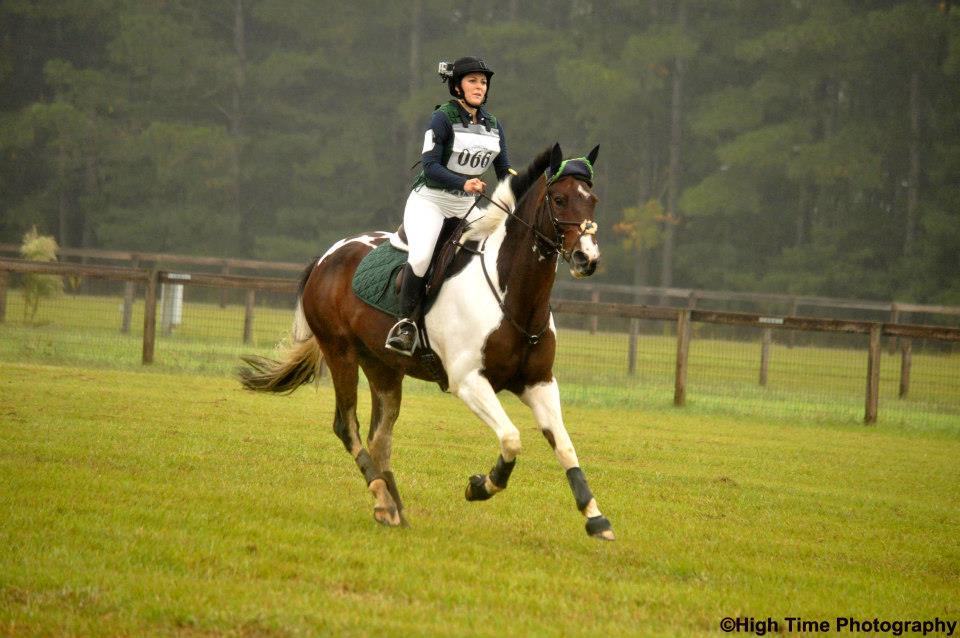
Novice @ CHP, October 2014 / PC: High Time Photography
I miss competing, and this dry spell combined with thoughts of moving up this year have caused a bit of self exploration- why do I show?
Personally, I treat competing as an opportunity to test our training. What I really look forward to at each event is the score- that quantitative (or in dressage, qualitative) feedback that shows how successfully we navigated a given challenge. I like to go to each competition with a number in my head, and at the end of it all comparing the actual score received helps me re-align my expectations or understand any gaps in our training. At the end of the day, I define success by how well we did compared to my original expectations for smaller goals- were our canter transitions as planned? Get an 8 on our free walk? Did we make time? Have runouts?
Novice @ Running Start, Feb 2014 / PC: Brant Gamma
For me, ribbons are a secondary treat. If we get them it’s great, and I won’t lie by saying I don’t enjoy being at the top. But in this area at many of the schooling shows we compete against professionals, so it’s hard to judge how well we do by placings alone.
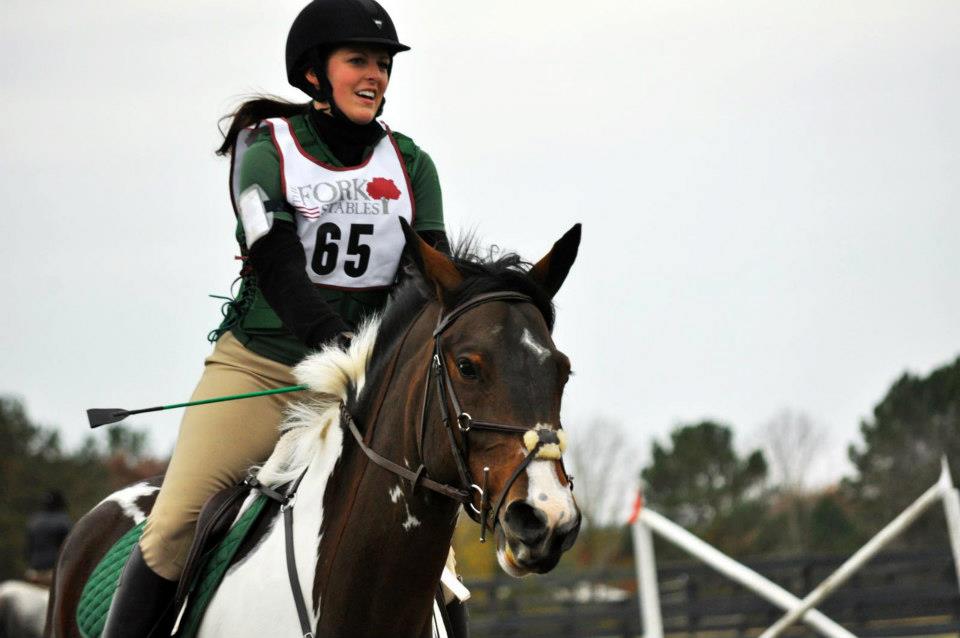
Novice @ CHP, Nov 2014 / PC: J
We all have our reasons for competing in equestrian disciplines. Maybe your competitive nature needs a place to shine. Maybe you have something to prove, or you just want to test your abilities. Maybe competing is just a part of a greater plan, or you have a die-hard passion for satin ribbons.
Why do you show? Or if you don’t compete, why don’t you show?
Since signing up for the Training CT this weekend, I’ve had some doubts. The last time we jumped was at the Carolina Clinic, and I wondered if I would be able to prepare Foster for another jumping round in time for this show. Thanks to the winter weather keeping us in the covered arena (an area too small for any real jumping) for the last couple weeks, in addition to vacation, Foster’s work has been irregular at best. But, I knew he could technically get around a Training course with relative ease.
Yesterday was the first time I was able to ride in the outdoor jump arena in a month, and with impending rain, I thought to make the best of it and get in a jump school. I had his open-fronts on, breastplate attached, and was doing up the girth when I decided- this was feeling too forced. Whenever it starts to feel that way regarding a show, I know it’s not the right decision. So I have elected to not jump this weekend.
Instead, we’ll forge ahead with the Training A dressage test, and [if the show staff will allow,] add another dressage test to the mix- First level 1. This will mark Foster’s first official time competing at First level, and shouldn’t be a great stretch for him, as the movements are very similar to the Training A test we’ve been practicing. There’s a slight chance he may be a bit tired for the second test, but I would much rather a lazy dressage test than an underpowered jump round, any day.
So, with that decision made, I quickly switched tack and instead dressaged around all the jumps I had set up not moments before. Immediately I felt a weight taken off my chest, and Foster was much happier than he has been in several rides to be out in the fresh air. We schooled our lengthenings at canter and trot before calling it a day. His expression was happy, ears alert and eyes bright, and I feel I’ve made the right decision by my horse.
As much as I want to get our first Training competition under our belt, his happiness and well being will always come first. Always!
The last aspect any competitor must consider, and equally if not most important aspect of equestrian competition, is the horse.
Without it, I suppose we could still compete, if only in a slightly, er, more humble sort of way.
But let’s be a bit more serious. The horse is our partner, and if he is not ready, we mere humans are woefully unable to compensate for the margin of error.
To be fair to the horse, we must ask what is reasonable of him in terms of both fitness and training. It is just as unjust to ask a horse to understand a new skill and execute it perfectly in a stressful environment as it is to push him to the extremes of his abilities and therefore compromise his soundness of body.
Derp faces abound
On the rider’s part, we alone are responsible for ensuring our mounts are physically ready to compete at the level we are to demand of them. Foster, for instance, is half warmblood, and as such, requires more work to get his cardiac fitness ready for anything more than Beginner Novice. Looking forward to Training level, it’s up to me to get my horse prepared by incorporating conditioning rides into our regular schedule. Mind-numbingly boring though they may be, that comes with the territory of having a [part] warmblood. Luckily, the reward is worth the work- galloping cross country on a fit (read: non-laboring) and happy horse is an amazing feeling, and gives me an accomplished feeling without ever having jumped a fence.
The second part of this is the horse’s mental preparation. Is the horse completely comfortable with the exercises we are asking him to compete at the show? Knowing that in most competition settings there is going to be some level of distraction, whether that be a horse lunging, a dog barking, or a flag flapping in the wind, keeping the experience positive can live or die by your horse being mentally prepared.
If I’m honest, right now I feel that Foster is more than prepared for Training level dressage, which to me is the equivalent of First level [pure] dressage. The jumping, as is usual, we’re teetering on the edge of being prepared. My goal is to feel comfortable jumping 3’6″ courses before doing any kind of horse trials- this so that when I walk up to a wide Training table on cross country that I won’t pee in my pants with fear (though I’m sure I still will, nonetheless). We’re not quite there yet, the recent snow especially messing things up, but that’s my requirement before moving up to a full 3 phase event. That’s the bar that makes me comfortable asking my horse to complete a task at a show.
Horses are the entire reason we compete in equestrian events, and therefore must be at the forefront of our competition considerations. With that in mind…
What do you do to get your horse mentally and physically fit for competition? What aspects of this do you struggle with? How do you decide if your horse is ready to move up a level?
Next up in the competitor’s toolbox: equipment. Because having the right equipment for your competition goes further than the truck and trailer needed to get there.
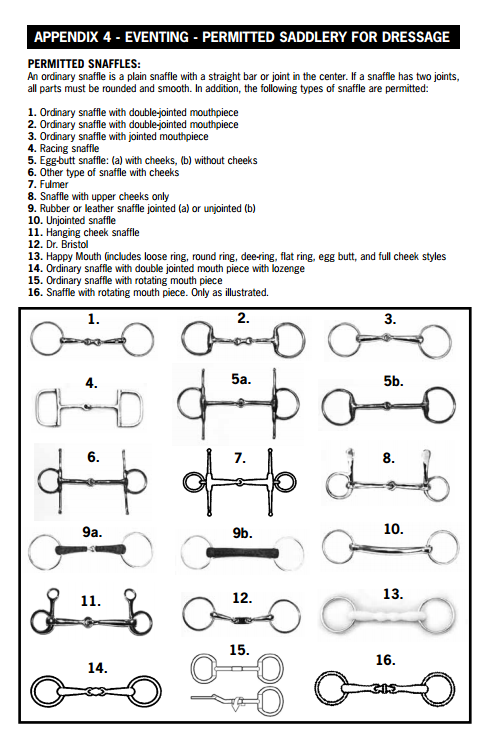
In many, if not all, disciplines, there are rules around what type of equipment is allowed, and what will get you disqualified. Needless to say, if you show up at a rated (english) Dressage show with a Tom Thumb bit on your horse, you will not be allowed to compete. This type of rule is in place to discourage using shortcuts on the path to ribbons, keeps the purity of dressage intact, and maintains a level playing field among competitors. Referring to yesterday’s post, this is yet another mental responsibility of the rider- to know what is and isn’t appropriate for your level and discipline.
Most rulebooks go into detail about appropriate or illegal equipment
And then there is tack as a matter of preference. This can get into the slightly subjective realm of what makes for the best picture to present to a judge, and whether or not the judge should look at the tack and what extent they should take it into consideration for scoring the horse and rider. But, preferred tack can also relate to the pieces we choose that we feel give us a competitive edge. On cross country, that may be a giant yellow watch. For a hunter rider, maybe it’s shoeing your horse in aluminum shoes. For a dressage rider, it could be the stickiest full seat breeches on the market. And so on and so forth. It could be any one thing that you utilize that makes you more confident, and in turn makes your showing experience a better one.
For instance, doing dressage in a dressage saddle is a preferred tack choice…
…since it helps your leg elongate around the horse
Lastly, we all have specific equipment requirements due for the safety of horse and rider. Eventing in particular has lots of rules around safety equipment, especially for the more dangerous cross country phase. Chest protectors and armbands with your medical information can help keep you safe or assist others in giving you medical aid. Whether you agree with it or not, the British Eventing Association just made skull caps (brimless helmets) mandatory for cross country jumping as well. All of these devices are meant to give all the greater chance of recovery, should something go wrong, and as such competitors are required to have them at events.
Whether it’s to make you an eligible competitor, to give you that competitive edge, or to keep you safe, having the right equipment is a mandatory facet of equestrian competition.
Do you have a piece of equipment you just won’t show without?
Recently I have been thinking about myself as not only a horseperson, but also as a competitor. That is, assessing how I stack up and whether or not I am prepared at competitions so that those shows set myself and my horse up for success. I’ve determined that there are three ways to think about the requirements of a good competitor, and these are the Mental Mindset or Psyche of the rider, Equipment, and Preparation of the Horse.
The first then that I want to assess is the mental game. I think a lot of this is knowing your strengths and weakness, and staying mentally focused so that you remain in the moment enough to use your strengths to your advantage, and make corrections (for your weaknesses) as you go along.
For instance, while it’s taken me many years to get there, I think I have a good Dressage ‘game face’. Intercollegiate Dressage in particular taught me to ride every step of every test, and have confidence in my abilities. I’ve practiced and perfected visualizing exactly how I plan to ride each movement in my mind, and now find this process relaxes me whenever nerves try to come up. Visualization comes up again in my day-to-day riding, as when I feel the horse getting heavy or sloppy I picture myself as a Grand Prix rider, tall and elegant and soft but clear with my aids. This in turn tends to correct my equitation and helps my horse respond to me more efficiently.
Game face on.
My weakness, then, is jumping. Because I have been a formal student of jumping for less time, I lack the ability to visualize exactly what I want to achieve, and therefore have less confidence going on course. Looking for riders at the top level as visual examples is, in my opinion, less clear, as I see a bevy of different releases, leg positions, and styles among professional jumpers and eventers. Additionally, not knowing the course until the day of (or sometimes the hour of) the competition makes my mental run-throughs rushed and not nearly as effective. In short, the techniques that work so well for me as a dressage competitor fall short for the other phases.
CHP, October 2014
Instead for jumping, I have started using other techniques to get my psyche in order. The bullet lists you see in each lesson post become mantras that I repeat as I prepare for the competition. I try to find songs that get me pumped. J played this one for me getting ready for the clinic, and I really found it helped me find a groove, even if the only lyrics I really know are ‘like a great white shark on shark week!’ (enthusiastically yelled by myself, of course).
Besides knowing your mental strengths and weaknesses, there are the other responsibilities of the rider to know- speeds required for the level and what that feels like, penalty rules, technicalities (such as what to do if your horse refuses the second fence in a related combination, whoops), and so on and so forth. Any detail of this could be the difference between success and failure (although we never fail, we just gain a learning opportunity!), or a blue ribbon and a red ribbon. Growing our knowledge and becoming a student of the sport is what being an amateur is about, and the more we know, the more we set ourselves up for success.
What mental techniques do you use to prepare for or at competition? How do you handle the stresses of competing? Are there mental aspects that you would like to improve yourself?
The second half of the year we continued with our busy schedule, and threw in both a Hunter/Jumper and Recognized show for fun.
Hunter/Jumper Show, August 2014
July – Hunter/Jumper Show
We went to a Hunter/Jumper show for a change of pace and with the goal of getting in jumping rounds in a low pressure environment. Leading up to the show, a series of crap schoolings and trying to fix things instead of leaving them alone left me with a super tired pony who just wasn’t up for what I asked of him. He tried very hard though, and still earned us two 4th place ribbons in a couple classes. I learned a lot about show prep for my horse and about the world of H/J.
FENCE, September 2014
September – Recognized Horse Trials at FENCE Foster’s first Recognized show, and my first one in about 10 years had me pretty nervous leading up to it. I did my damned best to prepare my horse for it, and overall it was a success. What felt like a fairly good test earned us our all-time low of 30 for dressage, and we debuted the helmet cam with a rockin’ cross country course up a small mountain and coming in well under time. I made a mishap of not getting to the start box as soon as I should, which looks bad on paper, but oh well. Foster was tired on showjumping day and took out 2 poles, which was pretty good considering I was almost concussed in the warmup.
CHP, October 2014
October – Carolina Horse Park Horse Trials
Another show at the Horse Park. Although an unrecognized event, they reused the course from the Recognized show prior, which meant I finally had to jump the dreaded trakehner and brush fences. The footing was super sloppy, which was a first for Foster, but he handled it well. We had a slightly tense test for a 31.7, and added 1 time fault in showjumping with a scrappy round. I thought I was going to puke with nerves before cross country after watching multiple refusals, but Foster came through brilliantly and went double clear. We got ourselves another 4th place ribbon.
CHP, November 2014
November – Carolina Horse Park Horse Trials
… and yet another at the Horse Park. A more forward dressage test and a harsh judge gave us a 35.7, but left us tied for second place. This followed by our most fluid showjumping round, though I made turns way too way big and Foster accidently dropped 2 poles. I then went out to cross country preparing for a fun run around, which I was having when I forgot a fence and was pulled up 3 fences from home. Ended on a Technical Elimination.
Our Season By the Numbers Total Shows: 10 Number of Horse Trials: 5
Average Dressage Score: 32.65 (67.35%) Average Number of Poles Down: .85 Double-clear cross country runs: 3 (4 if you count that we probably would have gone clear without my TE, regarding pace and jumping faults) Number of Ribbons: 6 Color of Ribbons (Placings): 2nd, 4th, 3rd, 4th, 4th, 4th Times I Forgot Part of Course: 2 Times I dyed Foster’s tail purple: 2
As the numbers show, our tendency is to be at the top of the pack after dressage, then for me to mess things up in the jumping phases. From now on I am holding myself to a mandatory second course walk. But, looking at the positives- we learned a TON. Foster’s confidence at the level has come in leaps and bounds, which in turn has made me more confident. Pace has not been an issue at Novice, though admittedly, there are other venues that run Novice faster than the few I attended. We had one run-out this year, and that was mostly due to my being a passenger instead of kicking on. Since then, my mantra of ride every fence (other than being ironic at the last show) has been a helpful attitude and keeps me from getting too laid back about seemingly easy fences. I should tattoo it on my arm, right next to where my cross country watch goes.
Next year’s calendar will be interesting, depending on how long it takes for us to feel ready to move up to Training. There’s another Running Start Horse Trials in February, and then we would wait until May to do another unrecognized event. Combined Training shows will help us dip our toes into the Training test and battle some showjumping courses, which may be just the ticket. I’ll be spending the winter thinking about our goals and what is the right path for the spring, and hoping the season goes just as well as 2014!
After walking the cross country course Saturday, the sky opened up and it poured. And poured. And poured. Luckily this provided excellent opportunity to huddle in Foster’s stall, do a bit of braiding, mentally run through my test, and try not to think about what was happening to the footing all through the deluge.
No dressage photos, so look at us in our snazzy new colors!
Dressage Needless to say, it was still very very wet Sunday morning. The dressage warm-up quickly turned to slop, which my poor pony is not so used to working in. I attribute his being slightly stiff in his neck because of this, as he attempted to pick his way through the mud and muck. Still, I was happy with the test he put in, and I was pretty confident it would score in the low 30’s.
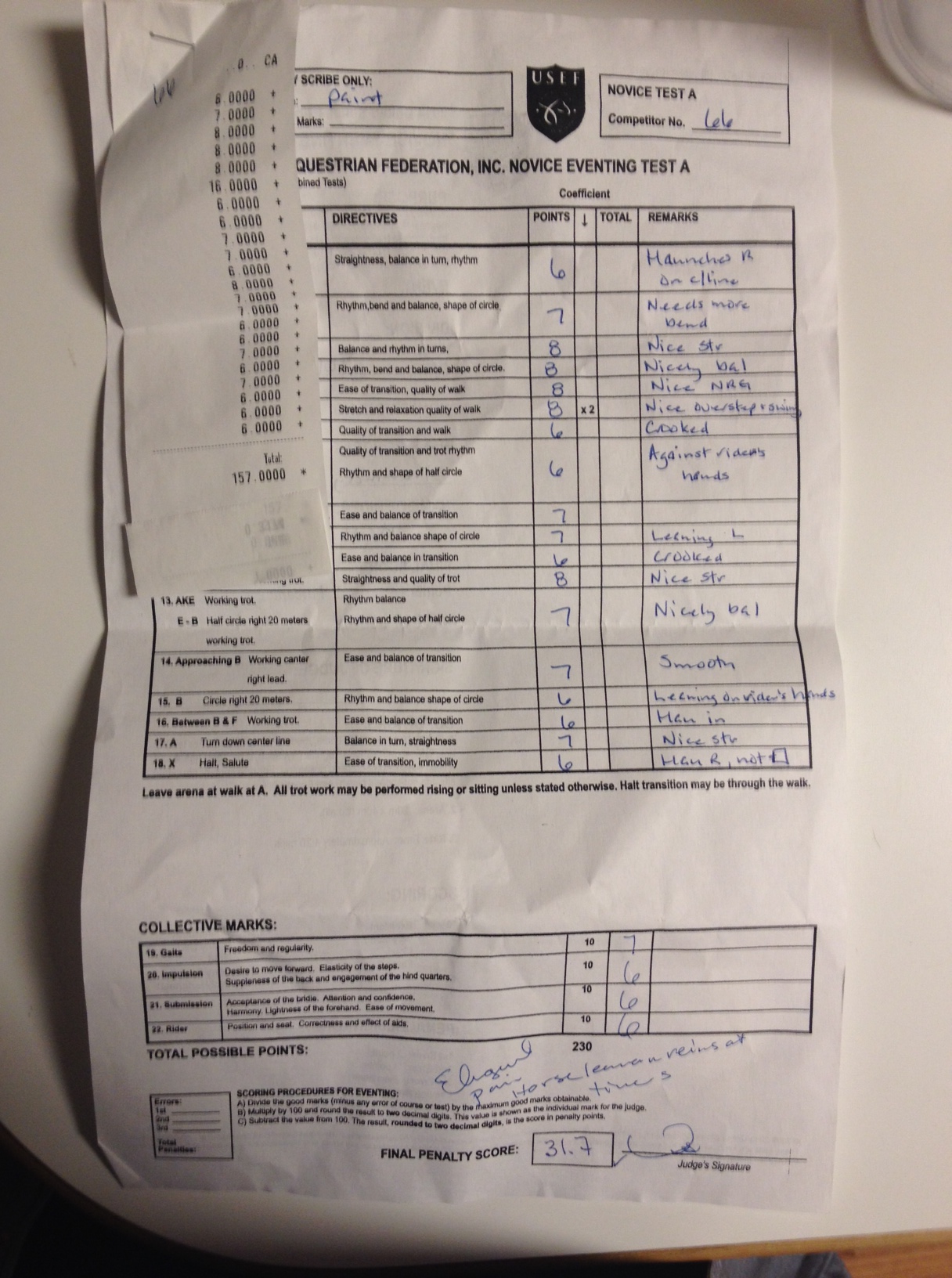
The test earned us a 31.7, good for 5th place. Looking at the test, I’m pleased with the number of 8’s on there, and it appears we were off to a pretty good start. I am, however, a little bummed with how the test finished, and I didn’t feel some of the things the judge remarked on. Similarly, I wish I could have seen my ride, so I could understand why our overall scores dropped so much from the last show just a couple weeks ago. So we’ll be chalking it up to experience and trying to improve even more for the next outing.
Showjumping
Because of the slop, I was a little worried about how showjumping would go. Foster looked just a hair too relaxed hanging out in his stall, and I knew he would need some extra oomph to push out of the steadily deteriorating footing. I gave myself about 15 minutes of warm up, starting by trying to get him really moving forward (kind of successful), before hopping over a couple fences. He was a bit sticky to the fences, but I decided to take the risk of not jumping further in order to save our energy for the fences that would count.
I’ll say this in regards to our round- thank goodness you don’t get pretty points in eventing. He jumped me out of the tack over fence 7, which I got him a little unprepared to and he made a huge effort over. He didn’t pick up the correct leads 100% of the time, and once I brought him back to a trot to switch leads. Because of this, I think, we got 1 time fault, but went otherwise clear through a course that was definitely taking names. I saw 1 fall, and 2 refusals just while I was waiting- an unusual pattern for these lower levels.
Fence 7
Cross Country
When I got to cross country, I was more than a little worried about the footing on course. Foster does not have studs, and though the sandy footing holds up pretty well, I still wondered about jumping these large fences like #3 right from the start. Combine that with watching 2 different horses have refusals at that fence, and thought I was going to puke. But a quick hop over the couple cross country warm-up fences and Foster perked up substantially, and I decided to give it a go.
I won’t rehash the entire experience, when you can watch the helmet cam!
Obviously the course ran pretty well. Other than getting in deep to 8A, we got all our spots and while being forward, Foster was adjustable and able to come back to me when I needed to rebalance him, such as down the hill and through some turns. We came in right under time because of my more conservative ride.
Breezing over fence 3
In Conclusion
Overall, we finished 4th out of a field of 15 or so horses. I am super happy with how the day went, and again, know there are things to improve which is a great place to be. It was a great relief to finally conquer the trakehner and brush that have been worrying me all year. We’re still waiting to break into the 20s for dressage, but between this and the last show I feel like Foster can confidently be described as a solid Novice horse. I’m thankful for the opportunity to put in another confidence-giving run, and look forward to our last show of the season, next month!
Ahh, that wonderful horse show hangover feeling you get. You know the one- you’ve spent an entire weekend on your feet, shoveling poo, hanging water buckets that inevitably splash all down your pants, walking courses, doing all sorts of math (optimum times, penalty times, time faults, dressage scores… yikes), and maybe doing a bit of riding, before you get back home, exhausted but pleased, and thoroughly brain dead.
So since my brain is not quite up to the task of rehashing all the gory details from the actual competition, let’s just talk about the course.
This slideshow requires JavaScript.
Pretty much from the first fence I knew this was going to be tougher than our last visit to the Horse Park. Generally fence 1 is smaller- Training jumps a Novice fence, Novice jumps a Beginner Novice fence, and so on. Not this time- fence 1 was a maximum height roll top, inviting, but still big enough. It turns out they were re-using the course from the previous recognized show. As it went on, this became more and more clear.
Fence 3 was the giant table that was at the end of my course in May. So right away, the pace needed to be forward and your horse in front of your leg.
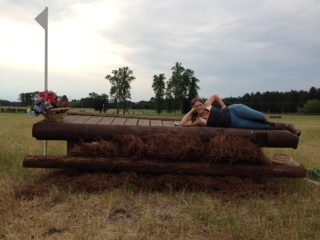
Remember this guy? Fence 3, baby!
Fence 5 took you through the new Stonehenge complex, which has caused spookiness issues even at the upper levels of competition. Then down and over the massive brush that has made me want to wet my pants. Another fence before hanging a sharp left turn down a hill, then a 90 degree angle turn into a bending line combination. Yikes.
Stonehenge Complex at Carolina International, PC: Everything Eventing
No break after the bending line, because you’ve got to get going again to make it over the huge red bench going up the hill. Followed by collecting again and sitting back into the sunken road at 10 A and B. Then over the trakehner that has made me want to puke ever since I moved up to Novice. Luckily after schooling the trakehner at Running Start, this guy didn’t look quite as intimidating as I remembered. Though I didn’t forget that I could easily sit in that ditch (which I did when I dropped my phone into it in May).
Then up the hill, catch our breath over the up bank down the slope to a rolltop, through the water complex, over one more fence and home free!












 Red on the Right