Foxhunting vs Eventing

While Huntseat is supposed to originate out of the foxhunting world, it could be argued that as the equestrian sports are today, foxhunting and eventing- the cross country phase of eventing, that is- are most closely related. And yet still there’s a lot that separates the two.

Jack has been a foxhunter, or a foxhunting reject, all his life before being started as an event horse last year. I hunted first flight with the Mecklenburg Hounds and was an active member from middle through high school. This helps me appreciate his quirks and the holes in his training that relate specifically to eventing.

Jumping Natural Obstacles
This is easily the best advantage a foxhunter has when transitioning to eventing- experience over natural obstacles. And this is definitely Jack’s forte. While most jumps found on the hunt country are simple logs, coops, and walls/verticals, and understanding of how to negotiate terrain and solidly built questions is a handy quality in the eventing world.
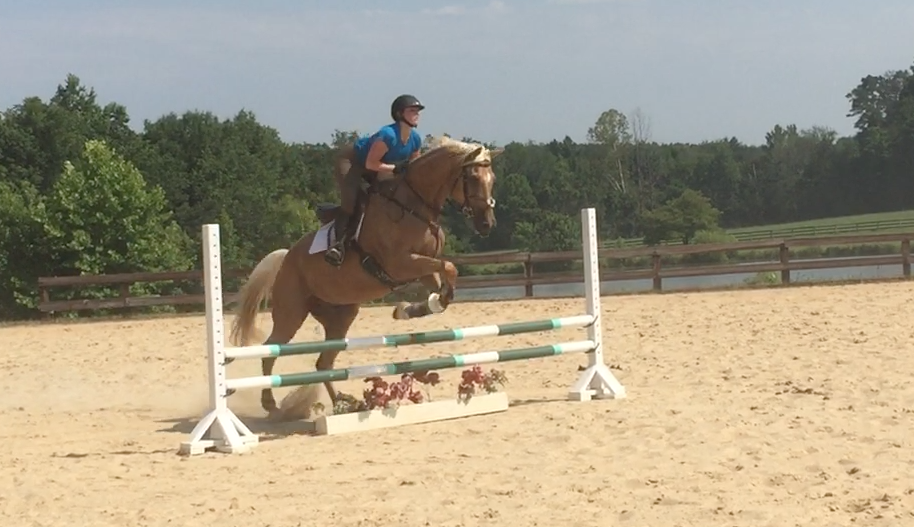
Jack says What be these sticks I jumping?

Jumping with Balance
There are no bonus points for pretty out in the hunt field. Your objective is to survive to hunt another day. Much of the jumping therefore is a sort of get-er-done deal, with the goal being getting from the front side to the back side of the fence. The flight you are in typically determines the speed at which you hunt- first flight stays with the huntsman and therefore sees the most speed and challenging aspects of the hunt. Second flight, and/or Hilltoppers, often includes hunting novices or younger participants and was a walk/trot group in the club I participated in. So, jumping generally happens one of two ways- from a trot or from a gallop. The rideability and, more specifically, ‘showjumping canter’ needed for stadium rounds or technical combinations in cross country is not typically installed in a foxhunting horse.

Tolerance for Dogs
The hounds make the hunt. And years of thoughtfully produced programs and breeding are put into these [occasionally dumb] creatures, so they are a highly valued, even blessed part of foxhunting. Probably the fastest way to get kicked out of a hunt is to have your horse kick or injure a dog. This is one of the reasons why Jack is a foxhunting ‘reject’: not because he was a hound-kicker, but that the large groups of hounds baying, barking, and generally being completely underfoot was more than he wanted to handle. In eventing, this isn’t shouldn’t be a concern, as dogs aren’t meant to be part of the action at all on the cross country course.

So many opinions about this I can’t even.

Colors
Lord only knows how much we eventers love our colors. Gold, green, red, royal blue, orange… Life’s a box of crayons for us, and we go hog wild for that shit. Foxhunting? Not so. This is likely the place that Hunter-Jumpers relate to foxhunting still in the strictest ways. There are purposeful rules about who can wear what color jacket, with red being reserved for staff and dark colors for everyone else. For safety reasons this makes sense- you need to be able to see and follow the staff across miles of countryside. Imagine trying to pick out a staff member if everyone dressed as eventers do? Yeah, there’s not enough whiskey in the world to make foxhunters adopt lime green and orange as their attire.
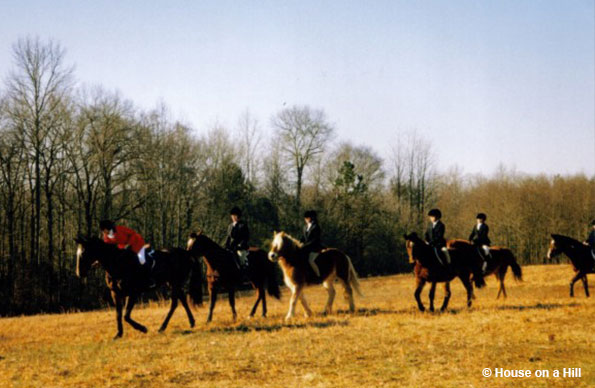
Following the huntsman on my fuzzy pony

While I have every hope and intention of making Jack a successful event horse, it’s important to remember that all of this is a slightly different world than he is used to!

Let’s Discuss: How do you Unwind?

You’ve worked extra hard towards accomplishing a goal- be that a competition, proving yourself in a clinic or lesson, finally struggling through trailer loading practice, and more. And after drilling yourself and your horse through the exercises, you’re ready for a mental break.

So what do you do?

Do you unwind with a trail ride? Ghost your horse for a few days? Break up dressage with a little jumping? Or what?

For me, trail riding generally induces clutching the saddle in a fetal position, or reaching for the nearest bottle of wine. And with eventing, it’s hard to just walk away for a few days and sacrifice any loss of basic fitness (more so in myself than the horse!). So my mental relief for myself and my horse tends to come in the form of stretchy days. Basic suppling exercises in dressage make me more calm with their repetitiveness and knowing that they are easy to accomplish for both of us, and of course the horse gets the benefit of stretching their topline and loosening up his back. If we get bored, we throw in a cross rail for fun, but typically nothing more. It’s just a fun, low-key way to take a step back for us.

What about you? What’s your way of taking a step back from the daily grind? What do you find to benefit you most? What does your horse most enjoy?

Raleigh Dressage Show II Recap: Day 2

Sunday at the show was an exciting day, as TC and I moved up to First Level in an Opportunity class. I felt like despite not really working at that level for very long, TC was more than able to handle it. After all, 10 meter circles are a lot easier on a 14.2 1/2 hony than on a 16.3 gigantor palomino. His trot lengthenings might be so-so, but they are there, and the canter lengthenings were quite good for this pony with a motor.

TC warmed up a little quietly, and I worried that we wouldn’t have enough gas in the tank to make for exciting lengthenings. Though he did wake up once we got into the arena and were surrounded by more of the show environment. In hind sight I should have slowed his tempo down slightly in the trot in order to show more of a difference in the lengthenings, but that’s a learning experience for me. We score 6’s on all the lengthening movements (bummer), but an 8 on the stretchy circle and a good smattering of 7’s. I was surprised to see the judge give him less than a 7 on his gaits, but rewarded me slightly more. Overall we earned a 65% and another blue ribbon for our efforts.

The weekend in general was a great success, and a huge feather in the cap for TC who is becoming a star of a show horse. I can only hope that Jack will settle into the fray just as quickly, but then again, TC has that ponytude to give him an edge in that area. I’m glad to have wrapped up my time riding TC on such a high note- I think his next rider will do an even better job with him and honestly am excited for the little guy’s future!

Raleigh Dressage Show Recap: Day 1

Since buying Jack, I knew that eventually I would need to give up the ride on TC, since riding 3 horses (with Riley back in Raleigh) is more than I can manage longterm. Because I also wanted to compete him one more time and improve on the last show’s experience, we determined that the Raleigh I/II dressage show would be our last hurrah before handing the reins over to someone else.

On Saturday, we competed in Training 2 and 3, tests that we also competed in at the prior show. TC’s entire demeanor was that of a well-traveled show horse, not the 7 yr old at his second competition, and he was the consummate professional.

Training 3 was our first test (why, oh why do they do the higher tests first?) and he warmed up beautifully. The test itself was fairly good, barring some spooking/looking at the water in one of the corners that turned into us almost leaving the arena in the next. Our only real bobble was in the canter, where for the first time TC did this fun thing where he got disunited, so I brought him back to a trot and picked up the lead again in time for the next movement, which was the downward trot transition across the diagonal. We got an unfortunate 4 for the break in canter, but that’s fair.

Our test scored a 67%, earning us 4th out of 16 competitors. It’s of course frustrating to think that if we hadn’t broke in the canter that we could have maybe even won the class, but overall I was really pleased and surprised to earn that score.

Training 2 was our afternoon ride, and even the in-laws turned out to witness dressage brilliance (kidding- Training 2 is a boring test at best). Luckily there was enough time to read the same judge’s comments from the morning, and learn from that feedback to make a plan for our second visit. Barring a little lookiness at the continuing standing water in the corner at A and scooting into the downward walk transition in the next corner, I am really happy with how the test went. The judge thought so too, and we finally broke 70% with a 72 for a pretty blue ribbon.

Some big goals (for us) were met in this test. I was finally able to show off his good stretchy trot and get an 8 on that movement (where’s my coefficient at- boo!). One of the goals I stated to my trainer before the show was also improving my rider score in the collection marks. Depending on where we are, I generally get a 6.5 or 7. So a 7.5 was a definitely step in the right direction, as I am finally getting the feel for where my elbows should live and keeping my hands closer together.

Tomorrow, we look at TC’s first First level test!

Let’s Discuss: Dolla Dolla Bills Y’all

This is a fairly personal discussion today, so feel free to not participate if you’d rather not share. But it’s one we certainly all think about- how do we finance our ridiculously expensive equestrian hobby? I realize that my own situation is just as unique to me as anything, but I’m curious how others make it work.

Horse ownership in a nutshell

Luckily for me, the husband is appreciative of my extracurricular activities because it keeps the weepy-Kujo version of myself at bay, among other less-emotional benefits. So when our finances became one we created a system for paying bills that covered basic horse expenses (board, farrier) and also reciprocated in affording some of his specific needs as well.

Precious pony gets what precious pony wants. Sometimes.

Everything else is on me. This includes all the tack, supplements, lessons, clinics, shows, breeches…. The list goes on and on. For all of this, I sit in front of my calendar and make a list at the beginning of every month of the expenses I have planned- lessons, a clinic, paying off that saddle I just bought, etc. Then the list goes through prioritization mode (i.e, what do I want most, what moves me towards my goals, and will I die if I try something without taking a lesson first, etc). Lessons and clinics tend to come before extraneous (beautiful) tack additions, for instance. After crossing things out, adding up the results, I can then create a budget.

Maybe it’s maybelline, maybe it’s really expensive blueing shampoo

Of course horses being horses, no plans, and definitely not expenses, are ever safe from change. So my budget allows for a little to be added to the future trailer fund savings account each month just in case. I try not to make quick decisions about purchases (as much as possible- not always possible) and take care of the things I have in order to help them live as long as possible (see posts about 15 yr old bridle, and brushes etc of similar age). My photography jobs help me fill in any gaps as well, and though it keeps me even busier, it’s huge for me at the moment to recoup some of the costs from you know, buying a horse recently.

How do you guys make it work? Do you have a side-hustle to support your hobby? Are there expenses that you prioritize before others? Are there things you forego in order to achieve financial stability? 

Adventures in Horse Shopping: How did we do?

Remember that ISO ad that traveled the interwebs? Well now that I am 7 weeks into owning the Barbie Dream Horse, let’s see how he compares to the initial requests in my unicorn hunt.

Adult amateur seeks fancypants unicorn in ultimate champagne on a beer budget scenario.
In budget? Check. Bonus: Champagne colored.

Prefer warmblood or warmblood X gelding, at least 15.3 hands tall and between the ages of 3 and 9.
Check. 9 yr old German Warmblood sticking at 16.3h. A bit bigger than I need but beggars can’t be choosers.

16.3h, most of which is shoulder.

Must have great brain, preferably canine-like personality and cuddly tendencies. A forgiving nature, for those amateur moments, is an absolute requirement. Need not be able to memorize show jumping tracks, but being able to count jumps would be helpful to this occasionally ditzy eventing DQ.
Great brain- got it, despite his tendency to notice everything. Personality-wise, he’s still blossoming, but is a big fan of chewing on his lead rope (or sneakily eating the right rein when I’m not looking). Definitely a cuddler, and thank goodness he’s forgiving of my rusty jumping game.

Suspension and athleticism important. And by suspension, I mean that of a Porsche or Audi, not a Model T.
Decent gaits- we has them. I don’t know cars that well (obviously)… maybe we’re like a new Volvo? Are those nice? Whatever, I drive a Kia.

Prospective owner seeks to be competitive in the dressage court up to 3rd level and in the eventing irons, that is, if she can remember her courses. Proven jumping ability preferred, but willing to survive training a green but willing jumper as well.
Horse can definitely jump, and probably fits the green-but-willing-jumper description. We’re going to be working on learning how to canter fences and not trot/gallop them. And that’s OK.

Horse will receive almost daily attention from prospective owner, be taught ridiculous tricks like smiling and bowing, and in general be spoiled rotten. As such, the horse must in turn tolerate copious amounts of picture taking, both as the subject of his new owner’s photography experiments, but also on a routine basis for the purpose of bombarding the blogosphere and social media channels with their presence.
Welcome to the blogosphere, Jack, aka Jack-Jack, aka Barbie Dream Horse, aka Goldenboy, aka Blondie. Thanks for giving me new things to write about. And photograph. Side note- we are already working on smiling.

Besides being sound of mind, horse must be sound of body. While this amateur owner has become efficient at wrapping, icing, hand walking, and bonding with vets, she would like to turn her attention to other hobbies. Like riding. Lemons need not apply, and you better believe there will be a pre-purchase exam.
Besides a few unsightly blemishes and a need for more conditioning…. I’m going to knock on wood right now.

In return for meeting these lengthy and lofty requirements, any future horse will be held on a pedestal above all others, if not in the judges’ eyes, then in his owner’s. He will receive the best of care at a top-notch facility, have his legs and feeding regimen obsessed over at length, and be stuffed full of cookies at every horse show. Oh, let’s be serious—he’ll be stuffed full of cookies on the daily. And with all hope, he will be a lifelong partner.
Yes, yes, and hopefully very much yes.

Lesson Notes 7-22

Somehow I survived my two lessons on Saturday, and both horses lived to tell the tale as well. And considering whatever the heat did to potentially addle my brain, in addition to my head already spinning with deadlines and the impending show this weekend, I find that I need to jot down the things I learned from those lessons while I still remember.

TC’s Dressage Lesson:

  • Conservative and correct is better than up tempo and tense
  • Sit into the canter transition (and keep mentally reminding myself to push him off the right leg from time to time)
  • Keep my elbows heavy and hands low
    • TC can be a head wagger occasionally- keeping my hands low and together (thinking about having a low center of gravity) stops his mouth from taking on any movement that happens as a result of posting with my elbows up high
  • Think about 10 meter circles as 2 halves
  • Prepare early for transitions- TC needs more time to process than I realize
  • Look out on the stretchy circle to maximize the number of steps available
  • Think about walk in the transition from lengthening trot to working trot- show off the “coming back”

Jack’s Jumping Lesson:
I had a very different horse under me for this jump lesson, despite the near three-digit temperature. Jack came out and was much stronger than I was used to, which is a result of his getting fit and building confidence. It’s also a direct reflection of his time as a foxhunter, where I was told that he was taught to either trot fences or gallop them. While we worked on managing his stride in front of the fence, trainer had some words of wisdom:

I’m going to take the suspense out of the situation for you. You’re going to have some ugly jumps for a while.

And well, as you’ll see in the video, she ain’t wrong. Here are the other tidbits that I need to stick in my skull moving forward:

  • Our flatwork is coming together (yay!) but I need to remember to not camp my legs out in front of me
  • As he gets stronger/fitter, I shouldn’t be surprised about his wanting to take the bit
    • Add a running martingale to allow for more control
      • Keep my hands up and reins short for same
  • Do not lean for the lead
  • Hold to the fence, then be sure to release as his front legs lift off

Between fences, we also chatted about goals. I would like to do a recognized show by the end of the year, and we decided to aim for Stable View at the end of September as a result. Even if showjumping looks a bit ugly, we should be able to get around a Beginner Novice course by then as long as I stick with the program. And with lots of schooling options between now and then, including a clinic in a few weeks, we should have a lot more experience under our belts as a pair before taking on Aiken!


This Heat, It’s Oppressive

We’re moving into the (so far) hottest days of the summer right now- so what sounds better than making all the riding plans?

Tomorrow I’ve got not one but two lessons. First TC at 8:15am in the dressage court, then I’ll be attempting to teleport out to the trainer’s for a jumping lesson at 10:30am. Luckily the fact that I have a lighter horse in a breezy stock trailer should keep us from melting on the way home.

The only weather appropriate activity for horse people this weekend… Perfecting the tan. Also- why does she have tan feet?

Sunday’s activities will either include staying in the air conditioning while the ponies enjoy their fans, or potentially wandering through the local forest on a trail ride. No need to go crazy on both days.

I hope everyone stays safe with the rising mercury! Happy Friday 🙂

Let’s Discuss: Alternative Therapies

Horse people are weird. We know that. We spend money on these animals in ways that even normal-crazy-people think are crazy. And sometimes that cray in us comes out in therapeutic sessions for our horses.

Accurate.

Sometimes we try things as part of the rabbit hole that can be lameness diagnosis (ask me how I know). Other times it’s because we believe in a certain program in order to keep our beloved ponies in the best condition possible. And sometimes it’s because we don’t like money.

Acupuncture and chiropractic adjustments have long been stand-bys in equine management programs. And even these have gray areas. What about chiropractic practicians that aren’t vets? What about acupuncture that doesn’t include needles? How many of you have had conversations about what type of horse yours is- earth/water/fire/etc?

Then there’s more ‘modern’ treatments entering the horse world thanks to the wonders of technology. Some of these, just off the top of my head, include:

  • Equine Kenisiology [Rocktape]
  • Theraplates [Active proprietary Vortex Wave Circulation Stimulation Technology]
  • Magnawave PEMF [Pulsed Electro-Magnetic Field]
  • Infrared Equine Solarium
  • Ceramic Fabric Therapy [aka Back on Track]
  • Magnetic Therapy

While I have only tried a couple of the above therapies, I probably would try all of them if the price was right, for curiosity’s sake. Even if there are some things that I would slightly choke on to discuss…

So readers, I want to know- have you tried any alternate therapies? What worked? What was a waste of money? What did you learn, and what were your experiences? Where do you draw the line for treating your 4 legged friend and/or keeping him in condition?