Post-Hock Injection Musings

Not really much content to blog about this week, since Foster got his hocks injected Monday afternoon. I’m going to ride him on the flat later today, and hopefully take the opportunity to practice that galloping position at the canter and get comfortable in my jump saddle.

When the vet was there on Monday I bombarded her with questions. Could this really be a stifle problem? Could his hocks be fusing? Were we going to be doing hock injections every six months forever? Is the level of work I am asking of him too much? The answer to all: Not likely. Of course I would have preferred a resounding No, but definites are well, not likely in horses.

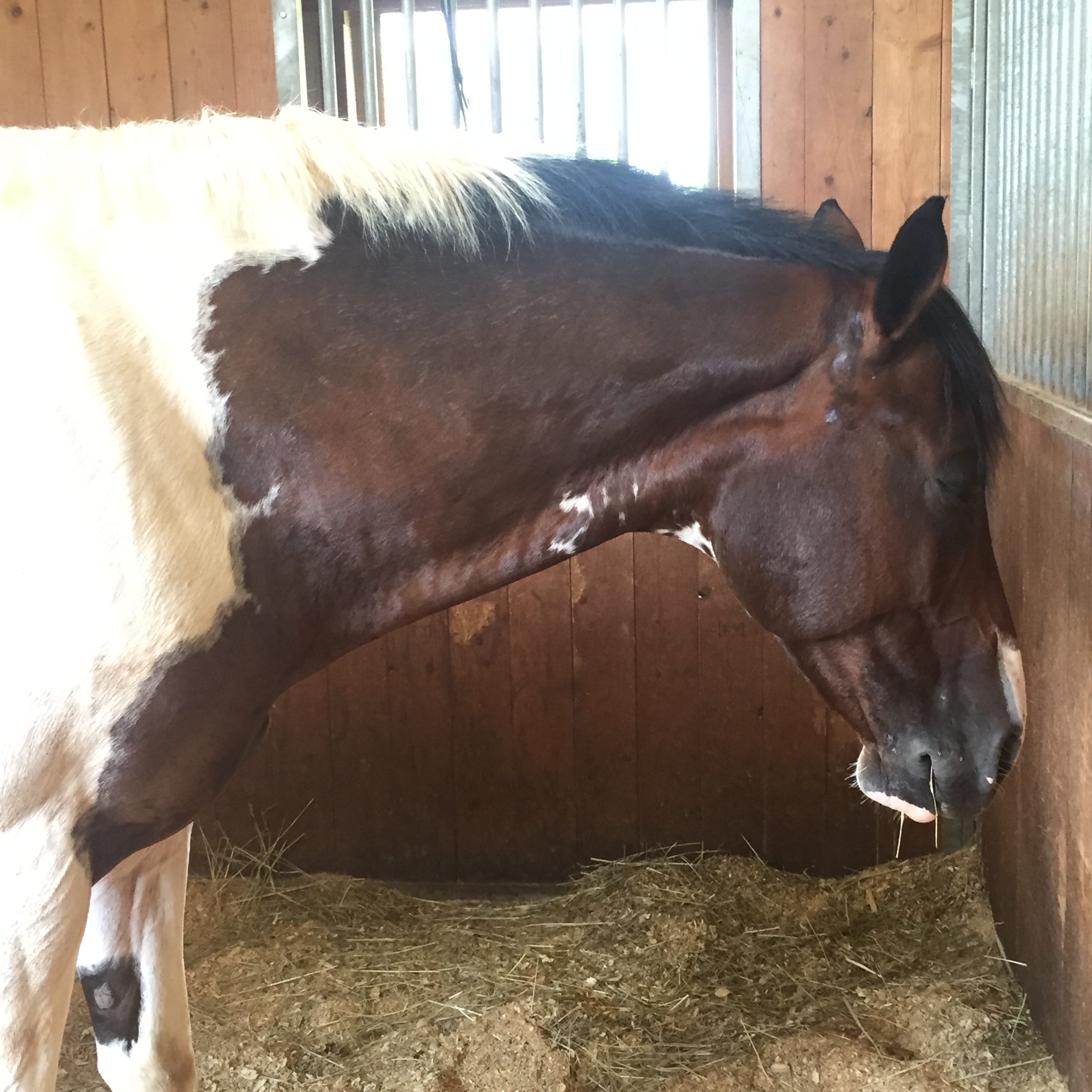
Feel bad for lightweight Fosterpants

Feel bad for lightweight Fosterpants

Of course pending how he is feeling over the next couple days, our plan is to take another cross country lesson with BC this Sunday. I’m a little concerned about not having really done much in the 3 weeks since our last lesson, much less having jumped. But still it will be worth getting out and galloping before the big clinic, which is coming up fast and furious. I can’t [don’t want to] jump Foster before our lesson because I feel it would be unfair to jump any sooner than Sunday, so we will do our best with playing with ground poles and me just getting the hang of really riding in a jump saddle again.


An update on the NQRness

Last Wednesday, after looking at my calendar and seeing that the NQRness/wonky shoulder stuff hadn’t really improved in a week and a half, I decided to get the vet out. So Friday afternoon I met the vet at the barn, prepared to show her my lame then not so lame horse on the lunge.

IMG_0767

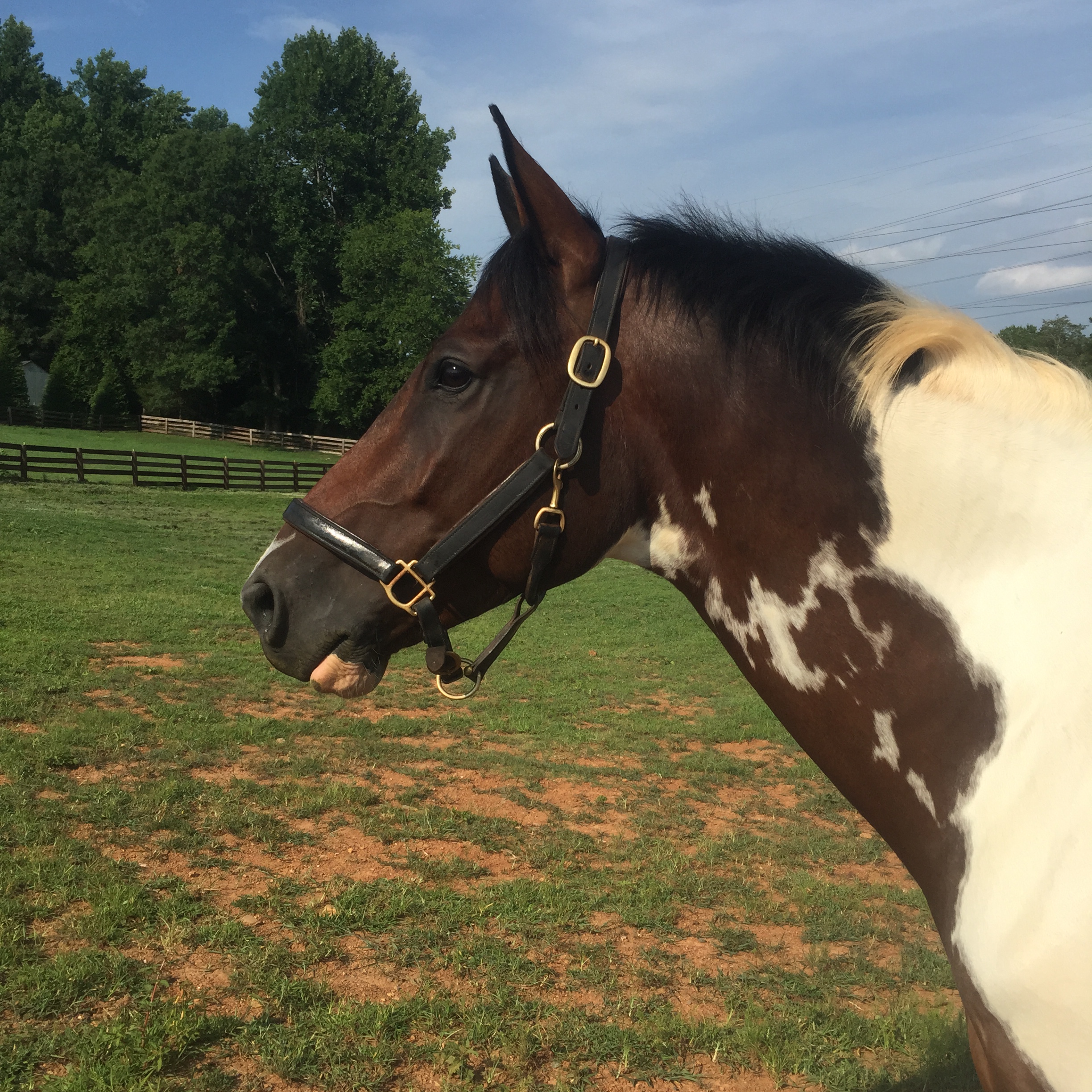
In an unrelated photo, I attempted to clean his halter. I bet it won’t look this way tomorrow.

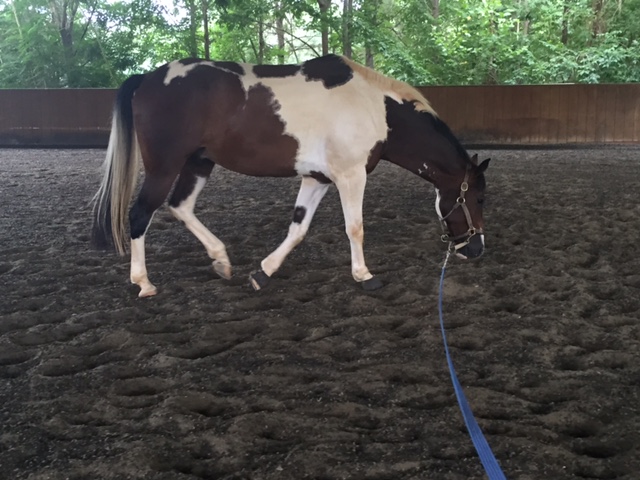
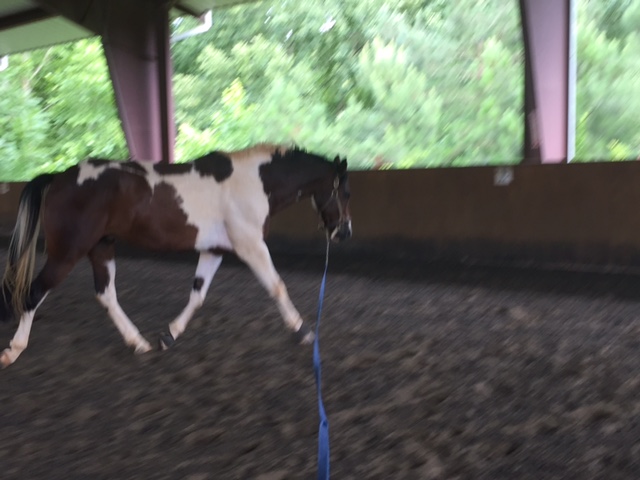
Well, as soon as I put him on the lunge, he looked completely different than the previous 10 days. No head bobbing, no super short front left. Instead, we both saw a slightly off hind left. Every few strides he would get a hitch in that hip, but nothing mortifying and though the vet called him “serviceably sound“, we still proceeded with flexion tests.

To make a long story short, he had a weak positive reaction to both hocks. For my peace of mind, we put him on muscle relaxer over the weekend so that if he improved he would know it was a simple soreness thing, but really deep down I know there’s not much chance of avoiding more injections.

It's mutual, buddy.

It’s mutual, buddy.

Now that the weekend is over, and I have poured over the videos taken from each day in order to compare the progression, he still takes the occasional funky step. So, while I’m glad to have my horse feeling better regarding soreness and in general, he’s still in a place where he can be improved- hence another date with the vet this afternoon. I admit to being slightly disappointed at having to inject again so soon. Goodbye, money!

Foster and the NQRness

Right as we start to gain momentum, we have another setback. But that seems to be the way with horses, right? Two steps forward followed by one step back.

Ever since the amazing lessons in Southern Pines (here and here for the recaps), Foster has been Not Quite Right. The day after the lessons he was given off, then that Tuesday I hopped on to do some happy stretchy work. At the trot, something immediately felt funky. As I hemmed and hawed and asked the other rider in the arena what they were seeing, I felt him gradually get better, until neither of us could detect anything wrong.

Getting that stretch on the lunge line

Getting that stretch on the lunge line

The next day, and pretty much every day subsequent, I have thrown him on the lunge to see what’s going on, and every day has been approximately the same. As he first picks up the trot he is somewhere between slight-head-bobbing-lame and short-and-stiff on his left front, but as he continues going around it gets better and better. In less than 5 minutes he is moving quite freely and forward, and the only thing detectable is tension in his topline in the left canter.

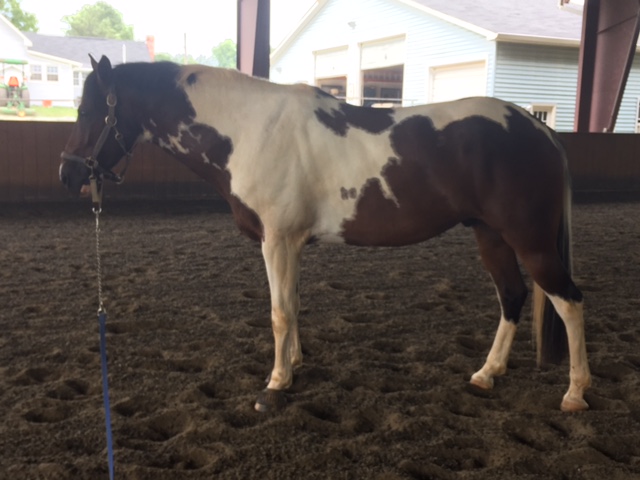
And for stopping, we like to take conformation photos

And for stopping, we like to take conformation photos

I had hoped that it was shoe related, even though I wouldn’t expect a foot issue to get better with work, but after getting shod on Monday he is still no better. There is no heat or puffiness in his legs, no response to hoof-testers all around.

sound horse is not-so-sound

sound horse is not-so-sound

So I had a professional in equine massage/bodywork take a look at him, and when she saw him first go on the lunge she was amazed that he would work out of it, but as usual, he did. Her palpations did reveal a reaction in the top of his left shoulder and slightly in his right sacral area, which pretty much confirmed what I had been seeing. Everywhere else he actually is better than average, so the pain seems to be localized to those two places. I gave him a dose of Ulcergard and a gram of Bute and tossed him outside.

seriously, horse loves to stretch

seriously, horse loves to stretch

The vet will be coming out on Friday to assess the situation, which I believe is a “tweaked” shoulder for lack of a better word. Our pending BC lesson this weekend is cancelled, and I am hoping (likely in vain) that there is a quick fix that might salvage our planned lesson next weekend. And of course that clinic at the end of the month.

Keep your fingers crossed- there seems to be lots of bad lameness juju going around!

Let’s Discuss: Humble Pie

It’s no secret that eventing is a sport that honors humility. But the collective equestrian world is also a community that knows what it’s like to experience the highest of highs and the lowest of lows, and champions those that can admit mistakes and come back stronger. I like to think that humor has a place in such a world, but maybe that’s just my own coping device for dealing with my own embarrassing moments.

We’ve discussed here on this blog plenty of times that I’ve done stupid things. Hell, if there’s visual proof, I’ll even make a gif out of it. But there’s plenty of stories in the archives that are worth sharing too. Today I’ll share with you my most embarrassing dressage story. Because, you know, it’s Tuesday and I haven’t made a fool of myself yet this week.

Fine, fine, I'll share it again.

Fine, fine, I’ll share it again.

Let’s just run through some of the better dressage moments, and not even touch on those missed leads, or jigging through the free walk, or being told flying changes were not required in a Training level test (bonus points for flair and pizzazz? no?). I’ve been eliminated for not being able to get down centerline. I’ve almost gone off course in a test, with a reader. I’ve ridden a horse that literally screamed every 10 seconds through the entire test, and I’ve ridden a different horse to be told by the judge that I shouldn’t be riding that horse. And let’s not even talk about my ride at the National Intercollegiate Dressage competition. There are some things you just can’t forget.

Judge's Comment: Movements not required at this level

Judge’s Comment: Movements not required at this level

No, my most embarrassing moment in a dressage court took place when I was a teenager. And I fell off. In a dressage ring. Off a pony.

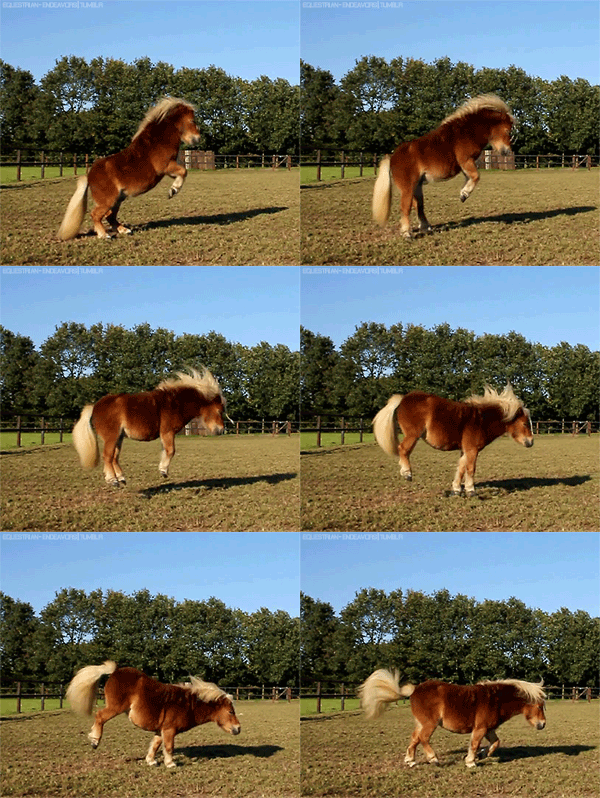
If you don’t remember him from here or here, Mac was a young Haflinger stallion that I evented in high school. While he had a bit of snarkiness in him (pony + stallion – watch out!), dressage judges loved him. I remember, at a little schooling dressage show down the road, I was in the middle of a great Training (dressage) level ride on Mac when out of my peripheral vision I noticed a horse’s head bouncing along the top a hill. Funnily enough, Mac noticed it too, and threw a buck in his surprise and excitement.

bucking

Yup, pretty much like this

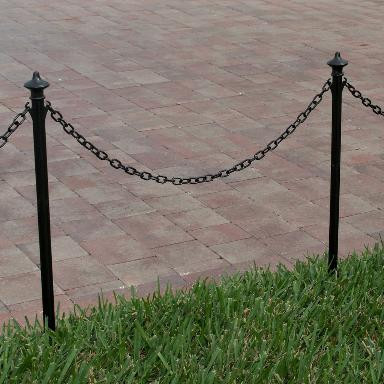
It must have caught me off guard, because the next thing I knew I was on the ground. And adding insult to injury (wait, reverse that), I had landed on one of the metal stakes holding the chain link dressage fence, which must have caused a temporary blackout because when I came to, my then-trainer was leaning over me, trying to straighten the stake which was now bent at a 90 degree angle from its encounter with my backside. While she was doing her best to fix the situation, she was hastily whispering to me to get back on the damned pony, and finish my test (remember this was a schooling show). I remounted, and then had to wait with my head hung in shame as my trainer and other volunteers attempted to mend the perimeter fencing. You know what’s worse than embarrassing and hurting yourself in front of strangers? Sitting in an arena waiting while those strangers can fix the thing your butt/back broke before you can recover from the incident.

Luckily I was not impaled

Luckily I was not impaled

In the end I did finish my test, but mortification is about the only way I can describe my emotions. This just about beat out the moment I realized I had spent the afternoon walking around the mall with a 7 inch long rent up the backside of my pants. Well, just about. I’m told that as a teenager your humor gland isn’t always fully developed, so humor as a coping device didn’t happen until much later. But to this day, it is still my most embarrassing moment in a dressage ring. Thankfully, I like to think that means that there’s not much else I can do worse than fall off, which kind of takes the pressure off of being a DQ. Silver linings and all that.

What is your most embarrassing moment? How did you handle your slice of humble pie?

Drawing the Bigger Picture: Part II

This didn’t get out Friday because I got caught up at the barn, trying to assess whether Foster is still sore from our jumping last weekend, or if there is something shoe-related going on there. I won’t even consider that it might be something else until tomorrow. *Sigh* Anyways, until then, here are the rest of our brainy break throughs (part 1 here) from the week of lessons.

fb_IMG_3127

Effectiveness of the Seat
To be a dressage queen is to have a good seat. But the seat is also important in jumping, as the rider has to make decisions about two-pointing versus sitting versus sticking close to the saddle (the last is BC’s phrase, used before XC fences). In dressage, I am really focusing on using my weight properly in the half-passes. I’m also working to fight against my own natural confirmation, the dreaded hollow-back ghetto booty combination, that makes it hard for me to stick with the full circle of movement my hips should make in the canter. For showjumping, Bobby emphasized a lighter seat and as previously mentioned, moving from galloping position to sticking “closer to the saddle” upon approach. One seat, used lots of different ways!

Locked on the fence- also, this photo just makes me laugh

Locked on the fence- also, this photo just makes me laugh [Portofino CT Oct 2013]

Commitment Issues
Damn all that baggage of the past. Committing to a course of action is an absolute necessity with jumping, and being less than confident can sometimes have dire consequences. BC picked up immediately on when I became anything less than a fence-eating-machine, and as of course, so did Foster. In his words, I am not to ride pathetically, and having that confidence and grit will help me be a quieter rider by not feeling the need to make any “big moves” in front of the fences. For dressage, commitment means being clear in my instructions and the level of my expectations. Even if it is a trot to walk transition, the horse should “land” going forward and in a good balance, not petering out or falling on the forehand into a lazy amble. It’s up to the rider to commit to asking for all those details, and thinking about these things until it becomes habit.

JumpLesson2

Thinking about the Landing
How many times have I heard this one? Probably a bajillion times, but it really resonated when BC asked us to halt in 5 strides after the gymnastic. That shit is hard. And why is it hard? Maybe because my horse is not used to expecting something to happen on the landing. Halting after fences is one of the big take-aways from our showjumping lesson, and a wonderful exercise for getting a horse listening. In the June Jump lesson, we did something similar in making small circles after landing from a fence before continuing on to another element. And guess what- in dressage, you know what is a great way to get a horse focused on you and “keyed up to your seat”? Transitions. Forward, backward, halt, etc. Never should we just careen around the arena without a plan, and that was the point I’ve finally figured out this week.

It’s going to take real discipline to remember all of these, and surely there will be times when I forget one or more of these major points. On the flip side, I really do think that if anyone can master all of these issues they would gain major ground in becoming a better rider. And that is, of course, what I aspire to be.

Drawing the Bigger Picture: Part I

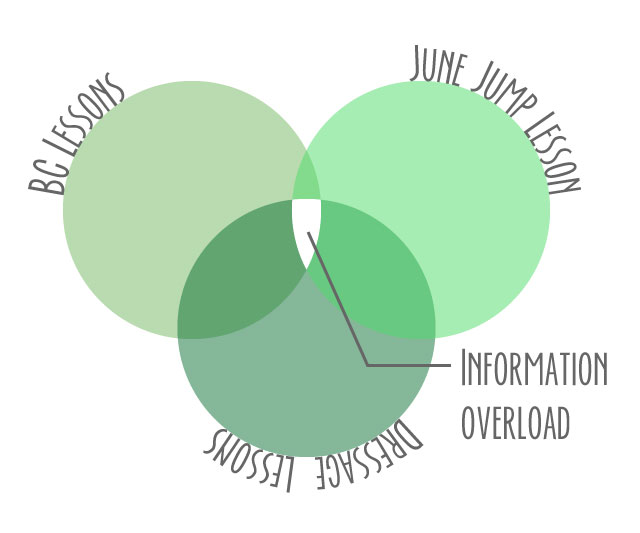
3 trainers, 8 days. Information overload? Just a little.

venndiagram

In many ways though, the lessons do overlap, even though each trainer had different ways of communicating the same things. Here are some of the theories that I’ve noticed transcend two or more of the lessons in just a short time period.

Response to the Aids
Foster should always be listening (ideally), and always waiting for the next cue. We’ve been together so long that sometimes I fall into being repetitive or allowing him to be ho-hum, which makes communication when I really need him a challenge. In our June jump lesson, the trainer had us do canter walk or canter halt transitions and incorporate turn on the haunches or turn on the forehand to keep him thinking about balance and reactiveness. In Bobby’s showjumping lesson, we focused on halting after fences or a line, to keep him coming back to me as the source of instruction. Both accomplish a horse that is listening and reacting quickly to my aids.

My [mental] picture of the right canter

My [mental] picture of the right canter

Focus on the Canter
The quality of the canter in showjumping is everything, and Bobby stressed that he be balanced and active when approaching fences. Similarly, in our dressage lessons we have been working on increasing the activity of the canter, which teaches Foster to sit while engaging his hind legs. Even though the truly collected canter is not a gait that you would use through a showjumping course, the idea of increasing engagement certainly translates.

[From the Clinic] Bobby Costello shows us how to use both hands and outside aids to make a turn to 9

[From the Clinic] Bobby Costello shows us how to use both hands and outside aids to make a turn to 9

Following with the Hands
All three instructors have now said something to this effect, which is saying something. In my June jump lesson, she reverberated pretty much word for word what BC said in the February clinic– push your elbows to the fence. With dressage, this really comes into getting the most out of the free walk by actively following the bit with my hands- even if there is slack in the reins, the horse can feel it and likely take that room to stretch down. With the collected canter, this comes as making sure that I am not constantly holding, which would make him heavier and heavier in my hands.


Tomorrow- 3 more things that have been beaten into me this week…

Bobby Costello XC Lesson Recap

Sunday morning was cool and lovely, which was a relief after having survived the massive storm the night before, complete with intense lighting that almost made me spill my red wine into my lap and even a tornado watch.

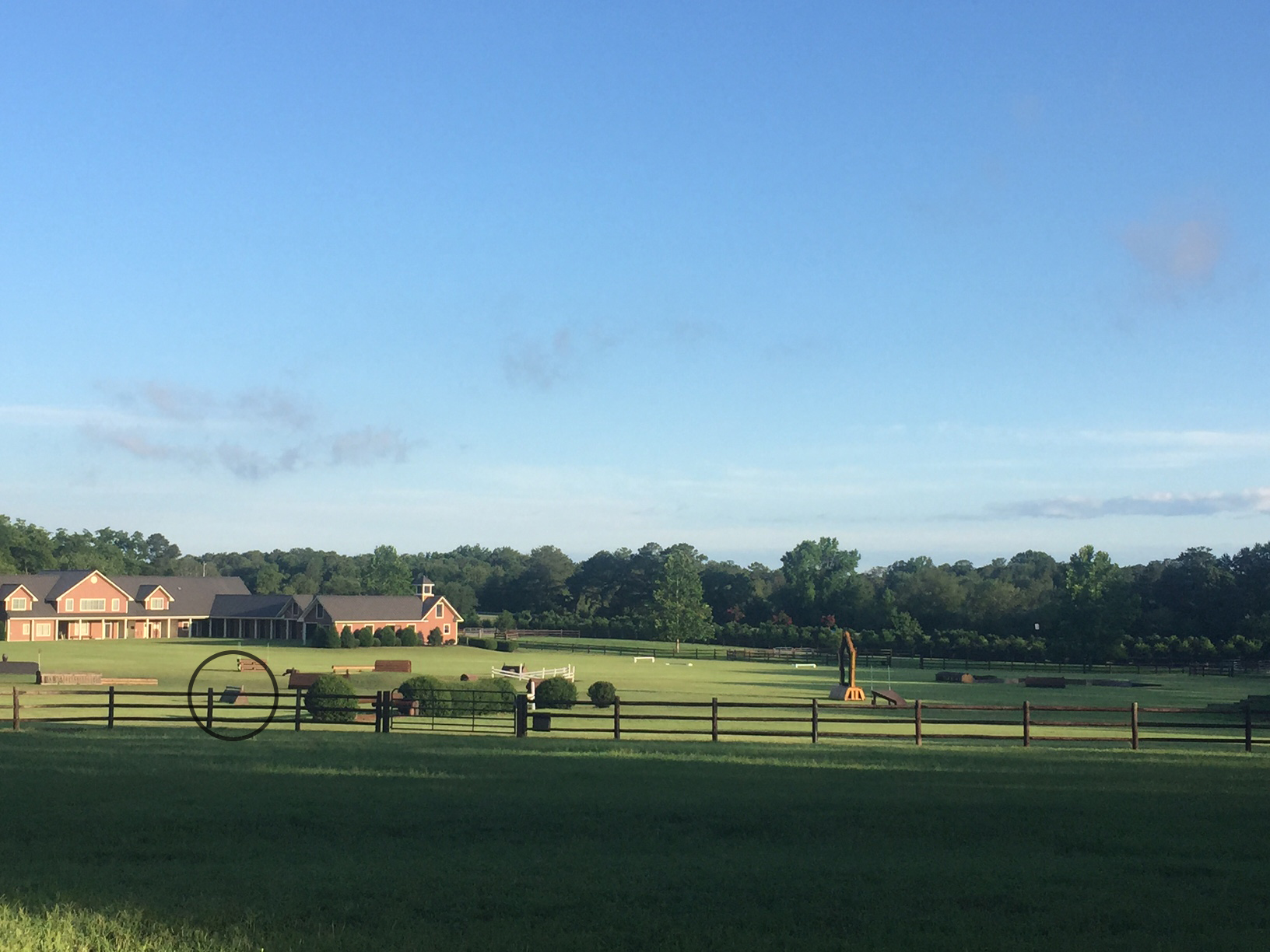
The facilities at Winterbook Farm are immaculate, but obviously cater to a crowd much more experienced than Foster and I. Anything that was below Novice (as in 3 Novice fences) was placed in extremely technical positions (like after a one stride up a hill from the biggest freaking ditch you’ve ever seen in your life), so warming up was somewhat interesting.

The stunning Winterbook Cross Country field

The stunning Winterbook Cross Country field

Just like the day before, Bobby wanted to assess my position before actually jumping anything. Apparently I fooled him once again into thinking my leg was solid, but he encouraged me to press my knuckles into Foster’s neck and stay there between fences.  As obvious as this is, it’s hard for me still, as with dressage and showjumping I am ever seeking that straight hand-to-bit line and in XC this makes my hands float around in the atmosphere.

Case in point

Case in point

From there we warmed up over the one baby fence a couple times (NBD) and then aimed at a solid Novice coop, to which I asked for a flyer distance and instead got a shitty chip. Hello, confidence problems. I revisited the coop and told myself not to be a pansy, and it went much better.

The one thing I told him I wanted to look at was Foster’s launching off of banks and issues with drops into water. So we started with the bank complex, and discussed really sitting up straight and slipping the reins at the top- to which I nodded, yes, I’d heard that plenty of times. However, it turns out in execution I have come to expect a big move, which causes me to clutch at the top of the bank, which in turn makes Foster feel like he can’t use his neck and therefore he launches himself. How bout that perpetual cycle? Immediately when I actually slipped the reins and sat back he dropped very casually. We ended that segment by going up a steep hill, one stride to a down bank, then 2 or 3 strides to another down bank. Beautiful, done.

A better view of the course, with the Novice coop circled

A better view of the course, with the Novice coop circled

We popped over a couple ditches and Foster confirmed that ignoring all else, this horse is not ditchy. So we moved on to the water complex. Foster had trotted through it for warmup, so we started by jumping a small fence coming out of the water up a small hill. He did this fine, so we reversed and jumped the fence back into the water. Enter my commitment issues, stage right. While he scooted over it, I got some very stern words about being confident about it and so we went back through a few times, getting better and better.

When on our third attempt he jumped it boldly, we moved on to dropping off banks into water.

Ugh, water drops.

I’ll be completely honest, the trouble lies with me. I feel Foster debate the obstacle, and I hesitate. My hesitation turns into him stopping, and us dancing at the precipice of the bank with no clear way of getting down but to re-approach. With lots of coercion, we finally got in, and then repeated the process until it was coming easily. But when we moved on to a higher bank and included a super long approach, I had the exact same issues. Again on re-presenting we made it happen, but I need to be in the habit of thinking “do or die” rather than waffling. You don’t waffle over cross country obstacles.

More of this please, and less of that

More of this please, and less of that

We ended on a good note, but I’m eager to repeat the process until that cross-country grit comes back. I’ll be coming back to Southern Pines in a couple of weeks to try again, and I’m hopeful that in turn I will become bolder for the experience.

Bobby Costello Showjumping Lesson Recap

I’m still coming down from Cloud 9 thinking about our showjumping lesson Saturday, which took place in a beautiful jump field in Southern Pines.

Walking Foster from the barn to the field, it was obvious that he was amped. He couldn’t wait to get started, and refused to be distracted by the busy road or the scary tarp jump. Bobby watched us warm up so he could check out my position and Foster’s way of going. Immediately he picked up on the fact that Foster gets a bit overbent and hollow going right, and therefore is harder to bend left- yes, yes, and more yes. So we talked about riding him more straight to the right and really asking for the left bend. I was shocked to hear that he liked my own position a lot and thought I was solid with my legs, but throughout the lesson did ask that I keep a very light seat if I was going to sit.

BC Video Screenshot

Without losing time we moved straight into the gymnastics. At first it was just a small fence with a placing pole, and Foster wanted to play a bit with all that energy- I think he was just so happy to be out and doing it all again! But the small fence quickly progressed into a full gymnastic, that was slowly built up to a placing pole/vertical/onstride/cavaletti oxer/one stride/oxer/one stride/cavaletti bounce/one stride/vertical/placing pole. Each time I was directed to halt at the end, and at first this was difficult, but we were able to make it happen more and more easily as the lesson progressed.

Through the gymnastic we talked about where to check him as he tried to rush through, how to get that halt at the end, and fixing a right drift that kept creeping in through the middle of the exercise.

After getting a really good go through the final gymnastic we moved on to single fences/courses. Of course I decided to show off my love for chippy distances the very first thing, but the re-approach was much better.

Because of my last lesson doing everything with bend, I was initially inclined to put the first fence on a circle. But Bobby noted that he looked like he was actually caught off balance when I did so, and preferred that I ride straight lines for now to allow Foster a chance to balance himself and get his shoulders square. He did say that there is a time and a place for riding with a lot of bend, and often that was for teaching the horse to land on the correct lead (as we were doing in that lesson).

Can we talk about my horse's knees for a second?

Can we talk about my horse’s knees for a second? Let’s ignore the fact that I’m getting jumped out of the tack…

Much of the conversation that we had was about the pace, and that before the fence I could add to or maintain the pace/canter, but was never to hold for the spot. Focusing on the canter also stopped me from pumping as much, or “making any big move” before the fence as Bobby put it, that would throw Foster off balance by distracting him. Another point he made was in talking about those fences course designers love, the lonely single with the long approach. He said though it’s tempting, do not even think about a distance until you are four strides out. Instead, think about the quality of the canter until you get much closer.

At the end of the lesson I asked if I could retry the skinny gate, since I’d been having a hard time finding a distance to it, and was so happy when he sailed over from the perfect spot. This lesson was huge for both Foster and I’s confidence, and all in all he felt like a showjumping machine. I do see plenty of things for myself to work on, such as folding at the hips and maintaining a light seat, but for not having jumped so much this year I’m pretty pleased with where we are now.

Tomorrow- sadly no video, but we’ll discuss the XC lesson!

Dressage Videos

Firstly, I want to thank Tracy for setting up a fund so we can show some support for Lauren, who is bravely going through one of the hardest things imaginable. Though I haven’t seen Lauren in person since before she was married, those events have been weighing on my heart all week and it’s good to know how to help.

Secondly, I just want to say that I had every good intention of blasting you guys with videos of the majority of the lesson, but thanks to an almost kaput computer, you’ll have to settle for the highlights- Half-pass and Canter Work.

Hoping you all have a good weekend! Get ready for more lesson recaps next week 🙂

Dressage Lesson Recap: Half-Pass, Baby Piaffe, and Canter-Walk

Phew- are you guys sick of recaps yet? Well if so- you’ll get a brief respite until next week, when you’ll find out just how hard I got my butt kicked by BC.

Monday’s lesson was much a review of the lesson before, except that I felt like I had figured out a couple key concepts regarding the half-pass and Foster had a bit better concept of the piaffe cue. The main difference was introducing canter-walk transitions and bonus- videos!! I’ll post a couple videos tomorrow, for today screenshots and gifs will have to do.
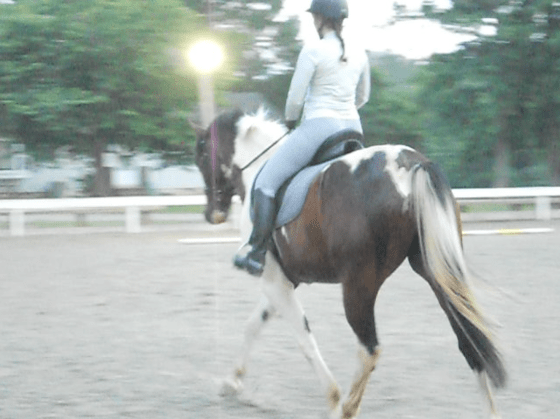
Working on the half-pass left

Working on the half-pass left.. and do I need taller tall boots?

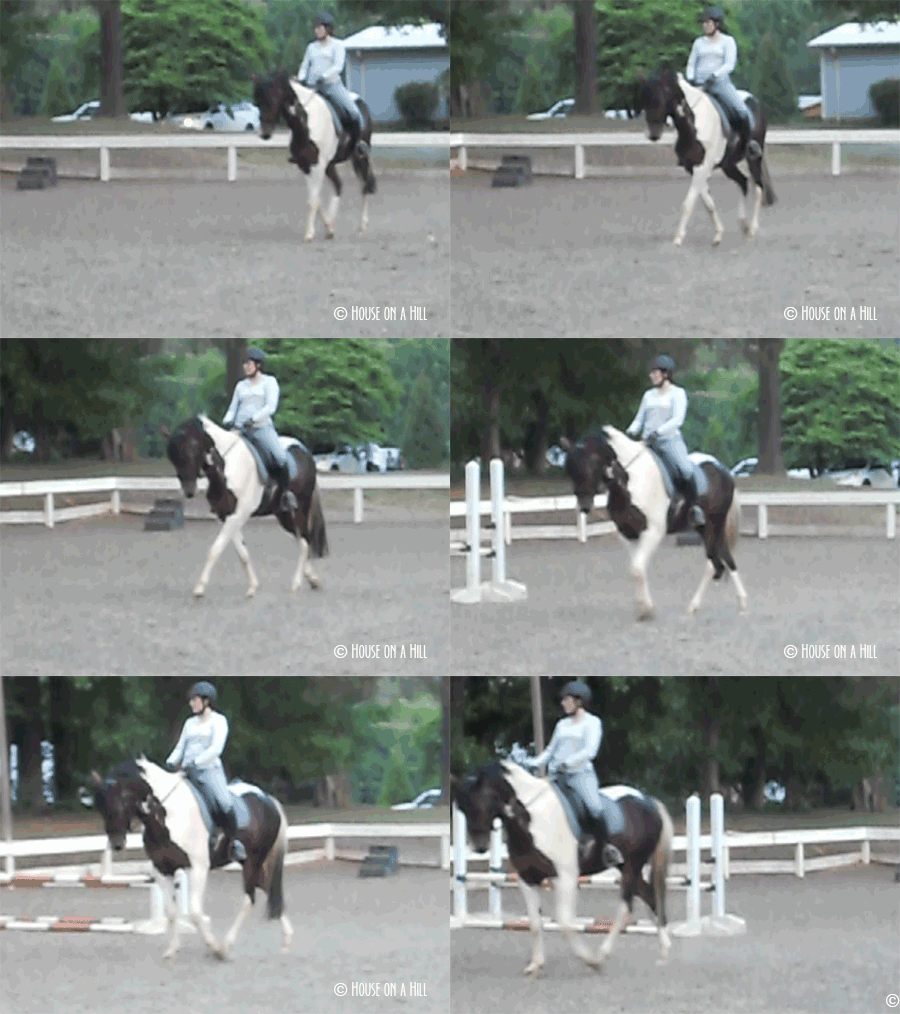
After warming up in shoulder-in and haunches-in, we started the lesson by revisiting half-pass, first at the walk and then at the trot.

Haunches in animated gif

Haunches-in for the win.. also I think I do need taller boots..

When talking about the half-pass at the clinic this weekend, I really had a lightbulb moment but only had half a schooling to try out what I had learned.  What I had been struggling with previously was having the haunches lead, when really it’s the shoulders that should be leading. Foster has picked up on the concept quite readily, but I need some finessing in my position to really be more effective- as in stop collapsing my rib cage, open my shoulders and body in the direction where I want to go, and keep that inside leg soft and bending the horse as he moves in that direction.
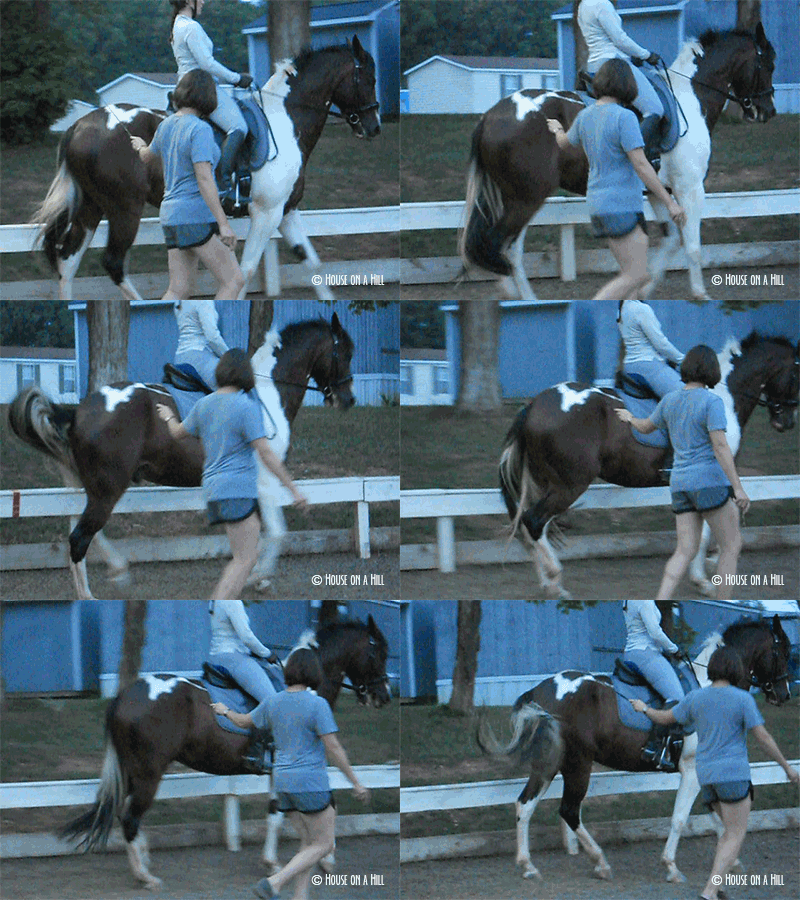
walk half pass animated gif

Walk Half-pass right

Following the half-pass, we went back to review baby piaffe and collected canter work. We are teaching the piaffe as a way to teach Foster to sit and have activity in his hind legs without necessarily going forward, which translates into the collected canter. Foster tries really hard to figure out the piaffe cue (a touch with the whip- no Fosters were harmed in the production of these gifs), but sometimes just doesn’t know what to do with the extra energy…

buck

and other times he starts to figure it out…
piaffe

Bounce baby bounce!

When he is starting to think up and under with his hind legs, we then move into the walk-canter depart, and I try to maintain the came level of electricity in his hind end. It’s tough, because Foster can be so laid back that he settles really quickly, and in this instance I want him to be amped.
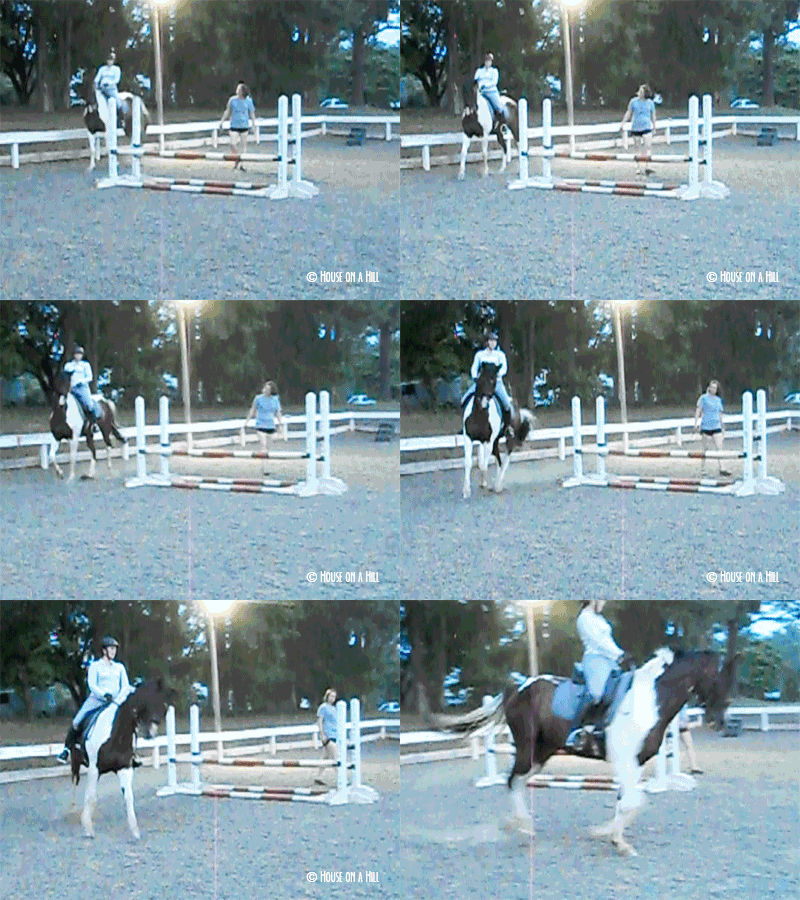
walkcanter

Since it was getting a bit late at this point, rather than hammer the collected canter we proceeded to start on those canter to walk transitions. These are brand-spanking-new to Foster, and it’s been about 12 years since I schooled them with Merry, so it was no shock that we didn’t achieve one right out of the gate.

canterwalk

Still, for his first attempts, I’m pretty pleased with how quickly he was able to sit and balance himself to walk, even if it took a step and a half of trot to get there. The tricky part of riding the canter to walk transition is to ride forward into it. For now, I am over-emphasizing my half halt in order to stop the motion of the canter, and purposefully thinking “halt”, which is what I almost got in my first attempts. Eventually my aids will become lighter, and I will be able to think about landing in a forward and balanced walk. But that’s probably some time away while we both figure things out.

Hind end: Engaged!

Hind end: Engaged!

As per usual, some quick notes regarding the lesson:

Canter-walk:

  • for now, might need to use more hand, but eventually this will lighten as he learns
  • Try using half halt at two different times- when I am deepest in the seat (when he is sitting) and when he is landing (stiff horses sometimes prefer the latter)

Half-pass:

  • Keep my weight left for left half pass
  • Do no let my left elbow become a chicken wing/collapse my left rib cage
  • Start with less angle to the haunches, I can always add more but taking away from the angle is hard to do quickly
  • Establish bend first then add the haunches (Half-pass and haunches-in)

Positioning Myself:

  • to the left think about allowing my left side to sink down
  • Tuck my tailbone under when sitting the canter so I “complete the circle” with my hips (rather than stop the motion slightly with my concave path)

Overall, the lesson was great in showing me the potential that Foster has, but like our last jumping lesson, that he needs to put on his big boy pants to accomplish some of these tougher exercises. On the same note, it’s become so much more important with these new movements that I am as effective and correct as I possibly can be, which is a struggle as I learn new things, or practice dressage that I haven’t done in over a decade.