Gaining insights from losing the bridle

Even though Foster isn’t with me at the moment, I thought it might be fun to share some of the things I learned from our last rides.

On a night when the cold temperatures kept the other boarders away, we had another nice quiet evening in which to test those bridleless skills again. Since I’m nowhere near as brave as Carly, so I opted to keep my saddle and again warmed up with the bridle, since who could say if our first ride was a fluke!
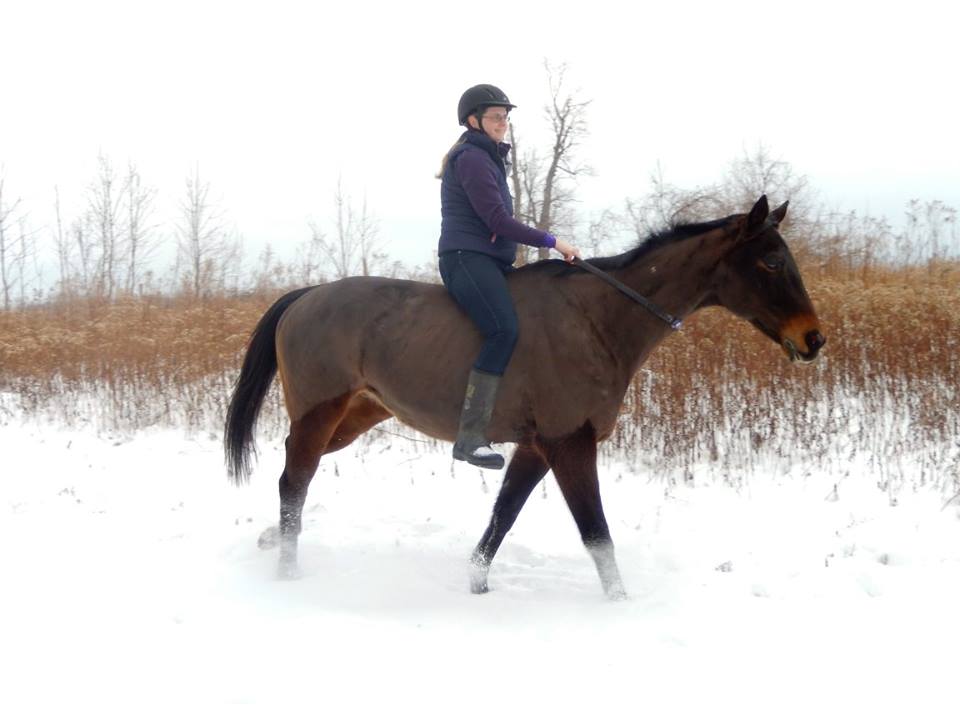
Carly of Poor Woman Showing, way more of a badass than myself

Carly of Poor Woman Showing, way more of a badass than myself

When things seems to be going just as swimmingly as the time before, I slipped the bridle off and played around a little more.

I wanted to see if I could do lateral movements without using rein aids, and in general these exercises were fairly revealing.

First, it became quickly obvious to me that Foster wants to continue to lean on the left shoulder. Considering the weak front right fetlock and right stifle issues, this really isn’t all that surprising in itself. I suppose what was nice to note was that the leaning isn’t also in part due to my less-coordinated left side, since there was obviously no rein for me to flail around.

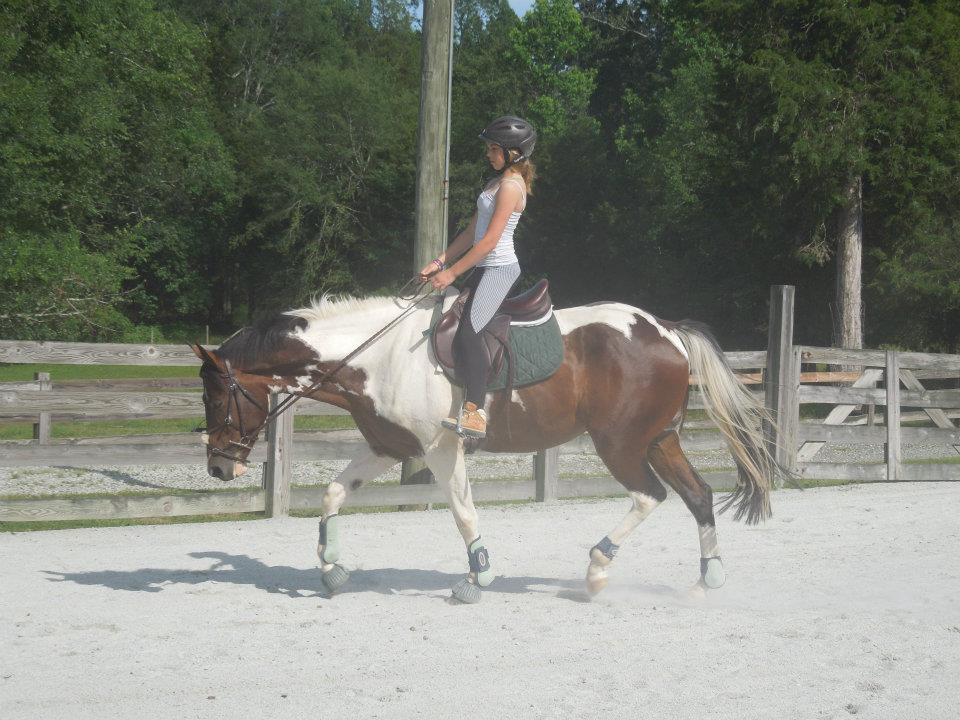
I was also surprised that I had more control of the shoulders (bar a bit of leaning) than I thought I would have with no reins. Granted, I am still using the neck strap as a “blocking” aid for the shoulders when need be. So we practiced leg yields and some other transitions, as seen in the video below.

Since this ride I’ve also introduced riding in the arena bridleless with other horses around, as I didn’t want to waste an opportunity to play just because others were also riding. Though I played fairly conservatively and picked my moments to try certain things, Foster continued to be a champ. I even peer pressured got my friend A up on him with no bridle, and she was able to walk, trot and get transitions without reins.

Overall, I’m glad I tried something new, and was able to learn from it. If Foster comes back we will continue playing around with no reins. And if not, well, here’s hoping the next horse is just as great at helping me let go.
The next house [on a hill]

So we wrapped up last week but having our offer on a new home accepted, and I think the husband and I are still trying to pick our jaws off the floor. Of course with these situations, nothing’s over until the paperwork is signed, but we’re still pretty stoked about how things are going so far. Once it’s all said and done I’ll be sharing pics- but here’s a hint- the blog’s name won’t have to change! 😀

Foster also moved to his hopeful-permanent home on Sunday, but not before taking some photos at our barn. He seemed to remember the barn (since he lived there for 3 years) immediately, since he started playing with the cross ties and licking everyone in sight. His Fosterparent took him on a trail ride and he was a very good boy, then we turned him out in a giant field where he immediately made friends with another gelding. Foster obviously loved having someone else’s face to nibble on and play with!

So now begins the two month trial period, and hopefully the life of a trail horse will suit Foster and the 3 of us (Foster, Fosterparent and I) will be thrilled.

_DSC0872


The Foster-Parent Plan

How odd is it that I’ve had this horse for 5 years, and never thought of that pun! Missed opportunity.

The lady who actually made the joke is a sweet woman who recently lost her elderly trail partner, and has been looking for a tall, non-drafty trail riding horse that she and her husband could love on.

Enter Foster.

Since this person boards at a facility that I am very fond of, and where many of my friends still board, I’ve been inundated with feedback on just how wonderful she is and how she and her husband are great horse-owners who treat their horses like part of the family. The fact that I wanted Foster to go to this particular facility anyway, with its lush pastures and immaculate care, was also a huge plus. So we arranged a meeting where the couple could come meet Foster and she could take him for a spin.

Foster was in full fledge Foster-mode, that is, licking everything/everyone, playing with the cross ties, and in general being an absolute ham. He just loved that there were 3 people giving him undivided attention, and I let the couple see how he does his neck stretches and smiling at liberty. They seemed enchanted, but I was reserved until the first ride was over.

Foster being Foster

Foster being Foster

I hopped on Foster first, letting the reins flop and walk, trotted, and cantered him around the arena. I wanted them to see him with the most minimal of aids, since of course they aren’t interested in a fancy pants dressage horse. All good, and so she climbed aboard.

Apparently, being avid trail riders, it had been several years since she had worked in an arena. Yet she walked and trotted him around and I smiled watching Foster’s ears flick back and forth as he tried to figure out exactly what she wanted. He stretched down into the contact and happily packed her around the ring.

Foster packing around a much younger rider (13?) many years ago

Foster packing around a much younger rider (13?) many years ago

She asked if she could canter him, and I said absolutely. My nerves were at a high at that point in time, since it was going so well, but Foster had been ridden for 5 minutes in the last 2 weeks, and though he’s always such an angel, I’ve never seen a novice rider canter him before. But she sat back, put leg on, and got a beautiful walk-canter transition, and proceeded to lope around the arena, giggling.

He makes me giggle sometimes too

He makes me giggle sometimes too

It was in that moment that I knew this could be a great match. She thanked him over and over for being a good boy, gave him a huge neck hug, and dismounted. Over and over she exclaimed how she was shocked at how much fun riding in an arena was, and fussed and fussed over him as he was untacked. Foster officially had earned himself another fan.

We’ve been waiting in the weeks since that meeting for a spot to open up at the facility, and finally it’s happened. Foster will move there in a week and a half, and start a two-month trial period in a new career as a trail horse.

To say this experience is bittersweet to me is an understatement. I’m sad to be handing him over, devastated that the future I imagined for us is not to be. But I can’t help but think that if this arrangement works out, it will be better than any solution I could have dreamed up. We’ll see how those two months go, but for now, I’m grateful for this opportunity and for the memories with him that I will cherish forever. Always in my heart, Fosterpants.


Change is in the Air

This is potentially a big week for me and mine.

The house is in the last stages of prep for going on the market. Therefore a house hunting we will go.

The horse, well, it looks like we’re about to implement stage 2 of his competition retirement.

And this weekend I’m potentially off to explore a business venture that could be super fun and exciting.

But with all this, we are also concerned with more family health issues. And family comes first.


I hate to be so cryptic, and hopefully I’ll be able to share soon.


Let’s Discuss: Helping the Helpers

Most (but of course not all) of us keep our horses at boarding facilities. So unless you work at a co-op barn, or own your own place, you’ve learned the value of a good barn manager.

Flynn_20151013_156

I’ve learned over the years that a barn manager can make all the difference in the world, that a so-so facility can be the best option with a good person in charge, and likewise a great place with a poor manager is reason for instantaneous departure.

These good barn managers are worth their weight in gold in my eyes. And the qualities that make them so valuable?

First and foremost, they put the horses first. They are observant, and take the time to notice if something is out of sorts with a horse, whether that be suspicious rolling or a lost shoe. And they communicate- keeping the owner or leaser in the loop and collaborating on details such as nutrition and turnout. They do the absolute best with what they have to create a safe place for the horses, even though that may mean taking on tedious projects and longer hours in return. And all this, often with no extra reward or compensation. Pretty much, they are gator-driving, muck shoveling angels.

Fairntosh

[PC: Robyn Van Dyke Photography]

To show appreciation for the hard work that these guys (or gals) put in, I like to try to make things easier for them wherever possible. If smartpaks make life easier, I’ll order smartpaks. I’ll make horse cookies to stuff medication in, so he doesn’t have to wonder if the horse got his meds. I’ll pick out the stall whenever I have time, refill the water, and change blankets when need be. And when helping out isn’t possible, I’ll bring beer as a token of appreciation.

I know I’m not alone, as I see many of my fellow boarders put in these little “favors” to help a good manager out. After all, we all know how lost we would be without them.

What do you do to help barn management? If you own a facility yourself, what do/could your boarders do to help you?

Branching out and going Brideless

While I still try to figure things out with Foster (we’ve got a wait-and-see timeframe of about a month), I’ve been wondering what I can do to stay motivated. It’s been hard not to get sour doing lap after lap around the covered, so, why not try something new?

Unless you count younger days lounging aboard my pony in the paddock, riding without [horsey] headgear is something I’ve never done. So, I read all of one google article on getting started, and decided Foster was a great candidate to try- he knows vocal cues (albeit on the lunge line), responds to leg pressure and seat, and is just generally a good guy.

brideless

I started out with a bridle on and the reins knotted high up on his neck. At first I was relying more on the neck strap (a crusty old stirrup leather in need of conditioning) than on my leg pressure, and while we had ‘whoa’ and ‘go’ ok, turning was a bit tricky. But we quickly figured it out and soon we were navigating the arena with ease.

So, you, know, why not take things to the next level. I turned on the camera again, and asked Foster to turn his head so I could slip off his bridle. I then chucked the bridle in the corner, and had our first go at for-realz bridleless riding. The trot and canter actually were surprisingly more easy to control for me, so I played around with walk-canter, and turn on the forehand for giggles.

Obviously, as you can hear from my constant nattering to Foster, we had a blast. This was just the ride I needed after a day in the doldrums- doing something new and exciting and proving once again how awesome the spotted pony really is!

Let’s Discuss: Return of the Quagga

First of all, thanks to all who chimed in on the inside or outside sock debate. Trivial as it may seem, I loved reading everyone’s comments and it just brings to light one more personal way we equestrians differentiate ourselves! Today’s discussion falls mostly in the world of science and ethics- all regarding a lost equine called the Quagga.

"Quagga in enclosure" by Frederick York (d. 1903) - http://openlibrary.org/books/OL18018139M/Extinct_animals. Licensed under Public Domain via Commons - https://commons.wikimedia.org/wiki/File:Quagga_in_enclosure.jpg#/media/File:Quagga_in_enclosure.jpg

“Quagga in enclosure” by Frederick York (d. 1903). Licensed under Public Domain via Commons

When I was a kid, I had this giant encyclopedia of the Animal Kingdom, which was my favorite possession ever. At the back of that book, it had a section on extinct animals, including the Quagga. I basically memorized this encyclopedia front to back (so much so that my second grade teacher called me Capybara, for my random outbursts of facts on overlarge rodents) to the point where it had to be bound together with duct tape. But the Quagga especially became a cool idea to me, and I remember it popping up in my schoolwork- for instance “create a new animal day” in second grade was a pegasus quagga.

So I found this article on CNN fascinating- a project to recreate the quagga through selective breeding of certain zebras.

"Agasse Quagga" by Jacques-Laurent Agasse - http://www.artprintcollection.com/p668184721/hD664CB2#hd664cb2. Licensed under Public Domain via Commons - https://commons.wikimedia.org/wiki/File:Agasse_Quagga.jpg#/media/File:Agasse_Quagga.jpg

“Agasse Quagga” by Jacques-Laurent Agasse. Licensed under Public Domain via Commons

Can you imagine, a “new” species of equus, raised from the dead? Is it right for conservationists to try and return an extinct species to the earth? Is it OK if the project involves only breeding, and not cloning? Or should cloning be introduced to the project to right man’s wrong? Weigh in with your opinion!

For more information on the Quagga Project, visit their site here.

Let’s Discuss: Under the Tall Boots

Every tack store has them somewhere, normally near the cash register where you are most likely to add an impulse buy to your order- and that is, socks.

Oh yes, this is a post about socks.

I’ve never quite understood the whole equestrian sock thing. What is different about these socks? Will they force my heel lower, and make me ride like Allison Springer? Will they fix my turned out toes when jumping? Will their oh-so-cute patterns make my horse believe I’m suddenly some kind of magickal being and not just a so-so adult amateur? I don’t think so.

Allison Springer. I love her.

Allison Springer. I love her.

When I’ve been given pairs of them (typically freebies coming with big purchases like new helmets or tall boots), I’ve found most of them of the slinky variety, and when wearing them with boots, feel like my foot slides around inside the footbed (though it really isn’t, just the sensation). Now I do realize that the slipperiness of the fabric would help with pull-on tall boots- but really, who has pull-on tall boots these days? All hail the zipper!

Which brings me to my next point- socks inside or outside the breeches?

I’m a creature of habit. When I was little, I wore jodphurs with the best of them- and when you wear jods, your socks go underneath, lest they be showing all the time. So when I graduated to tall boots, I kept it that way. Granted, my first set of tall boots were also zippered, but still- the habit went deep.


heidi

Once upon a time I was cute AF

Why is it that most people wear their socks on the outside of their breeches? Is this again a function of pull-on tall boots? Or did I go through puberty without learning some key lesson regarding footwear etiquette?

Or you know, no socks. Because water.

Or you know, no socks. Because water.

So in the spirit of silly Fridays and posts about socks.. chime in! Socks in or out? Special socks for riding? What’s your preferred way of padding your paws?

Bobby Costello XC Clinic Recap

It’s no secret that I’m a fangirl of Bobby- if you’ve met him, you’d know why. The guy knows his stuff, is funny as all get out, and somehow inserts both serious knowledge drops and biting humor into every lesson. Or in this case, clinic.

So when my friend Ali decided to participate in a January clinic in Southern Pines, I was immediately on board as groom. I was stoked to pick up new tidbits and more than happy to return the favor of videoing, since Ali filmed my lesson with Bobby last summer.

Any memories of a warm summer day when we had last been there quickly were replaced but what could, by North Carolina terms, be called the blizzard that started as soon as we rolled up. The snow was coming down at a hellish pace, but when we saw the first group of riders hacking to the cross country field, we started up our toe warmers (and donned every layer of clothing on hand) and prayed for the best.

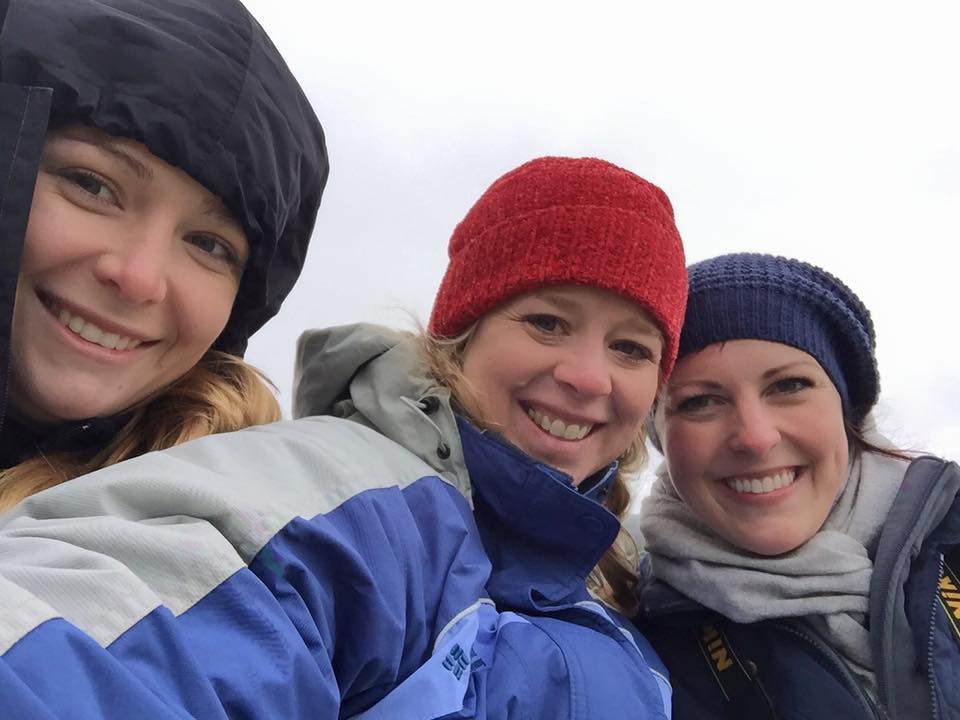
Spectator selfie- trying to stay warm!

Spectator selfie- trying to stay warm! PC: A

Thanks to the elements, it was occasionally hard to hear everything being said, but here are three key takeaways from the day.

First – shoulders over hips- do NOT get ahead of the motion.
In cross country, where terrain is often part of the question, it’s important to sit back and allow the horse the balance to do his job. Also, the adoption of a more defensive position can make for a safer ride and being with or slightly behind the motion can channel a nervous horse more easily. I loved the visual of “shoulders over hips” as you can immediately see it in other riders as well as use it as an alignment cue for yourself in the saddle.

Break down the elements.
With every group, whether Beginner Novice or Prelim, he started combinations or exercises with the most simple approach, and then added elements from there. Each session started with working on the gallop position, and then over a small vertical, before moving onto the day’s work. For the bowl combination, first riders went through just the bowl, followed by adding in a small vertical, and then putting together the vertical, bowl, and hanging log to finish off. Bobby was great for instilling confidence in both horse and rider by taking this approach to combinations.

Push outside the comfort zone.
You don’t learn anything new by not trying anything new. Bobby asked each pair about any weaknesses or sticking points. And if a rider said their horse was ditchy, that didn’t mean they avoided ditches. It just meant that they got a little bit more vocal support as they worked on it, or for each group there was an advanced rider that they could follow on the heels of to get through the exercise (an awesome feature!). Watching each rider overcome their cross country demons made for a fun day where each horse and rider combination walked away better than they came.

Following the clinic we found the one place open in Southern Pines for Sunday lunch and swapped stories as we thawed and congratulated Ali on her first proper outing since “retiring” Baron two years ago. Looking forward to tagging along with her for her private lesson with BC next month!